>
Scombriformes (Mackerels) >
Trichiuridae (Cutlassfishes) > Lepidopodinae
Etymology: Evoxymetopon: Greek, eu = good + Greek, oxys = sharpen + Greek, metopon = brow (Ref. 45335); macrophthalmus: Specific name refers to the large eye of the species.
Environment: milieu / climate zone / intervalo de profundidade / distribution range
Ecologia
marinhas bentopelágico. Deep-water
Distribuição
Países | Áreas FAO | Ecossistemas | Ocorrências | Mapa dos pontos | Introduções | Faunafri
Northwest Pacific: off Okinawa I., Ryukyu Is., Japan.
Tamanho / Peso / Idade
Maturidade: Lm ? range ? - ? cm
Max length : 162 cm SL macho/indeterminado; (Ref. 58273)
Descrição breve
Chaves de identificação | Morfologia | Morfometria
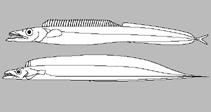
Raios dorsais moles (total) : 90; Vértebras: 94. Distinguished from other species with the following characters: upper head profile convex; posterior confluence of frontal ridges not elevated at the nape, resulting in the absence of the sagittal crest; eye 4.5 times in HL; lower hind margin of opercle broadly rounded; pelvic fins reduced to scalelike structure with 2 soft rays on posterior process of basipterygium, its origin below 9th dorsal-fin element; first anal spine single, oval, scalelike, and originating a short distance behind vent (opposite the 34th dorsal-fin soft ray), anterior anal-fin soft rays minute and embedded, barely penetrating skin and not visible externally, while posterior fin supporting rays enlarged and visible externally; anal-fin rays 15, externally visible; dorsal-fin elements 90, 1st spine elongate, sword-shaped, and finely ribbed; pectoral fin rays 12, with shorter anterior and longer posterior rays extending above the lateral line; first gill arch with upper gill rakers 9; vent at about 50% TL; total vertebrae 94; horizontal distance between posterior margin of eye and origin of first dorsal-fin spine short (8.5% HL); preanal length (PL) 49% TL; HL 27.5% PL; upper jaw length 9.5% PL; predorsal length 21% PL (Ref. 58273).
Body shape (shape guide): elongated.
Life cycle and mating behavior
Maturidade | Reprodução | Desova | Ovos | Fecundidade | Larvas
Chakraborty, A., T. Yoshino and Y. Iwatsuki, 2006. A new species of scabbardfish, Evoxymetopon macrophthalmus (Scombroidei: Trichiuridae), from Okinawa, Japan. Ichthyol. Res. 53(2):137-142. (Ref. 58273)
Categoria na Lista Vermelha da IUCN (Ref. 130435: Version 2025-1)
Ameaça para o homem
Harmless
Utilização humana
Ferramentas
Relatórios especiais
Descarregue XML
Fontes da internet
Estimates based on models
Phylogenetic diversity index (Ref.
82804): PD
50 = 0.5625 [Uniqueness, from 0.5 = low to 2.0 = high].
Bayesian length-weight: a=0.00275 (0.00104 - 0.00730), b=3.06 (2.83 - 3.29), in cm total length, based on LWR estimates for this (Sub)family-body shape (Ref.
93245).
Nível Trófico (Ref.
69278): 4.4 ±0.7 se; based on size and trophs of closest relatives
Resiliência (Ref.
120179): Médio, tempo mínimo de duplicação da população 1,4 - 4,4 anos (Preliminary K or Fecundity.).
Fishing Vulnerability (Ref.
59153): Very high vulnerability (90 of 100).
🛈