>
Gobiiformes (Gobies) >
Gobiidae (Gobies) > Gobiinae
Etymology: Coryphopterus: Greek, koryphe = summit + Greek, pteron = fin, wing (Ref. 45335); kuna: Named for the Kuna indigenous people of the Kuna Yala, the region of Atlantic Panama in which the holotype was collected, in recognition of their cooperation in marine biological research. Although
is masculine, kuna is a noun in app.
Eponymy: This is not a true eponym as it is named for the Kuna indigenous people of the Kuna Yala region of Atlantic Panama, where the type was collected. They were honoured for their cooperation in marine biological research. (Ref. 128868), visit book page.
Environment: milieu / climate zone / distribuzione batimetrica / distribution range
Ecologia
marino benthopelagico; distribuzione batimetrica 10 - 30 m (Ref. 58754). Tropical
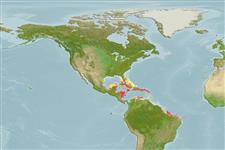
Western Atlantic: coasts of Panama and Mexico (Ref. 58754). Recently found in Utila, Honduras (Ref. 93936), Carrie Bow Cay, Belize (Ref. 93938), and Lake Worth Lagoon, Palm Beach, Florida (Ref. 93936).
Length at first maturity / Size / Peso / Age
Maturità: Lm 1.0, range 1 - 1.1 cm
Max length : 1.7 cm SL maschio/sesso non determinato; (Ref. 58754)
Short description
Chiavi di identificazione | Morfologia | Morfometria
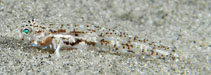
Spine dorsali (totale) : 7; Raggi dorsali molli (totale) : 8; Spine anali: 1; Raggi anali molli: 8; Vertebre: 26. Most distinctive character: two rows of small black spots across the upper aspect of the eye: 4-6 on the outer row and 2-3 on the medial row (Ref. 93936).
Body shape (shape guide): fusiform / normal.
Adults are found in exposed sandbeds (Ref. 93936), An elusive species for It occupies an obscure habitat:and was collected in deeper water than is usually surveyed, it was far from reef substrate, and the area is subject to some siltation from the Panamanian mainland. The species is also not particularly different-looking from the usual sand-bed gobies that it would not attract attention (Ref. 58754) .Depth at 15 - 20 m (Ref. 58754), range given by B. Victor (pers.comm. 10/18).
Life cycle and mating behavior
Maturità | Riproduzione | Deposizione | Uova | Fecundity | Larve
Victor, B.C., 2007. Coryphopterus kuna, a new goby (Perciformes: Gobiidae: Gobiinae) from the western Caribbean, with the identification of the late larval stage and an estimate of the pelagic larval duration. Zootaxa 1526:51-61. (Ref. 58754)
IUCN Red List Status (Ref. 130435: Version 2025-1)
Threat to humans
Harmless
Human uses
Strumenti
Special reports
Download XML
Fonti Internet
Estimates based on models
Phylogenetic diversity index (Fonte Biblio.
82804): PD
50 = 0.5001 [Uniqueness, from 0.5 = low to 2.0 = high].
Bayesian length-weight: a=0.01023 (0.00477 - 0.02194), b=3.01 (2.83 - 3.19), in cm total length, based on LWR estimates for this (Sub)family-body shape (Ref.
93245).
Trophic level (Fonte Biblio.
69278): 3.0 ±0.4 se; based on size and trophs of closest relatives
Resilienza (Fonte Biblio.
120179): Alto, tempo minimo di raddoppiamento della popolazione meno di 15 mesi (Preliminary K or Fecundity.).
Fishing Vulnerability (Ref.
59153): Low vulnerability (10 of 100).
🛈