Klassifizierung / Names
Namen | Synonyme | Catalog of Fishes(Gattung, Arten) | ITIS | CoL | WoRMS | Cloffa
Elasmobranchii (Haie und Rochen) (sharks and rays) >
Carcharhiniformes (Ground sharks) >
Pentanchidae (Deepwater catsharks)
Etymology: Halaelurus: halos (Gr.), sea; ailouros (Gr.), cat, probably an allusion to the vernacular “catshark,” so named for its cat-like eyes (See ETYFish); maculosus: Latin for speckled, referring to speckling of small dark spots over dorsal and lateral surfaces of body (See ETYFish).
More on authors: White, Last & Stevens.
Environment: milieu / climate zone / Tiefenbereich / distribution range
Ökologie
seewasser demersal. Tropical
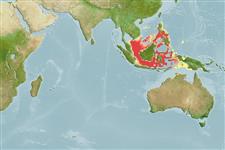
Pacific Ocean: known from the southern coast of Java, and off the islands of Bali and Lombok in eastern Indonesia, and has also been recorded from several landing sites in the Philippines (Ref. 59315).
Size / Gewicht / Alter
Geschlechtsreife: Lm ? range ? - ? cm
Max length : 45.7 cm TL Männchen/unbestimmt; (Ref. 59315); 52.8 cm TL (female)
Kurzbeschreibung
Bestimmungsschlüssel | Morphologie | Morphometrie
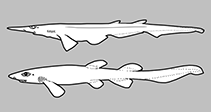
Small adult size; Body tapering, anterior trunk wide and somewhat depressed; tail long and slender, almost circular in cross-section at second dorsal-fin insertion; no lateral keels; no postnatal ridge between anal fin base and lower caudal-fin origin; no longitudinal ridges on dorsal surface, no obvious lateral ridges. Head short, wide and somewhat depressed, more so between eyes and ventrally; narrowly pointed, not upturned or knob-like in lateral view (slightly upturned in some paratypes); in dorsoventral view anterior to gill openings broadly parabolic; subocular ridge evident, variably angular. Eyes small, spindle-shaped; dorsolateral on head, with lower edges well medial to lateral head margin in dorsal view; subocular ridges weak, not well defined, subequal in length to eye, almost a spiracle length from eye margin; no supraorbital crest (Ref. 59315).
Body shape (shape guide): elongated.
Reported to be caught occasionally by demersal fisheries, but no depth distribution information is available (Ref. 59315).
Life cycle and mating behavior
Geschlechtsreife | Fortpflanzung | Ablaichen | Eier | Fecundity | Larven
White, W.T., P.R. Last and J.D. Stevens, 2007. Halaelurus maculosus n. sp. and H. sellus n. sp., two new species of catshark (Carcharhiniformes: Scyliorhinidae) from the Indo-West Pacific. Zootaxa 1639:1-21. (Ref. 59315)
IUCN Rote Liste Status (Ref. 130435: Version 2025-1)
Bedrohung für Menschen
Harmless
Nutzung durch Menschen
Tools
Zusatzinformationen
Download XML
Internet Quellen
Estimates based on models
Preferred temperature (Ref.
123201): 22.2 - 28.4, mean 27.4 °C (based on 51 cells).
Phylogenetic diversity index (Ref.
82804): PD
50 = 0.5078 [Uniqueness, from 0.5 = low to 2.0 = high].
Bayesian length-weight: a=0.00355 (0.00175 - 0.00721), b=3.08 (2.90 - 3.26), in cm total length, based on LWR estimates for this (Sub)family-body shape (Ref.
93245).
Trophic level (Ref.
69278): 4.4 ±0.5 se; based on size and trophs of closest relatives
Widerstandsfähigkeit (Ref.
120179): niedrig, Verdopplung der Population dauert 4,5 - 14 Jahre. (Preliminary low fecundity).
Fishing Vulnerability (Ref.
59153): Moderate vulnerability (41 of 100).
🛈