Classification / Noms
Noms communs | Synonymes | Catalog of Fishes(Genre, Espèce) | ITIS | CoL | WoRMS | Cloffa
>
Cichliformes (Cichlids, convict blennies) >
Cichlidae (Cichlids) > Cichlasomatinae
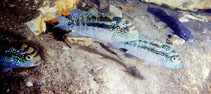
Etymology: Rocio: Named for the author's wife. In Spanish, the name means morning dew, in allusion to the resplendent spots on cheek and sides of some species, R. gemmata; gemmata: Name fro Latin 'gemmata' meaning 'bejeweled', referring to the large, bright green and blue cheek and opercle spots in life; an adjective.
Eponymy: Rocío is a Spanish word for ‘morning dew’, an “image evoked by the resplendent spots on cheek and sides of some species”; Rocío is also the name of Juan Schmitter-Soto’s wife. (Ref. 128868), visit book page.
Environnement : milieu / zone climatique / profondeur / gamme de distribution
Écologie
; eau douce benthopélagique. Tropical
North America: apparently endemic to the eastern Yucatan Peninsula, Mexico.
Taille / Poids / Âge
Maturité: Lm ? range ? - ? cm
Max length : 7.0 cm SL mâle / non sexé; (Ref. 74403)
Épines dorsales (Total) : 18; Rayons mous dorsaux (Total) : 9 - 10; Épines anales: 8 - 9; Rayons mous anaux: 7 - 8. This species is characterized by the following: spots on the sides are larger than scales and not clearly aligned (vs. smaller than scales and rather well-aligned); stripe from the snout to the eye is interrupted (vs. continuous); quadrate bone with a spine (vs. none); maxilla reaching both a vertical and a horizontal line from orbit (vs. just to the ventral rim); cheek-scale rows modally 7 (vs. 6 or fewer); interradial scales on dorsal fin arranged in a row (vs. distally in two rows); dorsal and anal fins without filaments (vs. bearing filaments); anal and medial gut-loops not adjacent, well separated by the stomach and the liver (vs. always adjacent); rostral end of maxilla is notched or at least concave (vs. convex, notch absent); caudal ocellus blue in life (vs. white) (Ref. 74403).
Body shape (shape guide): short and / or deep.
Cycle de vie et comportement reproducteur
Maturité | Reproduction | Frai | Œufs | Fécondité | Larves
Schmitter-Soto, J.J., 2007. A systematic revision of the genus Archocentrus (Perciformes: Cichlidae), with the description of two new genera and six new species. Zootaxa 1603:1-78. (Ref. 74403)
Statut dans la liste rouge de l'IUCN (Ref. 130435: Version 2025-2)
Menace pour l'homme
Harmless
Utilisations par l'homme
Outils
Articles particuliers
Télécharger en XML
Sources Internet
Estimations basées sur des modèles
Indice de diversité phylogénétique (Réf.
82804): PD
50 = 0.5625 [Uniqueness, from 0.5 = low to 2.0 = high].
Bayesian length-weight: a=0.02692 (0.01189 - 0.06092), b=3.03 (2.84 - 3.22), in cm total length, based on LWR estimates for this (Sub)family-body shape (Ref.
93245).
Niveau trophique (Réf.
69278): 3.2 ±0.4 se; based on size and trophs of closest relatives
Résilience (Réf.
120179): Haut, temps minimum de doublement de population inférieur à 15 mois (Preliminary K or Fecundity.).
Vulnérabilité de la pêche (Ref.
59153): Low vulnerability (10 of 100).
🛈