>
Eupercaria/misc (Various families in series Eupercaria) >
Haemulidae (Grunts) > Plectorhinchinae
Etymology: Plectorhinchus: Greek, plektos = plaited + Greek, rhyngchos = snout (Ref. 45335).
More on author: Lacepède.
Environment: milieu / Klimaatzone / Diepte / distribution range
Ecologie
marien; zoet water; brak water rifbewoner; diepte 8 - 25 m (Ref. 58652). Tropical; 30°N - 24°S
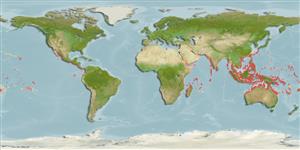
Indo-West Pacific: Red Sea to Natal, South Africa (including Madagascar and the Comoro and Reunion islands); Gulf of Aden and the Persian Gulf eastward to Samoa, north to the Ryukyu Islands, south to Australia; Caroline and Mariana islands in Micronesia.
Grootte / Gewicht / Leeftijd
Maturiteit: Lm ? range ? - ? cm
Max length : 75.0 cm TL mannelijk / geslacht onbekend; (Ref. 30874)
Dorsale stekels (totaal) : 14; Dorsale zachte stralen (totaal) : 15 - 16; Anale stekels: 3; Anale zachte stralen: 7 - 8.
Body shape (shape guide): short and / or deep; Cross section: compressed.
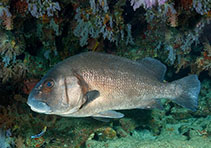
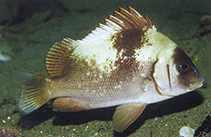
Found in coastal reefs, sandbanks, and near estuaries (Ref. 30573). Enter freshwater (Ref. 7050). Small juveniles occur along sheltered sandy shorelines where they mimic a dead leaf by drifting on their sides (Ref. 37816). Adults mainly in protected inshore reefs to deep offshore, sometimes swims in small groups (Ref. 48635). Excellent food fish (Ref. 2799).
Levenscyclus en paargedrag
Maturiteit | Voortplanting | Paaien | Eieren | Fecunditeit | Larven
Oviparous, distinct pairing during breeding (Ref. 205).
Myers, R.F., 1991. Micronesian reef fishes. Second Ed. Coral Graphics, Barrigada, Guam. 298 p. (Ref. 1602)
Status op de Rode Lijst van het IUCN (Ref. 130435: Version 2025-1)
Gevaar voor de mens
Reports of ciguatera poisoning (Ref. 2799)
Gebruik door de mens
Visserij: commercieel; sportvis: ja
Tools
Speciale rapporten
Download XML
Internetbronnen
Estimates based on models
Preferred temperature (Ref.
123201): 25.2 - 29.3, mean 28.4 °C (based on 3703 cells).
Fylogenetische diversiteitsindex (Ref.
82804): PD
50 = 0.5000 [Uniqueness, from 0.5 = low to 2.0 = high].
Bayesian length-weight: a=0.02042 (0.01151 - 0.03622), b=2.93 (2.77 - 3.09), in cm total length, based on LWR estimates for this species & (Sub)family-body (Ref.
93245).
Trofisch niveau (Ref.
69278): 3.6 ±0.5 se; based on diet studies.
Generation time: 5.5 ( na - na) years. Estimated as median ln(3)/K based on 2
growth studies.
Weerstandsvermogen (Ref.
120179): Gemiddeld, minimale populatieverdubbelingstijd 1,4-4,4 jaar (K=0.20).
Fishing Vulnerability (Ref.
59153): Moderate to high vulnerability (45 of 100).
🛈
Nutrients (Ref.
124155): Calcium = 24.5 [11.3, 52.9] mg/100g; Iron = 0.465 [0.242, 0.872] mg/100g; Protein = 19.3 [17.4, 21.3] %; Omega3 = 0.0948 [, ] g/100g; Selenium = 32.7 [16.9, 62.6] μg/100g; VitaminA = 37.4 [10.8, 128.7] μg/100g; Zinc = 0.981 [0.633, 1.547] mg/100g (wet weight);