Classification / Noms
Noms communs | Synonymes | Catalog of Fishes(Genre, Espèce) | ITIS | CoL | WoRMS | Cloffa
>
Siluriformes (Catfishes) >
Doradidae (Thorny catfishes) > Doradinae
Etymology: Rhinodoras: Greek, rhinos = nose + Greek, dora = skin (Ref. 45335); gallagheri: Named for Francis Richard Gallagher, mailroom supervisor at The Academy of Natural Sciences of Philadelphia, for his 37 years of dedicated service to the global community of taxonomists & systematists by shipping & receiving countless loans of specimens.
Eponymy: Francis Richard Gallagher (d: 1935) was the mailroom supervisor, Academy of Natural Sciences of Philadelphia (1967–2003). [...] (Ref. 128868), visit book page.
Environnement : milieu / zone climatique / profondeur / gamme de distribution
Écologie
; eau douce démersal. Tropical
South America: Río Apure, Río Capanaparo and Río Arauca of the middle Orinoco in Venezuela; and Río Aguas de Limón in Colombia.
Taille / Poids / Âge
Maturité: Lm ? range ? - ? cm
Max length : 15.0 cm SL mâle / non sexé; (Ref. 75166)
Description synthétique
Clés d'identification | Morphologie | Morphométrie
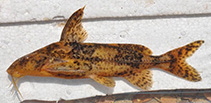
Épines dorsales (Total) : 1; Rayons mous dorsaux (Total) : 6. Differs from all other species of the genus Rhinodoras by the following combination of characters: pale, largely absence of dark pigmentation on ventral surfaces; anterior midlateral plates shallow to moderately deep, depth of fifth plate 16.6-26.2% of corresponding body depth; dorsal and ventral wings of anterior plates about equal in depth; midlateral plates anterior to vertical through pelvic-fin origin usually five; tympanal portion of lateral-line canal weakly ossified with two or three emergent plates, posterior-most largest with low medial ridge or procumbent thorn; postcleithral process moderately long and narrow, depth 23.9-34.5% of length; adipose eyelid moderate to large, horizontal diameter 10.9-14.6% of HL; pectoral fin rays usually eight; one-part gas bladder with terminal diverticula small and fused (Ref. 75166).
Body shape (shape guide): elongated.
Cycle de vie et comportement reproducteur
Maturité | Reproduction | Frai | Œufs | Fécondité | Larves
Sabaj, M.H., D.C. Taphorn and O.E. Castillo G., 2008. Two new species of thicklip thornycats, genus Rhinodoras (Teleostei: Siluriformes: Doradidae). Copeia 2008(1):209-226. (Ref. 75166)
Statut dans la liste rouge de l'IUCN (Ref. 130435: Version 2025-2)
Menace pour l'homme
Harmless
Utilisations par l'homme
Outils
Articles particuliers
Télécharger en XML
Sources Internet
Estimations basées sur des modèles
Indice de diversité phylogénétique (Réf.
82804): PD
50 = 0.5312 [Uniqueness, from 0.5 = low to 2.0 = high].
Bayesian length-weight: a=0.01122 (0.00528 - 0.02384), b=2.98 (2.80 - 3.16), in cm total length, based on LWR estimates for this (Sub)family-body shape (Ref.
93245).
Niveau trophique (Réf.
69278): 2.8 ±0.4 se; based on size and trophs of closest relatives
Résilience (Réf.
120179): Haut, temps minimum de doublement de population inférieur à 15 mois (Preliminary K or Fecundity.).
Vulnérabilité de la pêche (Ref.
59153): Low vulnerability (10 of 100).
🛈