klasifikasi / Names
Nama-nama umum | Sinonim (persamaan) | Catalog of Fishes(Marga, Jenis) | ITIS | CoL | WoRMS | Cloffa
>
Siluriformes (Catfishes) >
Heptapteridae (Three-barbeled catfishes)
Etymology: Rhamdella: Brazilian vernacular name, Nhamdia/Jamdia (Ref. 45335); cainguae: Named from the Guarani, ca'á (forest), and iguá (inhabitant), in reference to the Cainguá, indigenous people of northeastern Argentina.
Environment: milieu / climate zone / kisaran kedalaman / distribution range
Ekologi
; air tawar dasar (demersal). Subtropical
South America: known only from Arroyo Cuña-Pirú, Río Paraná basin in Argentina.
Size / Weight / umur
Kematangan: Lm ? range ? - ? cm
Max length : 15.8 cm SL jantan/; (Ref. 75872)
deskripsi pendek
Kunci identifiaksi (pengenalan) | Morfologi | Morfometrik
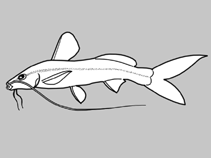
duri punggung lunak (Keseluruhan (total)) : 7 - 8; Sirip dubur lunak: 16 - 18. Presence of a distinct and large ovoid area in the supraorbital laterosensory canal between the frontal and sphenotic delimited by the apparently slender dorsal walls of these bones and with foramen for a laterosensory branch. Differs further from other species of Rhamdella by the following combination of characters: barbel tip reaching from the base of pectoral-fin ray in a specimen measuring 8.80 cm SL, to the posterior portion of opercular region, not surpassing the branchial slit, in a 15.75 cm SL specimen; horizontal eye diameter 20.6-23.9% of HL; interorbital distance 17.9-20.7% of HL; snout profile slightly convex but almost straight; branchiostegal rays seven, branchiostegal membranes not reaching the basal part of the first pectoral-fin ray in most specimens; interdorsal length 7.6-11.3% of SL; adipose-fin base length 36.0-41.6% of SL; anal-fin base length 16.6-22.0% of SL; anal-fin rays 16-18, commonly 17; and length of ventral caudal-fin lobe is 55.8-65.5% of length of dorsal lobe in males; snout length 37.9-43.2% of HL; pelvic fin length 13.3-16.9% of SL; a dense concentration of long and slender papillae on the lateral body surface in the pectoral and abdominal regions, most conspicuous near the lateral line, resulting in a hairy aspect; and by the presence of a distinct narrow dark mid lateral stripe (Ref. 75872).
Body shape (shape guide): elongated.
Occurs over rocky bottoms in a clear water stream, approximately 0.5 - 1 m deep, with pools around 3 m deep, running through a densely forested area (Ref. 75872). Tends to be gregarious as individuals were observed in dense group under large stones (Ref. 75872).
Life cycle and mating behavior
Kematangan | Reproduksi, perkembang biakan | Pemijahan | telur-telur | Fecundity | Larva
Bockmann, F.A. and A.M. Miquelarena, 2008. Anatomy and phylogenetic relationships of a new catfish species from northeastern Argentina with comments on the phylogenetic relationships of the genus Rhamdella Eigenmann and Eigenmann 1888 (Siluriformes, Heptapteridae). Zootaxa 1780:1-54. (Ref. 75872)
Status IUCN Red List (Ref. 130435: Version 2025-1)
ancaman kepada manusia
Harmless
penggunaan manusia
Alat, peralatan
laporan khas
muat turun XML
Sumber internet
Estimates based on models
Phylogenetic diversity index (Acuan
82804): PD
50 = 0.5020 [Uniqueness, from 0.5 = low to 2.0 = high].
Bayesian length-weight: a=0.00794 (0.00374 - 0.01688), b=2.97 (2.79 - 3.15), in cm total length, based on LWR estimates for this (Sub)family-body shape (Ref.
93245).
Trophic level (Acuan
69278): 3.5 ±0.4 se; based on size and trophs of closest relatives
Daya lenting (Acuan
120179): Rendah, Waktu penggandaan populasi minimum 4.5 - 14 tahun (Preliminary K or Fecundity.).
Fishing Vulnerability (Ref.
59153): Low vulnerability (10 of 100).
🛈