Classification / Names
Noms communs | Synonymes | Catalog of Fishes(Genre, Espèce) | ITIS | CoL | WoRMS | Cloffa
>
Eupercaria/misc (Various families in series Eupercaria) >
Gerreidae (Mojarras)
Etymology: Diapterus: Greek, di = two + Greek, pteron = wing, fin (Ref. 45335).
More on author: Sauvage.
Environment: milieu / climate zone / profondeur / distribution range
Écologie
marin; saumâtre démersal. Tropical
Eastern Pacific, tropical, western coast of Baja California (Bahia Magdalena), including Gulf of California, south to nothern Peru.
Taille / Poids / Âge
Maturité: Lm ? range ? - ? cm
Max length : 38.0 cm TL mâle / non sexé; (Ref. 75986)
Description synthétique
Clés d'identification | Morphologie | Morphométrie
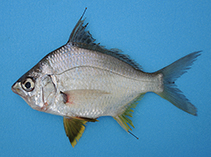
Épines dorsales (Total) : 9; Rayons mous dorsaux (Total) : 10; Épines anales: 3; Rayons mous anaux: 8. Distinguished by having serrated posterior and inferior margins of preopercular bones; smooth preorbital (lachrymal); sometimes with fine serrations on jugal (infraorbital ); pointed or pinniform pharyngeal teeth; rudder-shaped urohyal bone (Ref. 75986).
Occurs in bays, estuaries, and coastal lagoons bordered by mangroves, over sandy or muddy bottoms; usually enters continental waters. Carnivorous, based on reported consumption of benthic organisms of copepods, ostracods, foraminifera, sponges, polychaetes, and molluscs, fishes, and aquatic vegetation (Ref. 75986).
Life cycle and mating behavior
Maturité | Reproduction | Frai | Œufs | Fécondité | Larves
González-Acosta, A.F., P. Béarez, N. Álvarez-Pliego, J. De La Cruz-Agüero and J.L. Castro-Aguirre, 2007. On the taxonomic status of Diapterus peruvianus (Cuvier, 1830) and reinstatement of Diapterus brevirostris (Sauvage, 1879) (Teleostei: Gerreidae). Cybium 31(3):369-377. (Ref. 75986)
Statut dans la liste rouge de l'IUCN (Ref. 130435: Version 2025-1)
Menace pour l'homme
Harmless
Utilisations par l'homme
Outils
Articles particuliers
Télécharger en XML
Sources Internet
Estimates based on models
Phylogenetic diversity index (Réf.
82804): PD
50 = 0.5625 [Uniqueness, from 0.5 = low to 2.0 = high].
Bayesian length-weight: a=0.01349 (0.00868 - 0.02097), b=3.05 (2.92 - 3.18), in cm total length, based on LWR estimates for this species & (Sub)family-body (Ref.
93245).
Niveau trophique (Réf.
69278): 3.0 ±0.2 se; based on size and trophs of closest relatives
Résilience (Réf.
120179): Milieu, temps minimum de doublement de population : 1,4 à 4,4 années (Preliminary K or Fecundity.).
Fishing Vulnerability (Ref.
59153): Low to moderate vulnerability (28 of 100).
🛈