>
Cypriniformes (Carps) >
Leuciscidae (Minnows) > Leuciscinae
Etymology: laietanus: Named after the Laietani, a Bronze-Age tribe inhabiting an area partly corresponding to present Catalonia, and later Lalatania, a Roman province.
More on authors: Doadrio, Kottelat & deSostoa.
Environment: milieu / Klimaatzone / Diepte / distribution range
Ecologie
; zoet water benthopelagisch. Subtropical
Europe: Ebro to Port Bou drainages in Spain; Tech and Agly drainages in France (Ref. 75108), possibly also Aude (Languedoc-Roussillon); possible introgression with Squalius cephalus in southern Garonne tributaries and Adour drainage (Ref. 59043).
Grootte / Gewicht / Leeftijd
Maturiteit: Lm ? range ? - ? cm
Max length : 13.5 cm SL mannelijk / geslacht onbekend; (Ref. 75108); 20.1 cm SL (female)
Korte beschrijving
Determinatiesleutels | Morfologie | Morfometrie
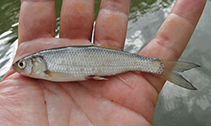
Dorsale zachte stralen (totaal) : 12; Anale zachte stralen: 10 - 12. Differs from congeners in Europe by a combination of the following characters: mouth slightly subinferior, with a slightly projecting upper lip and the tip of the lower jaw included in the upper lip; flank scales margined by a band of black pigments along their free margin, forming a regular reticulate pattern; presence of brown pigments on the inner area of the scales, especially on the upper half of the flank; brown pigments situated on the dermis under the scale, more densely set on the upper and lower extremity of the exposed part, and the pigment patches often appearing as faint longitudinal stripes between scale rows; no or little marked discontinuity between dorsal profile of head and trunk; dorso-hypural distance falling at or behind posterior margin of eye when reported forwards; lateral line scales 44-47 + 1-2; dorsal fin with 8½ branched rays; in stretched anal fin of specimens larger than about 15 cm SL, the distance between the tips of the first and the last branched rays is about equal to the depth of the caudal peduncle (Ref. 75108).
Body shape (shape guide): fusiform / normal.
Occurs in streams with clear water, gravel bottom and prefers moderate flowing stretches (Ref. 75108).
Levenscyclus en paargedrag
Maturiteit | Voortplanting | Paaien | Eieren | Fecunditeit | Larven
Doadrio, I., M. Kottelat and A. de Sostoa, 2007. Squalius laietanus, a new species of cyprinid fish from north-eastern Spain and southern France (Teleostei: Cyprinidae). Ichthyol. Explor. Freshwat. 18(3):247-256. (Ref. 75108)
Status op de Rode Lijst van het IUCN (Ref. 130435: Version 2025-1)
Gevaar voor de mens
Harmless
Gebruik door de mens
Tools
Speciale rapporten
Download XML
Internetbronnen
Estimates based on models
Fylogenetische diversiteitsindex (Ref.
82804): PD
50 = 0.5000 [Uniqueness, from 0.5 = low to 2.0 = high].
Bayesian length-weight: a=0.00813 (0.00411 - 0.01607), b=3.13 (2.97 - 3.29), in cm total length, based on LWR estimates for this Genus-body shape (Ref.
93245).
Trofisch niveau (Ref.
69278): 3.3 ±0.4 se; based on size and trophs of closest relatives
Weerstandsvermogen (Ref.
120179): Gemiddeld, minimale populatieverdubbelingstijd 1,4-4,4 jaar (Preliminary K or Fecundity.).
Fishing Vulnerability (Ref.
59153): Low vulnerability (15 of 100).
🛈