>
Eupercaria/misc (Various families in series Eupercaria) >
Labridae (Wrasses) > Cheilininae
Etymology: tanakai: Named for Hiroyuki Tanaka, M.D.
Eponymy: Frank ‘Alexander’ Wetmore (1886–1978) was an American ornithologist and avian palaeontologist who conducted extensive fieldwork in Latin America. [...] Dr Hiroyuki Tanaka is a Japanese physician and aquarist. [...] (Ref. 128868), visit book page.
More on authors: Randall & Kuiter.
Environment: milieu / climate zone / intervalo de profundidade / distribution range
Ecologia
marinhas associadas(os) a recifes; intervalo de profundidade 10 - 30 m (Ref. 90102). Tropical
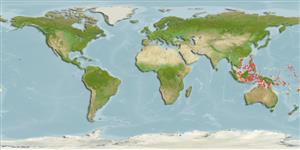
Western Pacific: Indonesia and the Philippines.
Tamanho / Peso / Idade
Maturidade: Lm ? range ? - ? cm
Max length : 3.7 cm SL macho/indeterminado; (Ref. 75144)
Descrição breve
Chaves de identificação | Morfologia | Morfometria
Espinhos dorsais (total) : 9; Raios dorsais moles (total) : 10; Espinhos anais: 3; Raios anais moles: 8; Vértebras: 23. This species is distinct with the following characters: D IX, 10; A III, 8; pectoral rays 12; 14+6 lateral-line scales; 15-17 gill rakers; body depth 3.0-3.3 in SL; head length (HL) 2.35-2.4 in SL; snout length 3.2-3.25 in HL; interorbital width 4.5 in HL; longest dorsal spine 2.15 in HL; third anal spine 2.05 in HL; pectoral-fin length 2.2 in HL; pelvic-fin length 2.15 in HL; when fresh it is purplish red posteriorly, grading to orange-red anteriorly; the snout and ventral part of head usually light blue-green; across body with 3 narrow white bars, the first from below second dorsal spine to abdomen, the second from eighth dorsal spine to third anal spine, the third across caudal peduncle; from nape across head behind eye runs a slightly oblique narrow bar, a faint white line extending ventrally from anterior edge of orbit; anteriorly on soft portion of dorsal fin is an ocellated black spot as large as eye; a short oblique narrow white band from middle of soft portion of dorsal fin onto back; anteriorly on soft portion of anal fin is a small elliptical ocellus; bluish white pelvic fins with a very large black spot; no blackish spot ventrally on abdomen between pelvic fins (Ref. 75144).
Body shape (shape guide): short and / or deep.
Found in coral reefs but secretive (Ref. 90102).
Life cycle and mating behavior
Maturidade | Reprodução | Desova | Ovos | Fecundidade | Larvas
Oviparous, distinct pairing during breeding (Ref. 205).
Randall, J.E. and R.H. Kuiter, 2007. Wetmorella tanakai, a new wrasse (Perciformes: Labridae) from Indonesia and the Philippines. aqua, Int. J. Ichthyol. 13(1):1-6. (Ref. 75144)
Categoria na Lista Vermelha da IUCN (Ref. 130435: Version 2025-1)
Ameaça para o homem
Harmless
Utilização humana
Ferramentas
Relatórios especiais
Descarregue XML
Fontes da internet
Estimates based on models
Phylogenetic diversity index (Ref.
82804): PD
50 = 0.6250 [Uniqueness, from 0.5 = low to 2.0 = high].
Bayesian length-weight: a=0.02138 (0.00871 - 0.05249), b=2.97 (2.76 - 3.18), in cm total length, based on LWR estimates for this (Sub)family-body shape (Ref.
93245).
Nível Trófico (Ref.
69278): 3.2 ±0.5 se; based on size and trophs of closest relatives
Resiliência (Ref.
120179): Elevada, tempo mínimo de duplicação da população menor que 15 meses (Preliminary K or Fecundity.).
Fishing Vulnerability (Ref.
59153): Low vulnerability (10 of 100).
🛈