>
Carangaria/misc (Various families in series Carangaria) >
Polynemidae (Threadfins)
Etymology: Polydactylus: Greek, poly = a lot of + greek, daktylos = finger (Ref. 45335).
More on author: Günther.
Environment: milieu / climate zone / rango de profundidad / distribution range
Ecología
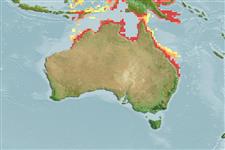
marino; agua dulce; salobre demersal; catadromo (Ref. 51243); rango de profundidad 0 - 6 m (Ref. 57343). Tropical; 5°S - 28°S, 121°E - 154°E (Ref. 57343)
Indo-West Pacific: southern New Guinea and northern Australia.
Tamaño / Peso / Age
Madurez: Lm ? range ? - ? cm
Max length : 170 cm FL macho / no sexado; (Ref. 6390); common length : 48.0 cm FL macho / no sexado; (Ref. 9685); peso máximo publicado: 45.0 kg (Ref. 9685); edad máxima reportada: 20 años (Ref. 6390)
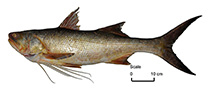
Body without spots nor stripes. Pectoral fin rays unbranched; 4th pectoral filament long, 40-53% of SL. Second spine of dorsal fin more robust than the rest. Posterior margin of maxilla extending considerably beyond level of posterior margin of adipose eyelid. Lower tip of 7th proximal pterygiophore of 1st dorsal fin directed backward. Lateral squamation on caudal fin unbranched (Ref. 40970).
Body shape (shape guide): fusiform / normal.
Found in shallow, turbid waters coastal waters, estuaries, mangrove creeks, and mangrove-lined rivers (Ref. 57343), over sandbanks and mud substrates (Ref. 6390). Usually forms loose schools, although larger fish are more often observed in pairs or singly (Ref. 6390). Feeds on prawns and fish. Protandrous hermaphrodites.
Life cycle and mating behavior
Madurez | Reproducción | Puesta | Huevos | Fecundidad | Larva
King threadfin between 70 cm and 100 cm FL may be transitional hermaphrodites (they possess mature male and immature female reproductive tissue, and function as males (Ref. 28736)). However, most king threadfin less than 80 cm FL are males and most more than 95 cm FL are females (Ref. 28737). Transitional king threadfin are most often found in the months of June, July, August and September (Ref. 6390).
There is little information on the larvae, although nursery areas are known to be inshore, shallow and of low salinity (Ref. 6390).
Motomura, H., 2004. Threadfins of the world (Family Polynemidae). An annotated and illustrated catalogue of polynemid species known to date. FAO Spec. Cat. Fish. Purp. Rome: FAO. 3:117 p. (Ref. 57343)
IUCN Red List Status (Ref. 130435: Version 2025-1)
Threat to humans
Harmless
Human uses
Pesquerías: comercial; pesca deportiva: si
Herramientas
Special reports
Download XML
Fuentes de Internet
Estimates based on models
Preferred temperature (Referencia
123201): 24.8 - 28.9, mean 28 °C (based on 575 cells).
Phylogenetic diversity index (Referencia
82804): PD
50 = 0.5000 [Uniqueness, from 0.5 = low to 2.0 = high].
Bayesian length-weight: a=0.00692 (0.00318 - 0.01504), b=3.10 (2.93 - 3.27), in cm total length, based on LWR estimates for this Genus-body shape (Ref.
93245).
Nivel trófico (Referencia
69278): 4.0 ±0.4 se; based on diet studies.
Generation time: 7.3 ( na - na) years. Estimated as median ln(3)/K based on 1
growth studies.
Resiliencia (Referencia
120179): Bajo, población duplicada en un tiempo mínimo de 4.5-14 años (tmax=20).
Fishing Vulnerability (Ref.
59153): High to very high vulnerability (66 of 100).
🛈