Klassifizierung / Names
Namen | Synonyme | Catalog of Fishes(Gattung, Arten) | ITIS | CoL | WoRMS | Cloffa
>
Ophidiiformes (Cusk eels) >
Dinematichthyidae (Viviparous brotula)
Etymology: Eusurculus: Name from Latin and Greek 'eu' for good or real and Latin 'surculus' for grapevine tendril, refers to the functional analogy with the pseudoclaspers and the specific shape of the inner pseudoclasper; andamanensis: Named for the type area, the Andaman Islands.
More on authors: Schwarzhans & Møller.
Environment: milieu / climate zone / Tiefenbereich / distribution range
Ökologie
seewasser demersal. Tropical
Eastern Indian Ocean, Andaman Islands and the south coast of Sumatra.
Size / Gewicht / Alter
Geschlechtsreife: Lm ? range ? - ? cm
Max length : 4.4 cm SL Männchen/unbestimmt; (Ref. 76869)
Kurzbeschreibung
Bestimmungsschlüssel | Morphologie | Morphometrie
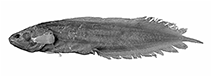
Rückenflossenweichstrahlen (insgesamt) : 78 - 84; Afterflossenweichstrahlen: 59 - 63; Wirbelzahl: 42 - 43. This species possess the following characters: D 78-84, A 59-63, D/A 21-27, V in D 2.2-2.3; vertebrae 12+30-31=42-43; the anterior nostril is positioned 1/4.5 to 1/5 the distance from upper lip to aggregate distance to anterior margin of eye; free pseudoclaspers 2 pairs, the outer pseudoclasper wing-shaped with broad base and distally widened supporter with anterior hook (covered by ligament), the inner one stalked, with slightly widened base and distally with concave sucker-disk; 5-6 rows of scales on upper part and 3-4 rows on lower part on cheek (Ref. 76869).
Body shape (shape guide): elongated; Cross section: compressed.
Life cycle and mating behavior
Geschlechtsreife | Fortpflanzung | Ablaichen | Eier | Fecundity | Larven
Schwarzhans, W. and P.R. Møller, 2007. Review of the Dinematichthyini (Teleostei: Bythitidae) of the Indo-west Pacific. Part III. Beaglichthys, Brosmolus, Monothrix and eight new genera with description of 20 new species. The Beagle, Records of the Museums and Art Galleries of the Northern Territory 23:29-110. (Ref. 76869)
IUCN Rote Liste Status (Ref. 130435: Version 2025-1)
Nutzung durch Menschen
Tools
Zusatzinformationen
Download XML
Internet Quellen
Estimates based on models
Preferred temperature (Ref.
123201): 28.3 - 29.4, mean 28.7 °C (based on 236 cells).
Phylogenetic diversity index (Ref.
82804): PD
50 = 0.6250 [Uniqueness, from 0.5 = low to 2.0 = high].
Bayesian length-weight: a=0.00389 (0.00180 - 0.00842), b=3.12 (2.94 - 3.30), in cm total length, based on all LWR estimates for this body shape (Ref.
93245).
Trophic level (Ref.
69278): 3.2 ±0.5 se; based on size and trophs of closest relatives
Fishing Vulnerability (Ref.
59153): Low vulnerability (10 of 100).
🛈