


Helcogramma rharhabe Holleman, 2007
Ajouter votre observation dans Fish Watcher
| Native range | All suitable habitat | Point map | Year 2050 |

|
| This map was computer-generated and has not yet been reviewed. |
| Helcogramma rharhabe AquaMaps Data sources: GBIF OBIS |
Envoyez vos Photos et vidéos
Images Google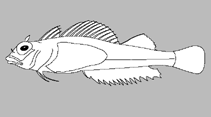 No image available for this species;
drawing shows typical species in Tripterygiidae.
Images Google
drawing shows typical species in Tripterygiidae.
Classification / Noms Noms communs | Synonymes | Catalog of Fishes(Genre, Espèce) | ITIS | CoL | WoRMS | Cloffa
> Blenniiformes (Blennies) > Tripterygiidae (Triplefin blennies) > Tripterygiinae
Etymology: Helcogramma: Greek, helkos, -eos, -ous = ulcer, sore + Greek, gramma = letter, mark (Ref. 45335); rharhabe: Named after Rharhabe a paramount chief from 1775 to 1787. The name is treated as a noun in apposition.
Eponymy: Rharhabe (ca: 1715–c. [...] (Ref. 128868), visit book page.
Etymology: Helcogramma: Greek, helkos, -eos, -ous = ulcer, sore + Greek, gramma = letter, mark (Ref. 45335); rharhabe: Named after Rharhabe a paramount chief from 1775 to 1787. The name is treated as a noun in apposition.
Eponymy: Rharhabe (ca: 1715–c. [...] (Ref. 128868), visit book page.
Environnement : milieu / zone climatique / profondeur / gamme de distribution Écologie
marin benthopélagique; profondeur 0 - 3 m (Ref. 75031). Tropical
Distribution Territoires | Zones FAO | Écosystèmes | Occurrences | Carte par point | Introductions | Faunafri
Western Indian and Southeast Atlantic: from Mozambique (Bazaruto) to South Africa. Speciimens collected from Shimoni, Kenya may refer to the species but are in poor condition so until additional specimens are available, Bazaruto is considered its most northern limit (Ref. 75031).
Taille / Poids / Âge
Description synthétique Clés d'identification | Morphologie | Morphométrie
Épines dorsales (Total) : 10 - 17; Rayons mous dorsaux (Total) : 10 - 11; Épines anales: 1; Rayons mous anaux: 19; Vertèbres: 34 - 35. Diagnosis: Medium to large species of the genus. Dorsal fin III + XIII+ 10, 2nd fin twice the 1st; anal fin I, 19; pectoral rays 16 (1+8+7); pelvic fin I, 2, spine short and hidden, segmented rays simple, partially united by membrane. Vertebrae 10+24-25. LL total lateral scales 37-38; tubed 21-31 (geographically variant means), ends below junction of 2nd and 3rd dorsal fin; nape, belly, 1st dorsal fin and anterior anal-fin bases scaleless, caudal-fin base with 2 rows of scales. Mandibular pores 5+1+5. Orbital cirrus simple and small. Head length 3.3-3.7 in SL; eye 2.6-3.2, maxilla 2.2-2.6 in HL. Males body with red and black spots evenly scattered, vertical stripes from dorsal fin to midline of side, and silvery spots below midline; head with blue stripe from mouth corner to preopercle, upperlip corner with crimson markings, black in the center (Ref. 75031).
Body shape (shape guide): elongated.
Body shape (shape guide): elongated.
Female members of the Tripterygiidae have eggs that are hemispherical and covered with numerous sticky threads that anchor them in the algae on the nesting sites (Ref. 240). Larvae are planktonic which occur primarily in shallow, nearshore waters (Ref. 94114).
Cycle de vie et comportement reproducteur Maturité | Reproduction | Frai | Œufs | Fécondité | Larves
Référence principale
Téléchargez vos références | Références | Coordinateur : Fricke, Ronald | Collaborateurs
Holleman, W., 2007. Fishes of the genus Helcogramma (Blennioidei: Tripterygiidae) in the Western Indian Ocean, including Sri Lanka, with description of four new species. Smith. Bull. 7:51-81. (Ref. 75031)
Statut dans la liste rouge de l'IUCN (Ref. 130435: Version 2025-2 (Global))
Préoccupation mineure (LC) ; Date assessed: 07 May 2010
CITES
Not Evaluated
Menace pour l'homme
Utilisations par l'homme
FAO - Publication: search | FishSource |
Plus d'informations
Écologie trophique
Aliments (proies)
Composition du régime alimentaire
Consommation alimentaire
Rations alimentaires
Prédateurs
Aliments (proies)
Composition du régime alimentaire
Consommation alimentaire
Rations alimentaires
Prédateurs
Dynamique des populations
Paramètres de croissance
Âges / tailles maximales
Longueur-poids rel.
Rel. longueur-longueur.
Fréquences de longueurs
Conversion de masse
Recrutement
Abondance
Paramètres de croissance
Âges / tailles maximales
Longueur-poids rel.
Rel. longueur-longueur.
Fréquences de longueurs
Conversion de masse
Recrutement
Abondance
Anatomie
Surface branchiale
Cerveau
Otolithe
Surface branchiale
Cerveau
Otolithe
Physiologie
Composition corporelle
Nutriments
Consommation d'oxygène
Type de natation
Vitesse de nage
Pigments visuels
Son de poisson
Maladies et parasites
Toxicité (CL50)
Composition corporelle
Nutriments
Consommation d'oxygène
Type de natation
Vitesse de nage
Pigments visuels
Son de poisson
Maladies et parasites
Toxicité (CL50)
Génétique
génôme
Génétique
Hétérozygotie
Héritabilité
Diversité génétique
génôme
Génétique
Hétérozygotie
Héritabilité
Diversité génétique
Liées à l'homme
Systèmes d'aquaculture
Profils d'aquaculture
Souches
Cas de ciguatera
Timbres, pièces de monnaie, divers
Systèmes d'aquaculture
Profils d'aquaculture
Souches
Cas de ciguatera
Timbres, pièces de monnaie, divers
Outils
E-book | Guide de terrain | Générateur de fréquences de longueur | Outil de dynamique de population | Carte par point |
Capture-MSY |
Articles particuliers
Télécharger en XML
Sources Internet
AFORO (otoliths) | Aquatic Commons | BHL | Cloffa | Websites from users | FishWatcher | CISTI | Catalog of Fishes: Genre, Espèce | DiscoverLife | ECOTOX | FAO - Publication: search | Faunafri | Fishipedia | Fishtrace | GloBI | Google Books | Google Scholar | Google | IGFA World Record | OneZoom | Open Tree of Life | Otolith Atlas of Taiwan Fishes | PubMed | Reef Life Survey | Socotra Atlas | TreeBase | Arbre de Vie | Wikipedia: aller à, chercher | World Records Freshwater Fishing | Zoobank | Zoological Record
Estimations basées sur des modèles
Température préférée (Réf. 123201): 22.4 - 27.5, mean 26.8 °C (based on 194 cells).
Indice de diversité phylogénétique (Réf. 82804): PD50 = 0.5000 [Uniqueness, from 0.5 = low to 2.0 = high].
Bayesian length-weight: a=0.00617 (0.00290 - 0.01310), b=3.04 (2.86 - 3.22), in cm total length, based on LWR estimates for this (Sub)family-body shape (Ref. 93245).
Niveau trophique (Réf. 69278): 3.1 ±0.3 se; based on size and trophs of closest relatives
Résilience (Réf. 120179): Haut, temps minimum de doublement de population inférieur à 15 mois (Preliminary K or Fecundity.).