


Uploaden van uw Foto's en video's
Google afbeelding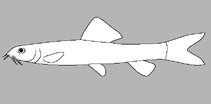 No image available for this species;
drawing shows typical species in Cobitidae.
Google afbeelding
drawing shows typical species in Cobitidae.
Classificatie / Namen Lokale namen | Synoniemen | Catalog of Fishes(Genus, Soort(en)) | ITIS | CoL | WoRMS | Cloffa
> Cypriniformes (Carps) > Cobitidae (Spined loaches)
Etymology: Cobitis: Greek, kobitis, -idos = a kind of sardine; also related with the voice Greek, kobios, Latin gobius = gudgeon (Ref. 45335); taurica: The specific epithet comes from Tauris-Taurida, the ancient Greek and Latin name of the Crimean Peninsula.
Etymology: Cobitis: Greek, kobitis, -idos = a kind of sardine; also related with the voice Greek, kobios, Latin gobius = gudgeon (Ref. 45335); taurica: The specific epithet comes from Tauris-Taurida, the ancient Greek and Latin name of the Crimean Peninsula.
Milieu: milieu / Klimaatzone / Diepte / verspreidingsgebied Ecologie
; zoet water benthopelagisch. Temperate
Verspreiding Gebieden | FAO regio's | Ecosystemen | Voorkomen | Verspreidingskaart | Introducties | Faunafri
Europe: Chornaya River in Crimean Peninsula, Ukraine.
A population known from lower South Bug with similar chromosome characters might represent an unnamed species (Ref. 59043).
Grootte / Gewicht / Leeftijd
Maturiteit: Lm ? range ? - ? cm
Max length : 9.7 cm SL mannelijk / geslacht onbekend; (Ref. 75104); 9.2 cm SL (female)
Max length : 9.7 cm SL mannelijk / geslacht onbekend; (Ref. 75104); 9.2 cm SL (female)
Korte beschrijving Determinatiesleutels | Morfologie | Morfometrie
Dorsale stekels (totaal) : 2 - 3; Dorsale zachte stralen (totaal) : 6 - 8; Anale stekels: 2 - 3; Anale zachte stralen: 5 - 6. Distinguished from other species by possessing the following characters: upper part of caudal-fin base with elongated narrow dark spot; males with one lamina Canestrini in the pectoral fin, usually broad, axe-shaped; more or less rounded scales with a relatively small central part devoid of cross furrows; Gambetta’s zones of pigmentation are well developed, the fourth zone with relatively small and low 15-28, usually more than 18 spots whose depth is about two times smaller than the horizontal eye diameter (the largest spots on the caudal peduncle are also noticeably smaller than the horizontal eye diameter); the suborbital spine always reaches the posterior edge of the pupil and usually goes further and in small specimens (with TL less than 6.5 cm), usually reaches the posterior edge of the eye; the outer branch of this spine usually (95.5 %) goes as far as centre of eye and often further; head moderately long and deep with a more or less straight profile; 2n=50 (5 pairs of meta-, 15 pairs of submeta-, 4 pairs of subtelo- and 1 pair of acrocentrics), NF=90 (Ref. 78640).
Body shape (shape guide): elongated.
Body shape (shape guide): elongated.
Found in streams with still to moderately flowing clear water, on sand to silt bottom or in dense vegetation (Ref. 59043). Oviparous, possibly with distinct pairing during breeding similar to congeners (Ref. 205). Population is threatened due to a concentrated distribution in a very limited stretch of stream which might dry up in summer (Ref. 59043). Females grow up to a maximum length of 9.1 SL (Ref. 78640).
Levenscyclus en paargedrag Maturiteit | Voortplanting | Paaien | Eieren | Fecunditeit | Larven
During courtship, 'the male follows the female and, after both enter dense vegetation (e.g. filamentous algae), the male forms a complete ring around the female's body behind the dorsal as the female releases the eggs' (Ref. 59043).
Hoofdreferentie
Upload uw referenties | Referenties | Coördinator | Medewerkers
Janko, K., V.P. Vasil'ev, P. Ráb, M. Rábová, V. Slechtová and E.D. Vasil'eva, 2005. Genetic and morphological analyses of 50-chromosome spined loaches (Cobitis, Cobitidae, Pisces) from the Black Sea basin that are morphologically similar to C. taenia, with the description of a new species. Folia Zool. 54(4):405-420. (Ref. 78640)
Status op de Rode Lijst van het IUCN (Ref. 130435: Version 2025-2 (Global))
Bedreigd (EN) (B1ab(iii)); Date assessed: 16 May 2023
CITES
Not Evaluated
Gevaar voor de mens
Harmless
Gebruik door de mens
FAO - Publication: search | FishSource |
Meer informatie
Trofische ecologie
Voedsel (prooien)
Dieetsamenstelling
Voedselconsumptie
Voedselrantsoenen
Predatoren
Voedsel (prooien)
Dieetsamenstelling
Voedselconsumptie
Voedselrantsoenen
Predatoren
Ecologie
Ecologie
Ecologie
Populatiedynamica
Groeiparameters
Max. leeftijden / maten
Lengte-gewicht rel.
Lengte-lengte rel.
Lengtefrequenties
Massaconversie
Rekrutering
Abundantie
Groeiparameters
Max. leeftijden / maten
Lengte-gewicht rel.
Lengte-lengte rel.
Lengtefrequenties
Massaconversie
Rekrutering
Abundantie
Levenscyclus
Voortplanting
Maturiteit
Rijpheid/kieuwen rel.
Fecunditeit
Paaien
Paaibestanden
Eieren
Ontwikkeling van de eieren
Larven
Larvale populatiedynamiek
Voortplanting
Maturiteit
Rijpheid/kieuwen rel.
Fecunditeit
Paaien
Paaibestanden
Eieren
Ontwikkeling van de eieren
Larven
Larvale populatiedynamiek
Anatomie
Kieuwoppervlak
Hersenen
Otoliet
Kieuwoppervlak
Hersenen
Otoliet
Fysiologie
Lichaamssamenstelling
Voedingsstoffen
Zuurstofverbruik
Type zwemmen
Zwemsnelheid
Visuele pigmenten
Vis geluid
Ziekten en parasieten
Toxiciteit (LC50)
Lichaamssamenstelling
Voedingsstoffen
Zuurstofverbruik
Type zwemmen
Zwemsnelheid
Visuele pigmenten
Vis geluid
Ziekten en parasieten
Toxiciteit (LC50)
Genetica
genoom
Genetica
Heterozygositeit
Erfelijkheid
Genetische diversiteit
genoom
Genetica
Heterozygositeit
Erfelijkheid
Genetische diversiteit
Menselijk gerelateerd
Aquacultuursystemen
Aquacultuurprofielen
Kweeklijnen
Ciguatera gevallen
Postzegels, munten, diversen.
Aquacultuursystemen
Aquacultuurprofielen
Kweeklijnen
Ciguatera gevallen
Postzegels, munten, diversen.
Tools
Speciale rapporten
Bekijk gegevens voor het houden in een aquarium | Bekijk Fact Sheets voor de soort | Bekijk Aquacultuur Fact Sheets
Download XML
Internetbronnen
AFORO (otoliths) | Aquatic Commons | BHL | Cloffa | Websites from users | Bekijk FishWatcher | CISTI | Catalog of Fishes: Genus, Soort(en) | DiscoverLife | ECOTOX | FAO - Publication: search | Faunafri | Fishipedia | Fishtrace | GloBI | Google Books | Google Scholar | Google | IGFA World Record | OneZoom | Open Tree of Life | Otolith Atlas of Taiwan Fishes | PubMed | Reef Life Survey | Socotra Atlas | TreeBase | Tree of Life | Wikipedia: ga naar, zoek | World Records Freshwater Fishing | Zoobank | Zoological Record
Schattingen op basis van modellen
Fylogenetische diversiteitsindex (Ref. 82804): PD50 = 0.5000 [Uniqueness, from 0.5 = low to 2.0 = high].
Bayesian length-weight: a=0.00513 (0.00231 - 0.01140), b=3.09 (2.92 - 3.26), in cm total length, based on LWR estimates for this Genus-body shape (Ref. 93245).
Trofisch niveau (Ref. 69278): 3.2 ±0.4 se; based on size and trophs of closest relatives
Weerstandsvermogen (Ref. 120179): Gemiddeld, minimale populatieverdubbelingstijd 1,4-4,4 jaar (Assumed Fec<1,000).