-

- Über diese Seite
- Sprachen
- Rückmeldungen der Nutzer
- Zitat
- Uploads
-
Verwandte Arten
- Arten in
Triplophysa - Arten in
Nemacheilidae - - Klassifizierung -
- Nemacheilidae
- Cypriniformes
- Teleostei
- Chordata
- Animalia
- Arten in
-



Triplophysa waisihani Cao & Zhang, 2008
Hochladen Photos und videos
Google Bild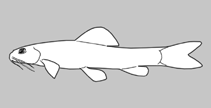 No image available for this species;
drawing shows typical species in Nemacheilidae.
Google Bild
drawing shows typical species in Nemacheilidae.
Klassifizierung / Names Namen | Synonyme | Catalog of Fishes(Gattung, Arten) | ITIS | CoL | WoRMS | Cloffa
> Cypriniformes (Carps) > Nemacheilidae (Brook loaches)
Etymology: Triplophysa: Greek, triplos = thrice + Greek, physa = tube (Ref. 45335); waisihani: The specific epithet is a reference to Wai Si Han, the Chinese spelling of the Wais Khan, (a tenth-generation male offspring of the Mongolian emperor Genghis Khan), whose mausoleum is located in the Dunmaza Town (in Yining County of the Xinjiang-Uighur a.
Eponymy: Wai Si Han (Chinese spelling of Wais Khan) was the 10th-generation male offspring of the Mongolian emperor Genghis Khan, whose mausoleum is located in Dunmaza Town (Yining County, Xinjiang-Uighur, China); the type locality. (Ref. 128868), visit book page.
Etymology: Triplophysa: Greek, triplos = thrice + Greek, physa = tube (Ref. 45335); waisihani: The specific epithet is a reference to Wai Si Han, the Chinese spelling of the Wais Khan, (a tenth-generation male offspring of the Mongolian emperor Genghis Khan), whose mausoleum is located in the Dunmaza Town (in Yining County of the Xinjiang-Uighur a.
Eponymy: Wai Si Han (Chinese spelling of Wais Khan) was the 10th-generation male offspring of the Mongolian emperor Genghis Khan, whose mausoleum is located in Dunmaza Town (Yining County, Xinjiang-Uighur, China); the type locality. (Ref. 128868), visit book page.
Umwelt: Milieu / Klimazone / Tiefenbereich / Verbreitungsgebiet Ökologie
; süßwasser benthopelagisch. Temperate; 44°N - 43°N, 81°E - 82°E
Verbreitung Territorien | FAO Gebiete | Ökosysteme | Vorkommen | Punkt Karte | Einführungen | Faunafri
Asia: China. Known from the Kax River, a tributary to the Ili River drainage, at Dunmaza Town in Yining County (81°53'E, 43°82'N; 1143m above sea level) of Xinjiang-Uighur Autonomous Region, Northwestern China. It was also documented by Zhu (1989, 1995) from the Ili River and Emin River drainages of Xinjiang, without precise locality and by Wu & Wu (1992) from the Manas River drainage (Ref. 79615).
Größe / Gewicht / Alter
Kurzbeschreibung Bestimmungsschlüssel | Morphologie | Morphometrie
Rückenflossenstacheln (insgesamt) : 3; Rückenflossenweichstrahlen (insgesamt) : 7; Afterflossenstacheln: 3; Afterflossenweichstrahlen: 5. Triplophysa waisihani belongs to the T. labiata species-group that is characterized by having widely separated anterior and posterior nostrils and no breeding tubercles on the sides of the head. It resembles T. labiata and T. herzensteini, with which it shares the presence of a columnar caudal peduncle with an
approximately circular cross-section at its beginning, but differs from both in possessing supraorbital and infraorbital canals that are not confluent (vs. confluent); and the posterior chamber of the gas bladder connected to the anterior chamber by a long duct, twice as long as the posterior chamber (vs. connected to the
anterior chamber by a shorter duct than the posterior chamber in T. labiata, or strongly reduced in T. herzensteini). It further differs from T. labiata in the possession of an anteriorly bifurcated (vs. non-bifurcated) pelvic girdle and in the absence (vs. presence) of the fourth basibranchial, and from T. herzensteini in having a truncate or slightly convex (vs. concave) distal margin of the anal fin (Ref. 79615).
Coloration of live specimens: ground colour of back, and lateral body gray, somewhat lighter ventrally; ventral region of body yellowish white. Six or seven brown transverse bars on predorsal region, five or six bars on postdorsal region of body. Many spots on flank above lateral line and area directly below. A longitudinal
light-yellow stripe running along lateral line, becoming increasingly narrower and ending at vertical through vent. Dorsal and caudal fins dusky. Dorsal surfaces of pectoral and pelvic fins gray. Anal fin hyaline (Ref. 79615).
Body shape (shape guide): elongated.
Body shape (shape guide): elongated.
Lebenszyklus und Paarungsverhalten Geschlechtsreife | Fortpflanzung | Ablaichen | Eier | Fruchtbarkeit | Larven
Hauptreferenz
Laden Sie Ihre Referenzen hoch | Referenzen | Koordinator | Partner
Cao, L. and E. Zhang, 2008. Triplophysa waisihani, a new species of nemacheiline loach from Northwest China (Pisces: Balitoridae). Zootaxa 1932:33-46. (Ref. 79615)
CITES
Not Evaluated
Bedrohung für Menschen
Harmless
Nutzung durch Menschen
FAO - Publication: search | FishSource |
Mehr Information
Trophische Ökologie
Lebensmittel (Beutetiere)
Nahrungszusammensetzung
Nahrungsaufnahme
Lebensmittelrationen
Räuber
Lebensmittel (Beutetiere)
Nahrungszusammensetzung
Nahrungsaufnahme
Lebensmittelrationen
Räuber
Ökologie
Ökologie
Ökologie
Populationsdynamik
Wachstumsparameter
Max. Alter/Größen
Länge-Gewicht-Rel.
Länge-Länge-Verhältnis.
Längenhäufigkeiten
Massenkonvertierung
Rekrutierung
Dichte
Wachstumsparameter
Max. Alter/Größen
Länge-Gewicht-Rel.
Länge-Länge-Verhältnis.
Längenhäufigkeiten
Massenkonvertierung
Rekrutierung
Dichte
Lebenszyklus
Fortpflanzung
Geschlechtsreife
Reifung/Kiemen rel.
Fruchtbarkeit
Ablaichen
Laichaggregationen
Eier
Eientwicklung
Larven
Larven Pop.Dyn.
Fortpflanzung
Geschlechtsreife
Reifung/Kiemen rel.
Fruchtbarkeit
Ablaichen
Laichaggregationen
Eier
Eientwicklung
Larven
Larven Pop.Dyn.
Anatomie
Kiemenoberfläche
Gehirn
Otolith
Kiemenoberfläche
Gehirn
Otolith
Physiologie
Körperliche Zusammensetzung
Nährstoffe
Sauerstoffverbrauch
Schwimmart
Schwimmgeschwindigkeit
Visuelle Pigmente
Fischgeräusche
Krankheiten und Parasiten
Toxizität (LC50s)
Körperliche Zusammensetzung
Nährstoffe
Sauerstoffverbrauch
Schwimmart
Schwimmgeschwindigkeit
Visuelle Pigmente
Fischgeräusche
Krankheiten und Parasiten
Toxizität (LC50s)
Genetik
Genom
Genetik
Heterozygotie
Vererbbarkeit
Genetische Vielfalt
Genom
Genetik
Heterozygotie
Vererbbarkeit
Genetische Vielfalt
Menschenbezogen
Aquakultur-Systeme
Aquakultur Profile
Zuchtlinien
Ciguatera-Fälle
Briefmarken, Münzen, Verschiedenes.
Aquakultur-Systeme
Aquakultur Profile
Zuchtlinien
Ciguatera-Fälle
Briefmarken, Münzen, Verschiedenes.
Tools
Zusatzinformationen
Download XML
Zusammenfassung | Punktdaten | Namen | Photos
Internet Quellen
AFORO (otoliths) | Aquatic Commons | BHL | Cloffa | Websites from users | FishWatcher Einträge suchen | CISTI | Catalog of Fishes: Gattung, Arten | DiscoverLife | ECOTOX | FAO - Publication: search | Faunafri | Fishipedia | Fishtrace | GloBI | Google Books | Google Scholar | Google | IGFA World Record | OneZoom | Open Tree of Life | Otolith Atlas of Taiwan Fishes | PubMed | Reef Life Survey | Socotra Atlas | TreeBase | Tree of Life | Wikipedia: Gehe zu, Suchen | World Records Freshwater Fishing | Zoobank | Zoologischer Rekord
Schätzungen auf der Grundlage von Modellen
Phylogenetischer Diversitätsindex (Ref. 82804): PD50 = 0.5000 [Uniqueness, from 0.5 = low to 2.0 = high].
Bayesian length-weight: a=0.00708 (0.00338 - 0.01484), b=3.00 (2.83 - 3.17), in cm total length, based on LWR estimates for this Genus-body shape (Ref. 93245).
Trophische Ebene (Ref. 69278): 3.1 ±0.4 se; based on size and trophs of closest relatives
Widerstandsfähigkeit (Ref. 120179): mittel, Verdopplung der Population dauert 1,4 - 4,4 Jahre. (Preliminary K or Fecundity.).