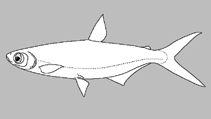
>
Characiformes (Characins) >
Alestidae (African tetras)
Etymology: Nannopetersius: Latin, nannus = small + Peters, 1877, naturalist, expeditionary in Asia; mutambuei: This species is dedicated to Professor Mutambue Shango, who collected fishes from the Inkisi River basin in 1985 and 1986 and deposited them at the MNHN and MRAC (Ref. 79819).
Eponymy: Dr Mutambue Shango is a biologist and aquarist who is the General Academic Secretary and Professor, École Régionale Post-universitaire d’Aménagement et de Gestion intégrés des Forêts et Territoires Tropicaux, Kinshasa, Democratic Republic of Congo. [...] (Ref. 128868), visit book page.
Environment: milieu / climate zone / intervalo de profundidade / distribution range
Ecologia
; Água doce bentopelágico. Tropical
Africa: only known from the Inkisi River upstream of Sanga dam (lower Congo River basin), in Democratic Republic of the Congo (Ref. 79819, 120641).
Tamanho / Peso / Idade
Maturidade: Lm ? range ? - ? cm
Max length : 12.0 cm SL macho/indeterminado; (Ref. 79819)
Descrição breve
Chaves de identificação | Morfologia | Morfometria
Espinhos dorsais (total) : 0; Raios dorsais moles (total) : 10; Espinhos anais: 0; Raios anais moles: 25 - 27. Diagnosis: Nannopetersius mutambuei is distinguished from its two congeners by the following combination of characters: lateral line with 28-30 scales and 27-30 pored scales, vs. 30-35 and 32-35 in N. ansorgii and 28-33 and 27-33 in N. lamberti; 5.5-6.5 scales between the origin of the dorsal fin and the lateral line, vs. 6.5 in N. ansorgii and 6.5-7.5 in N. lamberti; 10-13 gill rakers on the ceratobranchial of the first branchial arch, vs. 14-17 in N. ansorgii and 10-12 in N. lamberti; length of caudal peduncle 135.7-151.9% of its depth, vs. caudal peduncle nearly as long as deep in N. ansorgii and N. lamberti; snout length 26.6-29.2% of head length, vs. 18.4-23.0% in N. lamberti; eye diameter 31.7-39.6% of head length, vs. 46.0-56.2% in N. lamberti; and no broad dark band in life, however present in preserved specimens, and no additional black spots on caudal and distal blackish band on anal fin, vs. a faint dark medio-lateral band, in preserved specimens, hardly visible anteriorly but better marked on the caudal fin and no additional black spots on caudal and anal fin in N. ansorgii, and a broad, black, medio-lateral band in life as well as preserved specimens, distal part of both upper and lower caudal-fin lobe with a black spot and distal margin of anal fin blackish in N. lamberti (Ref. 79819).
Body shape (shape guide): fusiform / normal.
Life cycle and mating behavior
Maturidade | Reprodução | Desova | Ovos | Fecundidade | Larvas
Wamuini Lunkayilakio, S. and E. Vreven, 2008. Nannopetersius mutambuei (Characiformes: Alestidae), a new species from the Inkisi River basin, Democratic Republic of Congo. Ichthyol. Explor. Freshwat. 19(4):367-376. (Ref. 79819)
Categoria na Lista Vermelha da IUCN (Ref. 130435: Version 2025-1)
Ameaça para o homem
Harmless
Utilização humana
Ferramentas
Relatórios especiais
Descarregue XML
Fontes da internet
Estimates based on models
Phylogenetic diversity index (Ref.
82804): PD
50 = 0.6250 [Uniqueness, from 0.5 = low to 2.0 = high].
Bayesian length-weight: a=0.01000 (0.00244 - 0.04107), b=3.04 (2.81 - 3.27), in cm total length, based on all LWR estimates for this body shape (Ref.
93245).
Nível Trófico (Ref.
69278): 3.1 ±0.4 se; based on size and trophs of closest relatives
Resiliência (Ref.
120179): Elevada, tempo mínimo de duplicação da população menor que 15 meses (Preliminary K or Fecundity.).
Fishing Vulnerability (Ref.
59153): Low vulnerability (10 of 100).
🛈