


Glossogobius bellendenensis Hoese & Allen, 2009
Envoyez vos Photos et vidéos
Images Google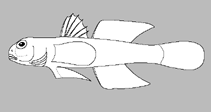 No image available for this species;
drawing shows typical species in Gobiidae.
Images Google
drawing shows typical species in Gobiidae.
Classification / Noms Noms communs | Synonymes | Catalog of Fishes(Genre, Espèce) | ITIS | CoL | WoRMS | Cloffa
> Gobiiformes (Gobies) > Gobiidae (Gobies) > Gobiinae
Etymology: Glossogobius: Greek, glossa = tongue + Latin, gobius = gudgeon (Ref. 45335); bellendenensis: Named for the Bellenden Ker Range, where the species was first discovered.
More on authors: Hoese & Allen.
Etymology: Glossogobius: Greek, glossa = tongue + Latin, gobius = gudgeon (Ref. 45335); bellendenensis: Named for the Bellenden Ker Range, where the species was first discovered.
More on authors: Hoese & Allen.
Environnement : milieu / zone climatique / profondeur / gamme de distribution Écologie
; eau douce benthopélagique. Tropical; 17°S - 18°S, 145°E - 146°E
Distribution Territoires | Zones FAO | Écosystèmes | Occurrences | Carte par point | Introductions | Faunafri
Oceania: Australia, Queensland.
Taille / Poids / Âge
Description synthétique Clés d'identification | Morphologie | Morphométrie
Épines anales: 1; Rayons mous anaux: 8. Mental fraenum bilobed, with lateral lobes broad and attached to chin, with a posteromedian
attachment sometimes giving the appearance of a third lobe; predorsal area partly scaled, midline scales extending no farther forward than posterior preopercular margin; cheek, operculum, pectoral base, prepelvic area and anterior midline of belly naked; first dorsal fin with one or two large black spots posteriorly; second dorsal-fin rays usually I,10; anal-fin rays I,8; pectoral-fin rays usually 16–17; predorsal scale count 2–14; cheek papilla lines composed of single row of papillae; papilla line 6 absent and vertebrae usually 12+16.Glossogobius bellendenensis is readily distinguished from other species of Glossogobius in dorsal and anal-ray counts, reduced predorsal scale coverage, absence of scales of prepelvic area and pectoral base and distinctive shape of the mental frenum. It shares most of those characteristics with Glossogobius muscorum from the Fly River in New Guinea. Glossogobius bellendensis differs from that species in coloration, in usually having 12+16 vertebrae (versus 11+17), and a trilobed mental frenum (versus bilobed). The coloration differences include lacking a horizontal brown stripe on the cheek below the eye, an oval brown spot on the anteromedian margin of the operculum and white on the posterior end of lips, characteristic of G. muscorum. It addition there are two large spots on the midside on the belly (versus one large blotch on the side of the belly).
The species can be confused with Glossogobius concavifrons, which has scales on the pectoral base and prepelvic area, predorsal scales reaching to near eye, more numerous precaudal vertebrae (13–15) and more compressed head. Currently the two species are not known to be sympatric. Glossogobius concavifrons is known from rivers of western Cape York to Arnhem Land in Australia and southern New Guinea. Separation of juveniles below 20 mm SL is difficult because the scales are not well developed in Glossogobius concavifrons at that size.
Body shape (shape guide): fusiform / normal.
Body shape (shape guide): fusiform / normal.
Kroon and Johnson (2006) document Queensland records of this species. Although the species currently is restricted in its distribution, it may have been mistaken for juveniles of other species because of the small size of the species. Consequently it is likely to be more widely distributed in Australia (Ref. 80299).
Cycle de vie et comportement reproducteur Maturité | Reproduction | Frai | Œufs | Fécondité | Larves
Référence principale
Téléchargez vos références | Références | Coordinateur | Collaborateurs
Hoese, D.F. and G.R. Allen, 2009. Description of three new species of Glossogobius from Australia and New Guinea. Zootaxa 1981:1-14. (Ref. 80299)
Statut dans la liste rouge de l'IUCN (Ref. 130435: Version 2025-2 (Global))
Menacé (EN) (B1ab(ii,iii)); Date assessed: 14 February 2019
CITES
Not Evaluated
Menace pour l'homme
Harmless
Utilisations par l'homme
FAO - Publication: search | FishSource |
Plus d'informations
Écologie trophique
Aliments (proies)
Composition du régime alimentaire
Consommation alimentaire
Rations alimentaires
Prédateurs
Aliments (proies)
Composition du régime alimentaire
Consommation alimentaire
Rations alimentaires
Prédateurs
Dynamique des populations
Paramètres de croissance
Âges / tailles maximales
Longueur-poids rel.
Rel. longueur-longueur.
Fréquences de longueurs
Conversion de masse
Recrutement
Abondance
Paramètres de croissance
Âges / tailles maximales
Longueur-poids rel.
Rel. longueur-longueur.
Fréquences de longueurs
Conversion de masse
Recrutement
Abondance
Cycle de vie
Reproduction
Maturité
Maturité/épines rel.
Fécondité
Frai
Agrégats de frai
Œufs
Développement de l'œuf
Larves
Dynamique des populations larvaires
Reproduction
Maturité
Maturité/épines rel.
Fécondité
Frai
Agrégats de frai
Œufs
Développement de l'œuf
Larves
Dynamique des populations larvaires
Anatomie
Surface branchiale
Cerveau
Otolithe
Surface branchiale
Cerveau
Otolithe
Physiologie
Composition corporelle
Nutriments
Consommation d'oxygène
Type de natation
Vitesse de nage
Pigments visuels
Son de poisson
Maladies et parasites
Toxicité (CL50)
Composition corporelle
Nutriments
Consommation d'oxygène
Type de natation
Vitesse de nage
Pigments visuels
Son de poisson
Maladies et parasites
Toxicité (CL50)
Génétique
génôme
Génétique
Hétérozygotie
Héritabilité
Diversité génétique
génôme
Génétique
Hétérozygotie
Héritabilité
Diversité génétique
Liées à l'homme
Systèmes d'aquaculture
Profils d'aquaculture
Souches
Cas de ciguatera
Timbres, pièces de monnaie, divers
Systèmes d'aquaculture
Profils d'aquaculture
Souches
Cas de ciguatera
Timbres, pièces de monnaie, divers
Outils
E-book | Guide de terrain | Générateur de fréquences de longueur | Outil de dynamique de population | Carte par point |
Capture-MSY |
Articles particuliers
Télécharger en XML
Sources Internet
AFORO (otoliths) | Aquatic Commons | BHL | Cloffa | Websites from users | FishWatcher | CISTI | Catalog of Fishes: Genre, Espèce | DiscoverLife | ECOTOX | FAO - Publication: search | Faunafri | Fishipedia | Fishtrace | GloBI | Google Books | Google Scholar | Google | IGFA World Record | OneZoom | Open Tree of Life | Otolith Atlas of Taiwan Fishes | PubMed | Reef Life Survey | Socotra Atlas | TreeBase | Arbre de Vie | Wikipedia: aller à, chercher | World Records Freshwater Fishing | Zoobank | Zoological Record
Estimations basées sur des modèles
Indice de diversité phylogénétique (Réf. 82804): PD50 = 0.5000 [Uniqueness, from 0.5 = low to 2.0 = high].
Bayesian length-weight: a=0.01023 (0.00477 - 0.02194), b=3.01 (2.83 - 3.19), in cm total length, based on LWR estimates for this (Sub)family-body shape (Ref. 93245).
Niveau trophique (Réf. 69278): 3.3 ±0.4 se; based on size and trophs of closest relatives
Résilience (Réf. 120179): Haut, temps minimum de doublement de population inférieur à 15 mois (Preliminary K or Fecundity.).