This website uses cookies to enhance your browsing experience and ensure the functionality of our site. For more detailed information about the types of cookies we use and how we protect your privacy, please visit our Privacy Information page..
×
Cookie Settings
This website uses different types of cookies to enhance your experience. Please select your preferences below:
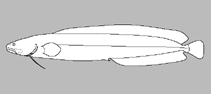
No image available for this species; drawing shows typical species in Bythitidae.
分類 / Names 俗名 | 同種異名 | Catalog of Fishes(屬, 種) | ITIS | CoL | WoRMS | Cloffa
Teleostei > Ophidiiformes (Cusk eels) 鼬鳚目 (Cusk eels) > Bythitidae (Livebearing brotulas) 深蛇鳚科 (Livebearing brotulas)
Etymology: robusta:The specific name, robusta, refers to the short, deep body (Ref. 80456). Eponymy: Cristoforo Bellotti (1823–1919) was an Italian ichthyologist and palaeontologist, who was also very interested in the breeding of silkworms. [...] (Ref. 128868), visit book page. More on authors: Nielsen, Ross & Cohen.
Environment: milieu / climate zone / 深度上下限 / distribution range 生態學
背的軟條 (總數) : 85 - 93; 臀鰭軟條: 75 - 88; 脊椎骨: 48 - 51. Body robust, highest near base of pectoral fin, completely covered with oval, ca.1.5 mm, cycloid scales. Anterior segment of lateral line extending close to dorsal margin of body and from above anus along midline of body. Head profile convex, cheek and gill-cover scaled, while rest of head naked. Mouth slightly oblique with posterior margin of maxillary vertically expanded ending well behind eye. Anterior nostril closer to upper lip than to posterior nostril, both with low rim. Small opercular spine strong and pointed, almostcompletely covered by skin, and not reaching posterior margin of opercle (a few specimens with spine reaching just beyond hind margin of opercle). Ventral margin of preopercle with four distinct spines and one spine on preopercular crest (spine often covered by skin; one specimen with two spines on crest).
Origin of dorsal fin above tip of pectoral fin, anal fin origin just behind midpoint of fish (some specimens with preanal up to 59 % SL). Pectoral fin placed on mid-body level with peduncle higher than long. A distinct spine on cleithrum just above base of pectoral fin (one specimen with spine ending in a blunt tip). Anterior gill arch with 2–3 (2–4) plate-like rakers on upper branch, one long raker in the angle between the two branches and lower branch with 4–5 long rakers, followed by seven (6–9) plate-like rakers. Longest gill filament
slightly shorter than longest raker. Two minute pseudobranchial filaments (Ref. 80456).
Bellottia robusta differs from its congeners by the following combination of characters: depth at origin of anal fin 17.5–23.0 % SL, small teeth blunt or pointed, four spines on hind margin and one on crest of preopercle, distinct spine on cleithrum above base of pectoral fin, anterior gill arch with 5–6 long rakers, predorsal 44.0–49.5 % SL and precaudal vertebrae 12 (Ref. 80456).
Life cycle and mating behavior 成熟度 | 繁殖 | 產卵場 | 卵 | 孕卵數 | 仔魚
Nielsen, J.G., S.W. Ross and D.M. Cohen, 2009. Atlantic occurrence of the genus Bellottia (Teleostei, Bythitidae) with two new species from the Western North Atlantic. Zootaxa 2018:45-57. (Ref. 80456)
Phylogenetic diversity index (參考文獻 82804): PD50 = 0.5312 [Uniqueness, from 0.5 = low to 2.0 = high].
Bayesian length-weight: a=0.00813 (0.00246 - 0.02688), b=2.92 (2.67 - 3.17), in cm total length, based on LWR estimates for this (Sub)family-body shape (Ref. 93245).
營養階層 (參考文獻 69278): 3.3 ±0.5 se; based on size and trophs of closest relatives
回復力 (參考文獻 120179): 高度, 族群倍增時間少於 15個月 (Preliminary K or Fecundity.).
Fishing Vulnerability (Ref. 59153): Low vulnerability (10 of 100). 🛈