>
Syngnathiformes (Pipefishes and seahorses) >
Syngnathidae (Pipefishes and seahorses) > Syngnathinae
Etymology: Hippocampus: Greek, ippos = horse + Greek,kampe = curvature (Ref. 45335); waleananus: Named for its type and only confirmed locality Walea Island, Sulawesi, Indonesia, where this species occurs and the Latin nanus for "dwarf".
Issue
Junior synonym in Lourie et al., 2016; valid in ECoff., 2023.
Environment: milieu / climate zone / пределы глубины / distribution range
экология
морской донно-пелагический; немигрирующий; пределы глубины 5 - 20 m (Ref. 80667). Tropical
Western Central Pacific: Indonesia.
Size / Вес / Возраст
половая зрелость: Lm ? range ? - ? cm
Max length : 1.8 cm SL самец/пол неопределен; (Ref. 80667)
Краткое описание
определительные ключи | морфология | морфометрия
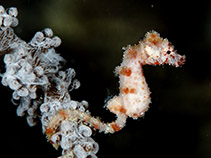
членистые (мягкие) лучи спинного плавника (общее число) : 12. This species is distinguished by the following characters: size extremely small (height 1.68 cm, 1.78 cm SL); trunks rings 12; tail elongate, 32 tail rings; D 12; pectoral fin rays 9; no anal fin (at least in one sex); apparently eggs brooded within trunk; medium length snout which lacks a bulbous tip; coronet raised and angular; fused gill openings on midline behind the coronet supported by raised cleithral girdle; enlarged knob-like structures on head and trunk; paired laterally directed knob-like structures and each with short fleshy filament on superior trunk ridge of the fifth trunk ring; last 28 tail rings each with small paired knobs on inferior tail ridge, fifth, ninth and twelfth tail rings with bilaterally paired enlarged knob-like structures on superior tail ridges. Colouration: pale pinkish to yellowish with red to brown blotches, radiating bands from eye; body protuberances are white, appearing as white spots (Ref. 80667).
Body shape (shape guide): other; Cross section: angular.
Found in association with the soft coral Nephtea, but has also been observed swimming lengthy distances from one coral to the next (Ref 90102).
Life cycle and mating behavior
половая зрелость | размножение | нерест | икра | Fecundity | личинки
Male carries the eggs in a brood pouch (Ref. 205).
Short, G., R. Smith, H. Motomura, D. Harasti and H. Hamilton, 2018. Hippocampus japapigu, a new species of pygmy seahorse from Japan, with a redescription of H. pontohi (Teleostei, Syngnathidae). ZooKeys 779:27-49. (Ref. 118476)
Статус Красного Списка МСОП (Ref. 130435: Version 2025-1)
Угроза для людей
Harmless
Использование человеком
дополнительная информация
инструменты
Специальные отчеты
Скачать в формате XML
ресурсы в Интернет
Estimates based on models
Phylogenetic diversity index (ссылка
82804): PD
50 = 0.5000 [Uniqueness, from 0.5 = low to 2.0 = high].
Bayesian length-weight: a=0.00447 (0.00175 - 0.01142), b=2.99 (2.77 - 3.21), in cm total length, based on LWR estimates for this (Sub)family-body shape (Ref.
93245).
Trophic level (ссылка
69278): 3.0 ±0.5 se; based on size and trophs of closest relatives
устойчивость к внешним воздействиям (ссылка
120179): высокий, минимальное время удвоения популяции до 15 месяцев (Preliminary K or Fecundity.).
Fishing Vulnerability (Ref.
59153): Low vulnerability (10 of 100).
🛈