>
Gobiiformes (Gobies) >
Gobiidae (Gobies) > Gobiinae
Etymology: Eviota: No etymology given, suggested by Christopher Scharpt: from Latin 'eu' for 'true' and 'iota' for anything very small, in combination 'truly very small' referring to it as being the smallest vertebrate at the time it has benn described by Jenkins (thus, making the suggestion by Scharpt plausible.
Environment: milieu / climate zone / rango de profundidad / distribution range
Ecología
marino; salobre asociado a arrecife. Subtropical
Distribución
Países | Áreas FAO | Ecosistemas | Ocurrencias, apariciones | Mapa de puntos | Introducciones | Faunafri
Northwest Pacific: Ryukyu Is., Japan.
Tamaño / Peso / Age
Madurez: Lm ? range ? - ? cm
Max length : 1.8 cm SL macho / no sexado; (Ref. 81713)
Short description
Claves de identificación | Morfología | Morfometría
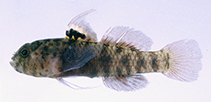
This species lacks preopercular canal and associated pores of cephalic sensory systems as with Eviota lacrimae and E. sparsa, but differs from these two in having moderately developed fifth pelvic-fin ray (10.5-18.1% of preceding ray in length) and a distinct semi-ocellated spot at the anteroventral part of first dorsal fin (Ref. 81713).
Body shape (shape guide): fusiform / normal.
Found resting only on the substrate at the mouth of a river in an estuary (Ref. 116739).
Life cycle and mating behavior
Madurez | Reproducción | Puesta | Huevos | Fecundidad | Larva
Shibukawa, K. and T. Suzuki, 2005. Two new species of the gobiid fish genus Eviota (Teleostei, Perciformes, Gobioidei) from the Western Pacific. Bull. Natl. Sci. Mus. Ser A 31(2):65-76. (Ref. 81713)
IUCN Red List Status (Ref. 130435: Version 2025-1)
Threat to humans
Harmless
Human uses
Herramientas
Special reports
Download XML
Fuentes de Internet
Estimates based on models
Phylogenetic diversity index (Referencia
82804): PD
50 = 0.5000 [Uniqueness, from 0.5 = low to 2.0 = high].
Bayesian length-weight: a=0.01023 (0.00477 - 0.02194), b=3.01 (2.83 - 3.19), in cm total length, based on LWR estimates for this (Sub)family-body shape (Ref.
93245).
Nivel trófico (Referencia
69278): 3.0 ±0.3 se; based on size and trophs of closest relatives
Resiliencia (Referencia
120179): Alto, población duplicada en un tiempo mínimo inferior a 15 meses (Preliminary K or Fecundity.).
Fishing Vulnerability (Ref.
59153): Low vulnerability (10 of 100).
🛈