


Enigmatochromis lucanusi Lamboj, 2009
Tải lên của bạn hình ảnh Và Video
Các tranh (Ảnh) | Google image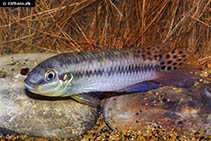 Enigmatochromis lucanusi
Hình ảnh của JJPhoto
Các tranh (Ảnh) | Google image
Hình ảnh của JJPhoto
Phân loại / Tên Tên thường gặp | Các synonym ( Các tên trùng) | Catalog of Fishes(Giống, Các loài) | ITIS | CoL | WoRMS | Cloffa
> Cichliformes (Cichlids, convict blennies) > Cichlidae (Cichlids) > Pseudocrenilabrinae
Etymology: lucanusi: Enigma from enigmatic, refers to the somewhat intermediate characters between Pelvicachromis and Parananochromis in possessing pigmentation similarities to the first, but anatomical similarities to the second genus; and chromis.
Eponymy: Oliver Lucanus (d: 1970) is a German born Canadian collector, aquarist, videographer, explorer and tropical fish importer. [...] (Ref. 128868), visit book page.
Etymology: lucanusi: Enigma from enigmatic, refers to the somewhat intermediate characters between Pelvicachromis and Parananochromis in possessing pigmentation similarities to the first, but anatomical similarities to the second genus; and chromis.
Eponymy: Oliver Lucanus (d: 1970) is a German born Canadian collector, aquarist, videographer, explorer and tropical fish importer. [...] (Ref. 128868), visit book page.
Môi trường: môi trường / vùng khí hậu / Mức độ sâu / phạm vi phân phối Sinh thái học
; nước ngọt sống nổi và đáy; pH range: 5.8 - ? ; dH range: 0 - ?. Tropical; 24°C - ? (Ref. 81928); 11°N - 10°N, 13°W - 14°W
Sự phân bố Lãnh thổ | Các khu vực của FAO | Các hệ sinh thái | Những lần xuất hiện | Bản đồ điểm | Những chỉ dẫn | Faunafri
Africa: Guinea. Only known from type locality, the Foto River, what is a small savannah river near the bauxite mining town of Fria in coastal Guinea, north of Conakry (Ref. 81928).
Bộ gần gũi / Khối lượng (Trọng lượng) / Tuổi
Chín muồi sinh dục: Lm ? range ? - ? cm
Max length : 4.5 cm SL con đực/không giới tính; (Ref. 81928)
Max length : 4.5 cm SL con đực/không giới tính; (Ref. 81928)
Mô tả ngắn gọn Khóa để định loại | Hình thái học | Sinh trắc học
The new genus is distinguished from all other chromidotilapiine genera by a unique combination of characters. It possesses twelve scales around the caudal peduncle vs. (13 or 14 scales) in Limbochromis Greenwood 1987, (14-16 scales) in Chromidotilapia, Boulenger 1898, and (16 scales) in Benitochromis Lamboj 2001, Pelvicachromis Thys van den Audenaerde 1968 and Thysochromis Daget 1988. Among the remaining chromidotilapiine genera with twelve circumpeduncular scales this new genus is further distinguished from Congochromis Stiassny & Schliewen 2007 and Nanochromis Pellegrin 1904 by: an infraorbital series containing a lachrymal and three additional tubular bones, and a gap between the 2nd and 3rd tubular infraorbitals (vs. lachrymal and one tubular bone), plus the lateral line is clearly separated from the dorsal-fin base (vs. posterior part contiguous with the dorsal-fin base). It is distinguished from Divandu Lamboj & Snoeks 2000 by: an infraorbital series with a lachrymal and three additional tubular bones and a gap between the 2nd and 3rd tubular infraorbitals (vs. four tubular bones), only four openings of the
laterosensory system in the lachrymal bone (vs. five), the first ray of pelvic fin in adult females is of equal length or longer than second ray of this fin (vs. first ray always longer), being a pair-bonding cave breeder (vs. a mouthbrooder), and by well developed sexual dichromatism (vs. weakly developed). Finally it is distinguished from Parananochromis Greenwood 1987 by: an infraorbital series with a lachrymal and three additional tubular bones with a gap between the 2nd and 3rd tubular infraorbitals (vs. four tubular bones in some species of Parananochromis), juveniles with 3 or 4 rows of irregular dark brown to black dots on body (vs. maximum of 2 rows), and the first ray of pelvic fin in adult females of equal length or longer than the second ray of this fin (vs. second ray slightly longer or of equal length) (Ref. 81928).
Where it was collected, Enigmatochromis lucanusi occured syntopically with Pelvicachromis humilis (Ref. 81928).
Vòng đời và hành vi giao phối Chín muồi sinh dục | Sự tái sinh sản | Đẻ trứng | Các trứng | Sự sinh sản | Ấu trùng
In aquaria, the species is a monogamous, pair bonding, cave spawner. Eggs are guarded by both sexes, but more intensively by the female. Hatching occurs after three days post-spawn.
Larvae are normally deposited on the bottom of the cave, rarely in other caves nearby the original cave. Juveniles are free swimming 8 or 9 days post-hatching, and are guarded by both parents for about 5 to 6 weeks. Breeding and guarding individuals of both sexes regularly exhibit more aggressive and intensive coloration. The dark, longitudinal stripe that is typical for breeding and guarding specimens of both sexes in
many other cave breeders of the chromidotilapiine lineage (e.g., Pelvicachromis, Congochromis, and Parananochromis) is prominently visible in males, but is more rarely and weakly visible in females. In this
character, females of Enigmatochromis differ from females of Pelvicachromis, Congochromis and Parananochromis, where a prominent dark, longitudinal stripe is typical for females (and only rarely for males) during the first 2 to 4 weeks when guarding fry (Ref. 81928).
Tài liệu tham khảo chính
Tải lên tài liệu tham khảo của bạn | Các tài liệu tham khảo | Người điều phối : Kullander, Sven O. | Người cộng tác
Lamboj, A., 2009. A new dwarf cichlid genus and species (Teleostei, Cichlidae) from Guinea, West Africa. Zootaxa 2173:41-48. (Ref. 81928)
CITES
Not Evaluated
Mối đe dọa đối với con người
Harmless
Sử dụng của con người
FAO - Publication: search | FishSource |
Thêm thông tin
Sinh thái dinh dưỡng
Thức ăn (con mồi)
Thành phần thức ăn
Thành phần thức ăn
Khẩu phần ăn
Các động vật ăn mồi
Thức ăn (con mồi)
Thành phần thức ăn
Thành phần thức ăn
Khẩu phần ăn
Các động vật ăn mồi
Biến động dân số
Các thông số tăng trưởng
Độ tuổi / kích thước tối đa
Chiều dài-trọng lượng tương đối
Chiều dài-chiều dài tương đối.
Chiều dài-tần số
Chuyển đổi khối lượng
Bổ xung
Sự phong phú
Các thông số tăng trưởng
Độ tuổi / kích thước tối đa
Chiều dài-trọng lượng tương đối
Chiều dài-chiều dài tương đối.
Chiều dài-tần số
Chuyển đổi khối lượng
Bổ xung
Sự phong phú
Vòng đời
Sự tái sinh sản
Chín muồi sinh dục
Độ trưởng thành/Mang liên quan
Sự sinh sản
Đẻ trứng
Tập hợp sinh sản
Các trứng
Sự phát triển của trứng
Ấu trùng
Sự biến động ấu trùng
Sự tái sinh sản
Chín muồi sinh dục
Độ trưởng thành/Mang liên quan
Sự sinh sản
Đẻ trứng
Tập hợp sinh sản
Các trứng
Sự phát triển của trứng
Ấu trùng
Sự biến động ấu trùng
Sự phân bố
Lãnh thổ
Các khu vực của FAO
Các hệ sinh thái
Những lần xuất hiện
Những chỉ dẫn
BRUVS - Video
Lãnh thổ
Các khu vực của FAO
Các hệ sinh thái
Những lần xuất hiện
Những chỉ dẫn
BRUVS - Video
Giải phẫu
Vùng mang
Não
sỏi tai
Vùng mang
Não
sỏi tai
Sinh lý học
Thành phần cơ thể
Chất dinh dưỡng
Thành phần ô-xy
Kiểu bơi
Tốc độ bơi
Sắc tố thị giác
Tiếng cá
Bệnh tật & Ký sinh trùng
Độc tính (LC50)
Thành phần cơ thể
Chất dinh dưỡng
Thành phần ô-xy
Kiểu bơi
Tốc độ bơi
Sắc tố thị giác
Tiếng cá
Bệnh tật & Ký sinh trùng
Độc tính (LC50)
Di truyền
Bộ gen
Di truyền
Sự dị hợp tử
Di sản
Đa dạng di truyền
Bộ gen
Di truyền
Sự dị hợp tử
Di sản
Đa dạng di truyền
Liên quan đến con người
Hệ thống nuôi trồng thủy sản
Các tổng quan nuôi trồng thủy sản
Các giống
Các trường hợp ngộ độc Ciguatera
Tem, tiền xu, v.v.
Hệ thống nuôi trồng thủy sản
Các tổng quan nuôi trồng thủy sản
Các giống
Các trường hợp ngộ độc Ciguatera
Tem, tiền xu, v.v.
Các công cụ
Sách điện tử | Hướng dẫn hiện trường | Tần suất chiều dài Wizard | Công cụ của vòng đời | Bản đồ điểm |
Bắt-MSY |
Báo cáo đặc biệt
Kiểm tra bảo trì bể cá | Kiểm tra các tờ thông tin về loài | Kiểm tra các tờ thông tin về nuôi trồng thủy sản
Tải xuống XML
Các nguồn internet
AFORO (otoliths) | Aquatic Commons | BHL | Cloffa | Websites from users | Check FishWatcher | CISTI | Catalog of Fishes: Giống, Các loài | DiscoverLife | ECOTOX | FAO - Publication: search | Faunafri | Fishipedia | Fishtrace | GloBI | Google Books | Google Scholar | Google | IGFA World Record | OneZoom | Open Tree of Life | Otolith Atlas of Taiwan Fishes | Bể cá công cộng | PubMed | Reef Life Survey | Socotra Atlas | TreeBase | Cây Đời sống | Wikipedia: Go, tìm | World Records Freshwater Fishing | Zoobank | Tạp chí Zoological Record
Ước tính dựa trên mô hình
Chỉ số đa dạng phát sinh loài (Tài liệu tham khảo 82804): PD50 = 1.0000 [Uniqueness, from 0.5 = low to 2.0 = high].
Bayesian length-weight: a=0.01445 (0.00671 - 0.03113), b=2.99 (2.82 - 3.16), in cm total length, based on LWR estimates for this (Sub)family-body shape (Ref. 93245).
Mức dinh dưỡng (Tài liệu tham khảo 69278): 3.2 ±0.4 se; based on size and trophs of closest relatives