Classification / Names
Nombres comunes | Sinónimos | Catalog of Fishes(Género, Especie) | ITIS | CoL | WoRMS | Cloffa
>
Cyprinodontiformes (Rivulines, killifishes and live bearers) >
Nothobranchiidae (African rivulines)
Etymology: Nothobranchius: Greek, nothos = false + Greek, brangchia = gill (Ref. 45335); makondorum: The name makondorum is a dedication to the Makonde tribe, inhabiting the southeastern part of Tanzania and the adjacent part of northeastern Mozambique; the territory of the tribe covers, in part, the distribution of this species (Ref. 83514).
Eponymy: The Makonde are a people who live in southeast Tanzania and northeast Mozambique; the area where this fish occurs. (Ref. 128868), visit book page.
Environment: milieu / climate zone / rango de profundidad / distribution range
Ecología
; agua dulce bentopelágico. Tropical
Africa: temporary pools and swamps on floodplains in southeastern Tanzania and northeastern Mozambique (Ref. 83514).
Tamaño / Peso / Age
Madurez: Lm ? range ? - ? cm
Max length : 6.1 cm SL macho / no sexado; (Ref. 83514); 5.4 cm SL (female)
Short description
Claves de identificación | Morfología | Morfometría
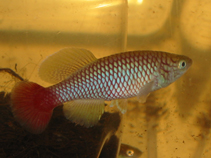
Espinas dorsales (total) : 0; Radios blandos dorsales (total) : 14 - 17; Espinas anales: 0; Radios blandos anales: 13 - 19. Diagnosis: Nothobranchius makondorum males are distinguished from those of the related N. melanospilus and N. lucius by a complete black margin around the red caudal fin vs. plain red caudal fin with a narrow black margin at the upper and lower corners in N. melanospilus, red-brown and orange-red with broad black margin in N. lucius, and light blue iris vs. silver in N. melanospilus; females are distinguished from those of N. melanospilus and N. lucius by grey spots on the sides vs. black in N. melanospilus, brown in N. lucius, and absence of spots on the head and unpaired fins vs. spotted unpaired fins in N. melanospilus and spotted head and unpaired fins in N. lucius (Ref. 83514).
Body shape (shape guide): fusiform / normal.
Annual species; found in water-filled depressions on the floodplain of rivers and creeks or remnant pools of seasonal creeks; water in all pools turbid; during dry season, pools mostly dry up; usually no aquatic vegetation, but grasses may be present only at the margins of the water bodies; if aquatic vegetation is present, it may include Nymphea, Ottelia, Lagarosiphon, and Utricularia species; no associated fish species were observed (Ref. 83514).
Life cycle and mating behavior
Madurez | Reproducción | Puesta | Huevos | Fecundidad | Larva
Wildekamp, R.H., K.M. Shidlovskiy and B.R. Watters, 2009. Systematics of Nothobranchius melanospilus species group (Cyprinodontiforme: Nothobranchidae) with description of two new species from Tanzania and Mozambique. Ichthyol. Explor. Freshwat. 20(3):237-254. (Ref. 83514)
IUCN Red List Status (Ref. 130435: Version 2025-1)
Threat to humans
Harmless
Human uses
Herramientas
Special reports
Download XML
Fuentes de Internet
Estimates based on models
Phylogenetic diversity index (Referencia
82804): PD
50 = 0.5000 [Uniqueness, from 0.5 = low to 2.0 = high].
Bayesian length-weight: a=0.01122 (0.00472 - 0.02669), b=2.94 (2.74 - 3.14), in cm total length, based on LWR estimates for this (Sub)family-body shape (Ref.
93245).
Nivel trófico (Referencia
69278): 3.3 ±0.4 se; based on size and trophs of closest relatives
Fishing Vulnerability (Ref.
59153): Low vulnerability (10 of 100).
🛈