>
Gobiiformes (Gobies) >
Gobiidae (Gobies) > Gobiinae
Etymology: Eviota: No etymology given, suggested by Christopher Scharpt: from Latin 'eu' for 'true' and 'iota' for anything very small, in combination 'truly very small' referring to it as being the smallest vertebrate at the time it has benn described by Jenkins (thus, making the suggestion by Scharpt plausible; rubrisparsa: Name from Latin 'rubrum' for red and 'sparsus' or sprinkled, referring to the live color pattern of red dots.
More on authors: Greenfield & Randall.
Environment: milieu / climate zone / djupintervall / distribution range
Ekologi
marina revassocierade; djupintervall 20 - 28 m (Ref. 83982). Tropical
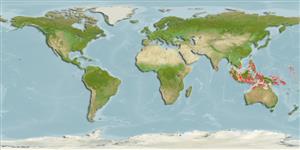
Indo-West Pacific: Christmas Island (Indian Ocean), Indonesia (Flores, Alor, West Papua), Papua New Guinea (D'Entrecasteaux Islands and New Britain), Solomon Islands.
Size / Vikt / Age
Könsmognad: Lm ? range ? - ? cm
Max length : 2.0 cm SL hane/ej könsbestämd; (Ref. 83982)
Short description
Bestämningsnycklar | Morfologi | Morfometri
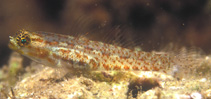
Taggstrålar i ryggfenan (totalt) : 7; Mjukstrålar i ryggfenan (totalt) : 9; Taggstrålar i analfenan: 1; Mjukstrålar i analfenan: 8. This species is distinguished from its congeners by the following set of characters: dorsal/anal fin-ray formula 9/8; pectoral fin rays 16-19 (mean 18), 5-6 lower rays branched; cephalic sensory-pore system pattern I (complete); fifth segmented pelvic-fin ray 11.5-22% of fourth; branches on fourth pelvic-fin ray 5-7, 3 segments between branches; non-fimbriate genital papilla; dorsal fin filamentous (to 36.9% SL); body with no distinct large dark marks; anal fin and lower half of caudal fin dark; scattered melanophores behind eyes on nape; when alive, small red dots cover the body but these disappear when preserved in ethyl alcohol (Ref. 83982); characterized further by longitudinal scale series 25; ctenoid scales, none on head, nape, breast and pectoral fin base; depth of body 4.7-5.6 in SL (Ref. 90102).
Body shape (shape guide): elongated; Cross section: oval.
Inhabits sand-rubble bottoms among reefs in 4-15 m (Ref 90102).
Life cycle and mating behavior
Könsmognad | Reproduktion | Lek | Ägg | Fecundity | Larver
Greenfield, D.W. and J.E. Randall, 2010. Four new gobiid fishes of the genus Eviota from the Western Pacific, with clarification of Evoita guttata and Evoita albolineata (Teleostei: Goblidae). Proc. Calif Acad. Sci. 61(3):269-289. (Ref. 83982)
IUCN Red List Status (Ref. 130435: Version 2025-1)
Threat to humans
Harmless
Human uses
Verktyg
Special reports
Download XML
Internet-källor
Estimates based on models
Preferred temperature (Ref.
123201): 27.2 - 28.3, mean 28 °C (based on 7 cells).
Phylogenetic diversity index (Ref.
82804): PD
50 = 0.5000 [Uniqueness, from 0.5 = low to 2.0 = high].
Bayesian length-weight: a=0.00692 (0.00284 - 0.01683), b=3.10 (2.92 - 3.28), in cm total length, based on LWR estimates for this Genus-body shape (Ref.
93245).
Trofisk nivå (Ref.
69278): 3.0 ±0.3 se; based on size and trophs of closest relatives
Fishing Vulnerability (Ref.
59153): Low vulnerability (10 of 100).
🛈