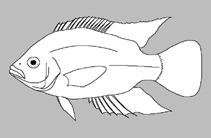
वर्गीकरण / नाम
आम नाम | उपशब्द | Catalog of Fishes(वर्ग, प्रजाति) | ITIS | CoL | WoRMS | Cloffa
>
Cichliformes (Cichlids, convict blennies) >
Cichlidae (Cichlids) > Cichlinae
Etymology: Australoheros: From the Latin word 'australis' meaning southern, and the name Heros, after the nominotypic genus of the Heroini tribe.
Tribe; capixaba: From the Brazilian idiomatic expression capixaba, meaning people who were born in the Estado de Espírito Santo (Ref. 84134).
पर्यावरण: पर्यावरण / जलवायु क्षेत्र / गहराई सीमा / वितरण सीमा
पारिस्थितिकी
; स्वच्छ जल, अलवण जल बेनथोपिलाजिक. Tropical; 18°S - 19°S, 40°W - 41°W
South America: Brazil. Rio São Mateus basin, rio Itaúnas basin, rio Barra Seca basin and lower rio Doce basin, all in south-eastern Brazil (Ref. 84134).
आकार / वज़न / आयु
परिपक्व अवधि: Lm ? range ? - ? cm
Max length : 5.7 cm SL पुल्लिंग / अलिंग; (Ref. 84134)
संक्षिप्त वर्णन
पहचान कुंजी | आकृति विज्ञान | मौरफोमैटरिक्स
पृष्ठीय रीढ़ (सम्पूर्ण) : 15 - 16; पृष्ठीय सौफट रेज़ (सम्पूर्ण) : 10 - 11; गुदा कांटा: 6 - 7; ऐनल सौफट रेज़: 8; जानवरों की रीड़ का जोड़: 26. Australoheros capixaba is distinguished from A. facetus, A. kaaygua, A. tembe, A. forquilha, A. guarani, A. minuano, A. scitulus, A. charrua and A. taura by having fewer caudal vertebrae (12 in A. capixaba vs. 13 – 15 in the other species). Australoheros capixaba differs from A. saquarema, A. muriae, A. robustus, A. barbosae, A. macacuensis, A. ipatinguensis, A. paraibae and A. ribeirae by having a longer caudal peduncle (9.6 – 11.4 % SL in A. capixaba vs. 5.1 – 9.2 % SL in the other species); from A. autrani, A. barbosae, A. ipatinguensis, A. muriae and A. saquarema by having fewer anal-fin rays (8 in A. capixaba vs. 9 – 10 in the other species); from A. macacuensis, A. macaensis, A. ribeirae and A. saquarema by having large red spots on the dorsal portion of the trunk (vs. absence); from A. autrani, A. macacuensis, A. macaensis and A. saquarema by having a reddish chest (vs. chest not reddish, i.e. a coloration similar to the entire trunk); from A. macaensis and A. saquarema by not having a detached snout, with a depression on the snout (vs. detached snout, with depression on head in specimens above 30.0 mm SL); from A. robustus by fewer dorsal-fin spines (15 – 16 vs. 17) and more dorsal-fin rays (10 – 11 vs. 8 – 9); from A. macacuensis by having both arms of trunk bar 7 with the same width (vs. postero-dorsal arm of trunk bar 7 wider than anterior one) and pelvic fins with green and yellow iridescence (vs. black or dark brown); and from A. paraibae by having a longer last anal-fin spine (last anal-fin spine length 14.0 – 17.2 % SL vs. 12.2 – 13.3 % SL) (Ref. 84134).
जीवन चक्र और संभोग व्यवहार
परिपक्व अवधि | पुनरुत्पत्ति | मछलीऔ का अंडे देना | अंडे | उपजाऊपन | लार्वा
Ottoni, F.P., 2010. Australoheros capixaba, a new species of Australoheros from south-eastern Brazil (Labroidei: Cichlidae: Cichlasomatinae). Verteb. Zool. 60(1):19-25. (Ref. 84134)
आईयूसीएन रेड लिस्ट स्थिति (Ref. 130435: Version 2025-2)
मनुष्यों के लिए ख़तरा
Harmless
मानव उपयोग
साधन
विशेष रिपोर्ट
XML डाउनलोड करें
इंटरनेट स्रोत
मॉडल पर आधारित अनुमान
जातिवृति विविधता सूचकांक (संदर्भ
82804): PD
50 = 0.5000 [Uniqueness, from 0.5 = low to 2.0 = high].
Bayesian length-weight: a=0.01380 (0.00659 - 0.02894), b=3.07 (2.89 - 3.25), in cm total length, based on LWR estimates for this (Sub)family-body shape (Ref.
93245).
ट्रॉफिक स्तर (संदर्भ
69278): 3.1 ±0.5 se; based on size and trophs of closest relatives
मछली पकड़ने की भेद्यता (Ref.
59153): Low vulnerability (10 of 100).
🛈