Classification / Names
Nombres comunes | Sinónimos | Catalog of Fishes(Género, Especie) | ITIS | CoL | WoRMS | Cloffa
Environment: milieu / climate zone / rango de profundidad / distribution range
Ecología
; agua dulce bentopelágico. Tropical; 26°N - 25°N, 96°E - 97°E
Asia: Myanmar. Known from Lake Indawgyi and an unnamed small hill stream south of Mogaung, Kachin State, northern Myanmar (Ref. 84451).
Tamaño / Peso / Age
Madurez: Lm ? range ? - ? cm
Max length : 21.6 cm SL macho / no sexado; (Ref. 84451)
Short description
Claves de identificación | Morfología | Morfometría
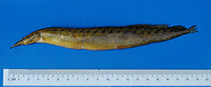
Espinas dorsales (total) : 21 - 22; Radios blandos dorsales (total) : 50 - 54; Espinas anales: 3; Radios blandos anales: 50 - 51; Vértebra: 74 - 75. Macrognathus aureus is a member of the M. aculeatus species group. It differs from all other members of this species group by the following combination of characters: rostral tooth plates 8–10, dorsal-fin spines 21–22, and a unique colour pattern consisting of a series of large white rimmed dark-brown to black blotches along the dorsal fin and even larger black blotches along the lateral line, of which some are confluent with the dorsal series. In particular it differs from M. aral, M. lineatomaculatus, M. pentophthalmos, M. siamensis, M. tapirus, and M. aculeatus in having fewer rostral toothplates (8–10 vs 11–55), from M. pavo, M. morehensis, M siamensis, M. meklongensis, and M. pentophthalmos in having a greater number of dorsal-fin spines (21–22 vs 4–18). The only species of the M. aculeatus group with a similar range in the number of rostral tooth-plates and dorsal-fin spines is M. obscurus, from which the new species differs in its colour pattern (large white rimmed dark brown to black blotches along the dorsal fin and the lateral line, of which some are confluent with the dorsal series, vs minute or absent dorsal fin spots and absence of lateral line blotches) (Ref. 84451).
Body shape (shape guide): eel-like; Cross section: oval.
Life cycle and mating behavior
Madurez | Reproducción | Puesta | Huevos | Fecundidad | Larva
Britz, R., 2010. Macrognathus aureus, a new spiny eel of the M. aculeatus species group from the Upper Ayeyarwaddy River Drainage, Myanmar (Teleostei: Synbranchiformes: Mastacembelidae). Zootaxa 2514:55-60. (Ref. 84451)
IUCN Red List Status (Ref. 130435: Version 2025-1)
Threat to humans
Harmless
Human uses
Herramientas
Special reports
Download XML
Fuentes de Internet
Estimates based on models
Phylogenetic diversity index (Referencia
82804): PD
50 = 0.5000 [Uniqueness, from 0.5 = low to 2.0 = high].
Bayesian length-weight: a=0.00295 (0.00138 - 0.00633), b=2.94 (2.76 - 3.12), in cm total length, based on LWR estimates for this Genus-body shape (Ref.
93245).
Nivel trófico (Referencia
69278): 3.3 ±0.4 se; based on size and trophs of closest relatives
Resiliencia (Referencia
120179): Alto, población duplicada en un tiempo mínimo inferior a 15 meses (Preliminary K or Fecundity.).
Fishing Vulnerability (Ref.
59153): Low vulnerability (16 of 100).
🛈