


Nothobranchius krysanovi Shidlovskiy, Watters & Wildekamp, 2010
分类 / 名称 俗名 | 同种异名 | Catalog of Fishes(属, 种) | ITIS | CoL | WoRMS | Cloffa
Teleostei > Cyprinodontiformes (Rivulines, killifishes and live bearers) > Nothobranchiidae (African rivulines)
Etymology: Nothobranchius: Greek, nothos = false + Greek, brangchia = gill (Ref. 45335); krysanovi: The species is named in honour of Prof. Eugeny Y. Krysanov, a scientist at the Russian Academy of Sciences, who carried out cytological studies on Nothobranchius species, as well as the effects of radiation on their chromosomes in the Chernobyl area; the species name is pronounced 'kree-sa-nofi' (Ref. 85866).
Eponymy: Eugeny Y Krysanov is a scientist at the Severtsov Institute of Ecology and Evolution, Russian Academy of Sciences. [...] (Ref. 128868), visit book page.
Etymology: Nothobranchius: Greek, nothos = false + Greek, brangchia = gill (Ref. 45335); krysanovi: The species is named in honour of Prof. Eugeny Y. Krysanov, a scientist at the Russian Academy of Sciences, who carried out cytological studies on Nothobranchius species, as well as the effects of radiation on their chromosomes in the Chernobyl area; the species name is pronounced 'kree-sa-nofi' (Ref. 85866).
Eponymy: Eugeny Y Krysanov is a scientist at the Severtsov Institute of Ecology and Evolution, Russian Academy of Sciences. [...] (Ref. 128868), visit book page.
环境:氛围 / 气候带 / 深度上下限 / 分布范围 生态学
; 淡水 底中水层性.
分布 领土 | FAO区域 | 生态系 | 标本纪录 | 分布图 | 简介 | Faunafri
Africa: ephemeral pools and swamps on floodplains in coastal lowlands north of the lower Zambezi River in east-central Mozambique (Ref. 85866).
大小 / 重量 / 年龄
简单描述 检索表 | 型态特徵 | 形态测量图
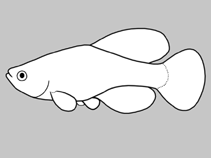
背棘 (总数) : 0; 背的软条 (总数) : 15 - 17; 臀棘: 0; 臀鳍软条: 15 - 17. Diagnosis: Nothobranchius krysanovi is distinguished from other species of the genus Nothobranchius by the following combination of characters: males with bright colouration consisting of alternating light blue and orange-red oblique bars on body, dorsal and anal fins, and orange-brown caudal fin with orange subterminal and black terminal band; female with faint brown oblique bars on posterior part of flanks (Ref. 85866). It can be distinguished from the other species of the subgenus Nothobranchius as follows: from N. furzeri by male colouration, higher number of dorsal fin rays, 15-17 vs. 14-15; from N. kadleci by male colouration and shape of the frontal region, higher number of dorsal and anal fin rays, 15-17 vs. 13-14 and 15-17 vs. 13-14; and from N. orthonotus by male and female colouration, and lower number of scales on the mid-longitudinal series, 27-29 vs. 28-33 (Ref. 85866). Nothobranchius krysanovi can also be distinguished from N. rachovii by its higher number of diploid chromosomes, 2n=18 vs. 2n=16; and from N. pienaari by its much lower diploid chromosome number, 2n=18 vs. 2n=34 (Ref. 85866).
Body shape (shape guide): fusiform / normal.
Body shape (shape guide): fusiform / normal.
Found in ephemeral pools and swamps on floodplains; water level in the habitats is subject to seasonal changes and generally the water disappears completely during the dry season (Ref. 85866). Grass vegetation is usually found near the habitat margins; much of the swamps may be utilised by local inhabitants for the cultivation of rice; aquatic vegetation may comprise Nymphea, Ottelia, Lagarosiphon and Utricularia species (Ref. 85866). It has an annual mode of reproduction (Ref. 85866).
生命周期和交配行为 成熟度 | 繁殖 | 产卵场 | 卵 | 孕卵数 | 仔鱼
主要参考文献
上传您的参考资料 | 参考文献 | 合作者 | 合作者
Shidlovskiy, K.M., B.R. Watters and R.H. Wildekamp, 2010. Notes on the annual killifish species Nothobranchius rachovii (Cyprinodontiformes; Nothobranchiidae) with the description of two new species. Zootaxa 2724:37-57. (Ref. 85866)
世界自然保护联盟红皮书 (Ref. 130435: Version 2025-2 (Global))
易受伤害 (VU) (B1ab(iii)); Date assessed: 23 December 2018
CITES
Not Evaluated
对人类的威胁
人类利用
FAO - Publication: search | FishSource |
更多信息
解剖学
鳃区
大脑
耳石
鳃区
大脑
耳石
生理学
身体成分
营养素
耗氧量
游泳类型
游泳速度
视觉色素
鱼声
疾病与寄生虫
毒性(半数致死浓度)
身体成分
营养素
耗氧量
游泳类型
游泳速度
视觉色素
鱼声
疾病与寄生虫
毒性(半数致死浓度)
遗传学
基因组
遗传学
异质性
遗传率
基因多样性
基因组
遗传学
异质性
遗传率
基因多样性
工具
特别资料
下载 XML
网络资源
AFORO (otoliths) | Aquatic Commons | BHL | Cloffa | Websites from users | 核实 FishWatcher | CISTI | Catalog of Fishes: 属, 种 | DiscoverLife | ECOTOX | FAO - Publication: search | Faunafri | Fishipedia | Fishtrace | GloBI | Google Books | Google Scholar | Google | IGFA World Record | OneZoom | Open Tree of Life | Otolith Atlas of Taiwan Fishes | PubMed | Reef Life Survey | Socotra Atlas | TreeBase | 树状分类阶层 | Wikipedia: 转至, 搜寻 | World Records Freshwater Fishing | Zoobank | 动物学的记录
基于模型的估算
系统发育多样性指数 (参考文献 82804): PD50 = 0.5000 [Uniqueness, from 0.5 = low to 2.0 = high].
Bayesian length-weight: a=0.01096 (0.00461 - 0.02608), b=2.94 (2.74 - 3.14), in cm total length, based on LWR estimates for this (Sub)family-body shape (Ref. 93245).
营养阶层 (参考文献 69278): 3.1 ±0.4 se; based on size and trophs of closest relatives