


Nothobranchius pienaari Shidlovskiy, Watters & Wildekamp, 2010
Carica il tuo foto e Video
Google image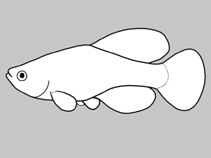 No image available for this species;
drawing shows typical species in Nothobranchiidae.
Google image
drawing shows typical species in Nothobranchiidae.
Classificazione / Nomi Nomi Comuni | Sinonimi | Catalog of Fishes(Genere, Specie) | ITIS | CoL | WoRMS | Cloffa
> Cyprinodontiformes (Rivulines, killifishes and live bearers) > Nothobranchiidae (African rivulines)
Etymology: Nothobranchius: Greek, nothos = false + Greek, brangchia = gill (Ref. 45335); pienaari: Named after Dr. U. de V. Pienaar, retired biologist of the Kruger National Park, Republic of South Africa, and discoverer of Nothobranchius species, in honour of his efforts to protect and conserve these populations; the species name is pronounced 'pea-nahri' (Ref. 85866).
Eponymy: Dr Uys de Villiers ‘Tol’ Pienaar (1930–2011) was a South African biologist and game warden, whose doctorate was awarded by Wits Medical School (1953). [...] (Ref. 128868), visit book page.
Etymology: Nothobranchius: Greek, nothos = false + Greek, brangchia = gill (Ref. 45335); pienaari: Named after Dr. U. de V. Pienaar, retired biologist of the Kruger National Park, Republic of South Africa, and discoverer of Nothobranchius species, in honour of his efforts to protect and conserve these populations; the species name is pronounced 'pea-nahri' (Ref. 85866).
Eponymy: Dr Uys de Villiers ‘Tol’ Pienaar (1930–2011) was a South African biologist and game warden, whose doctorate was awarded by Wits Medical School (1953). [...] (Ref. 128868), visit book page.
Ambiente: milieu / zona climatica / distribuzione batimetrica / gamma di distribuzione Ecologia
; acqua dolce benthopelagico. Tropical
Distribuzione Territories | Aree FAO | Ecosistemi | Presenze | Mappa dei ritrovamenti | Introduzioni | Faunafri
Africa: coastal lowlands of central and southern Mozambique and northeastern South Africa (Ref. 85866).
Dimensione / Peso / Età
Maturità: Lm ? range ? - ? cm
Max length : 3.9 cm SL maschio/sesso non determinato; (Ref. 85866); 3.6 cm SL (female)
Max length : 3.9 cm SL maschio/sesso non determinato; (Ref. 85866); 3.6 cm SL (female)
Breve descrizione Chiavi di identificazione | Morfologia | Morfometria
Spine dorsali (totale) : 0; Raggi dorsali molli (totale) : 14 - 16; Spine anali: 0; Raggi anali molli: 15 - 17. Diagnosis: Morphology similar to Nothobranchius rachovii and N. krysanovi but distinguished from those by a slightly deeper body in males (Ref. 85866). Nothobranchius pienaari is distinguished from other species of the genus by the following combination og characters: male with colouration consisting of alternating blue-green to grey-green and dark red-brown to almost black scale margins and oblique bars on body and dorsal and anal fins, dark brown spotted basal half of caudal fin, and orange subterminal and black terminal band (Ref. 85866). It can be distinguished from the other species of the subgenus Nothobranchius as follows: from N. furzeri by male colouration and a slightly higher number of dorsal fin rays, 14-16 vs. 14-15; from N. orthonotus by male colouration, lower number of scales on the mid-longitudinal series, 26-31 vs. 28-33; and from N. kadleci by male colouration and shape of the frontal region, higher number of dorsal and anal fin rays, 14-16 vs. 13-14 and 15-17 vs. 13-14 (Ref. 85866). Female distinguished by faint brown oblique bars on posterior part of flanks (Ref. 85866). Nothobranchius pienaari can also be distinguished from N. rachovii and N. krysanovi by a much higher number of diploid chromosomes, 2n=34 vs. 2n=16 for N. rachovii and 2n=18 for N. krysanovi; it can also be distinguished from the karyotypes of N. furzeri and N. orthonotus that both have with 2n=38 a higher number of chromosomes (Ref. 85866).
Body shape (shape guide): fusiform / normal.
Body shape (shape guide): fusiform / normal.
Found in temporary pools and swamps in the floodplains of several rivers flowing into the Indian Ocean south of the lower Zambezi River; usually found in water-filled depressions in the floodplains of rivers and bordering swamps; water depth is variable with the progress of the season (Ref. 85866). Aquatic vegetation may consist of Nymphea, Ottelia, Lagarosiphon and Utricularia species (Ref. 85866).
Ciclo vitale e comportamento di accoppiamento Maturità | Riproduzione | Deposizione | Uova | Fecondità | Larve
Riferimento principale
Caricare le referenze | Bibliografia | Coordinatore | Collaboratori
Shidlovskiy, K.M., B.R. Watters and R.H. Wildekamp, 2010. Notes on the annual killifish species Nothobranchius rachovii (Cyprinodontiformes; Nothobranchiidae) with the description of two new species. Zootaxa 2724:37-57. (Ref. 85866)
Stato della Lista Rossa IUCN (Ref. 130435: Version 2025-2 (Global))
Least Concern (LC) ; Date assessed: 08 January 2019
CITES
Not Evaluated
Minaccia per l'uomo
Harmless
Usi umani
FAO - Publication: search | FishSource |
Informazioni ulteriori
Ecologia trofica
Articoli alimentari (prede)
Alimentazione
Consumo di cibo
Razioni alimentari
Predatori
Articoli alimentari (prede)
Alimentazione
Consumo di cibo
Razioni alimentari
Predatori
Dinamica della popolazione
Parametri di crescita
Età massima / dimensioni massime
Rapporto lunghezza-peso.
Lunghezza-lunghezza rel.
Lunghezza-frequenze
Conversione di massa
Reclutamento
Abbondanza
Parametri di crescita
Età massima / dimensioni massime
Rapporto lunghezza-peso.
Lunghezza-lunghezza rel.
Lunghezza-frequenze
Conversione di massa
Reclutamento
Abbondanza
Ciclo di vita
Riproduzione
Maturità
Maturità/Gli occhielli sono relativi.
Fecondità
Deposizione
Aggregazioni riproduttive
Uova
Sviluppo delle uova
Larve
Dinamica popolazioni larvali
Riproduzione
Maturità
Maturità/Gli occhielli sono relativi.
Fecondità
Deposizione
Aggregazioni riproduttive
Uova
Sviluppo delle uova
Larve
Dinamica popolazioni larvali
Anatomia
Area branchiale
Cervello
Otolite
Area branchiale
Cervello
Otolite
Fisiologia
Composizione corporea
Nutrienti
Consumo di ossigeno
Tipo di nuoto
Velocità di nuoto
Pigmenti visivi
Suono del pesce
Malattie e parassiti
Tossicità (LC50)
Composizione corporea
Nutrienti
Consumo di ossigeno
Tipo di nuoto
Velocità di nuoto
Pigmenti visivi
Suono del pesce
Malattie e parassiti
Tossicità (LC50)
Genetica
Genome
Genetica
Eterozigosi
Ereditarietà
Diversità genetica
Genome
Genetica
Eterozigosi
Ereditarietà
Diversità genetica
Legato all'uomo
Sistemi di acquacoltura
Profili di acquacoltura
Varietà
Casi di Ciguatera
Francobolli, monete, materiale vario.
Sistemi di acquacoltura
Profili di acquacoltura
Varietà
Casi di Ciguatera
Francobolli, monete, materiale vario.
Strumenti
Libro elettronico | Giuda pratica | Generatore frequenze di lunghezza | Strumento Parametri Biologici | Mappa dei ritrovamenti |
Cattura-MSY |
Rapporti speciali
Controllo della manutenzione dell'acquario | Verificare la presenza di schede informative sulle specie | Verifica delle schede informative sull'acquacoltura
Scarica XML
Fonti Internet
AFORO (otoliths) | Aquatic Commons | BHL | Cloffa | Websites from users | Check FishWatcher | CISTI | Catalog of Fishes: Genere, Specie | DiscoverLife | ECOTOX | FAO - Publication: search | Faunafri | Fishipedia | Fishtrace | GloBI | Google Books | Google Scholar | Google | IGFA World Record | OneZoom | Open Tree of Life | Otolith Atlas of Taiwan Fishes | PubMed | Reef Life Survey | Socotra Atlas | TreeBase | Tree of Life | Wikipedia: Go, ricerca | World Records Freshwater Fishing | Zoobank | Record zoologico
Stime basate su modelli
Indice di diversità filogenetica (Fonte Biblio. 82804): PD50 = 0.5000 [Uniqueness, from 0.5 = low to 2.0 = high].
Bayesian length-weight: a=0.00603 (0.00250 - 0.01453), b=3.13 (2.93 - 3.33), in cm total length, based on LWR estimates for this (Sub)family-body shape (Ref. 93245).
Livello trofico (Fonte Biblio. 69278): 3.2 ±0.4 se; based on size and trophs of closest relatives