


Rhamdiopsis krugi Bockmann & Castro, 2010
分类 / 名称 俗名 | 同种异名 | Catalog of Fishes(属, 种) | ITIS | CoL | WoRMS | Cloffa
Teleostei > Siluriformes (Catfishes) > Heptapteridae (Three-barbeled catfishes)
Etymology: Rhamdiopsis: Brazilian vernacular name, Nhamdia/Jamdia (Ref. 45335); krugi: Named for Luiz Krug, professional tourist guide based in the city of Lençóis, in the Chapada Diamantina area, who called our attention of the existence of this new catfish and helped to collect its type series, and for his efforts dedicated to its conservation.
Eponymy: Luiz Krug is an extremely knowledgeable, independent tour guide based in Lençóis, Bahia, Brazil. [...] (Ref. 128868), visit book page.
Etymology: Rhamdiopsis: Brazilian vernacular name, Nhamdia/Jamdia (Ref. 45335); krugi: Named for Luiz Krug, professional tourist guide based in the city of Lençóis, in the Chapada Diamantina area, who called our attention of the existence of this new catfish and helped to collect its type series, and for his efforts dedicated to its conservation.
Eponymy: Luiz Krug is an extremely knowledgeable, independent tour guide based in Lençóis, Bahia, Brazil. [...] (Ref. 128868), visit book page.
环境:氛围 / 气候带 / 深度上下限 / 分布范围 生态学
; 淡水 居于水底的.
分布 领土 | FAO区域 | 生态系 | 标本纪录 | 分布图 | 简介 | Faunafri
South America: lake inside the Poço Encantado cave, and isolated pools inside the Lapa do Bode and Natal caves in Bahia, Brazil.
大小 / 重量 / 年龄
简单描述 检索表 | 型态特徵 | 形态测量图
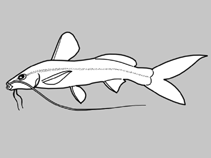
背的软条 (总数) : 7 - 8; 臀鳍软条: 13 - 17. Distinguished from its congeners, Rhamdiopsis microcephala and Rhamdiopsis moreirai by the possession of the following characters: ethmoid cartilage discontinuous; eyes absent and optic foramen atrophied; longer barbels, length of maxillary barbel 32.2-43.3% SL; supraorbital and infraorbital sensory canals not connected to each other anteriorly; presence of s7 branch and pore of the supraorbital laterosensory canal; no subpreopercle; anterior and posterior branches of the transverse process 4 co-ossified to each other; posterior limb of transverse process 4 undivided, with spatulated shape; posterolateral corner of posterior portion of the posterior branch of the transverse process of vertebra 4 extending approximately to midlength of the transverse process of vertebra 5; presence of a widely exposed pseudotympanum; dorsal fin larger, dorsal-fin base 11.2-14.1% SL and length of third dorsal-fin ray 14.4-18.7% SL; posterior lobe of the adipose fin straight; anal fin deep and rounded; shorter anal-fin base, supported typically by 14-15, less commonly 13 or 16-17 rays; hypural 5 usually co-ossified to hypural 4 at its distal portion; dorsal hypural plate typically with 7, rarely 6 or 8 rays; dorsal caudal-fin lobe typically with 6, rarely 4, 5 or 7 branched rays; ventral caudal plate typically with 6, rarely 7 rays; ventral
caudal-fin lobe typically with 6, rarely 4 or 5 branched rays; body relatively shorter, with 38-40 vertebrae; lateral line very short, with 5-15 pores, usually reaching from the vertical through posterior region of pseudotympanum to the vertical through dorsal-fin origin; fatty tissue
broadly spread through the body; adults of small body size, reaching 3.85 cm SL; body unpigmented; non-cryptobiotic behavior, expressed by marked midwater activity; non-photophobic behavior; poorly-developed circadian rhythms; and life in lentic habitat. Differs also from Rhamdiopsis microcephala by its epiphyseal branches of supraorbital laterosensory canals not fused to each other, each one bearing its own pore, the s6 pore, and basal third of the posterior border of the adipose fin connected with the dorsal fold of caudal fin, leaving a large, almost complete free posterior lobe (Ref. 86271).
Found in the upper phreatic zone of a large karstic area (over 300 km2) including limestones
and quartzites, which is connected to surface through caves. Inhabits lentic waters formed by the water table inside the caves, varying from large, partially illuminated lakes to isolated pools. Mainly solitary. Observed swimming up to about 35 m depth, but it usually aggregates between the surface and 10 m. Reported to show preference for substrate, concentrating in the rocky walls. Strictly a carnivorous species which feeds on invertebrates found near or on the bat guano (Ref. 86271).
生命周期和交配行为 成熟度 | 繁殖 | 产卵场 | 卵 | 孕卵数 | 仔鱼
主要参考文献
上传您的参考资料 | 参考文献 | 合作者 : Bockmann, Flavio | 合作者
Bockmann, F.A. and R.M.C. Castro, 2010. The blind catfish from the caves of Chapada Diamantina, Bahia, Brazil (Siluriformes: Heptapteridae): description, anatomy, phylogenetic relationships, natural history, and biogeography. Neotrop. Ichthyol. 8(4):673-706. (Ref. 86271)
世界自然保护联盟红皮书 (Ref. 130435: Version 2025-2 (Global))
易受伤害 (VU) (B1ab(iii)); Date assessed: 07 November 2018
CITES
Not Evaluated
对人类的威胁
人类利用
FAO - Publication: search | FishSource |
更多信息
营养生态学
食物(猎物)
食性组成
食物消耗量
口粮
捕食者
食物(猎物)
食性组成
食物消耗量
口粮
捕食者
生态学
生态学
生态学
人口动态
成长参数
最大年龄/尺寸
长度-重量关系
长短关系
体长-频率
质量转换
入添量
丰度
成长参数
最大年龄/尺寸
长度-重量关系
长短关系
体长-频率
质量转换
入添量
丰度
解剖学
鳃区
大脑
耳石
鳃区
大脑
耳石
生理学
身体成分
营养素
耗氧量
游泳类型
游泳速度
视觉色素
鱼声
疾病与寄生虫
毒性(半数致死浓度)
身体成分
营养素
耗氧量
游泳类型
游泳速度
视觉色素
鱼声
疾病与寄生虫
毒性(半数致死浓度)
遗传学
基因组
遗传学
异质性
遗传率
基因多样性
基因组
遗传学
异质性
遗传率
基因多样性
工具
特别资料
下载 XML
网络资源
AFORO (otoliths) | Aquatic Commons | BHL | Cloffa | Websites from users | 核实 FishWatcher | CISTI | Catalog of Fishes: 属, 种 | DiscoverLife | ECOTOX | FAO - Publication: search | Faunafri | Fishipedia | Fishtrace | GloBI | Google Books | Google Scholar | Google | IGFA World Record | OneZoom | Open Tree of Life | Otolith Atlas of Taiwan Fishes | PubMed | Reef Life Survey | Socotra Atlas | TreeBase | 树状分类阶层 | Wikipedia: 转至, 搜寻 | World Records Freshwater Fishing | Zoobank | 动物学的记录
基于模型的估算
系统发育多样性指数 (参考文献 82804): PD50 = 0.6250 [Uniqueness, from 0.5 = low to 2.0 = high].
Bayesian length-weight: a=0.00813 (0.00379 - 0.01743), b=2.97 (2.79 - 3.15), in cm total length, based on LWR estimates for this (Sub)family-body shape (Ref. 93245).
营养阶层 (参考文献 69278): 3.2 ±0.4 se; based on size and trophs of closest relatives