


Haplochromis antleter Mietes & Witte, 2010
Ladda upp din foton och Videor
Bilder | Google image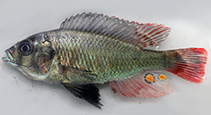 Haplochromis antleter
Bild av Moser, F. / eawag
Bilder | Google image
Bild av Moser, F. / eawag
Klassificering / Namn Populärnamn | synonymer | Catalog of Fishes(Släkte, Arter) | ITIS | CoL | WoRMS | Cloffa
> Cichliformes (Cichlids, convict blennies) > Cichlidae (Cichlids) > Pseudocrenilabrinae
Etymology: Haplochromis: Greek, Haploos = single + Greek, chromis = a fish, perhaps a perch (Ref. 45335); antleter: The name antleter comes from the Greek word for scooper, dredger; 'άντλητήρ', from the stem of the verb ‘άντλεϊν’ (‘to scoop’, ‘to dredge’) and the ending '-τήρ' that indicates the acting person; the name refers to the dredging of mud bottoms, the ‘core business’ of this species (Ref. 85523).
Etymology: Haplochromis: Greek, Haploos = single + Greek, chromis = a fish, perhaps a perch (Ref. 45335); antleter: The name antleter comes from the Greek word for scooper, dredger; 'άντλητήρ', from the stem of the verb ‘άντλεϊν’ (‘to scoop’, ‘to dredge’) and the ending '-τήρ' that indicates the acting person; the name refers to the dredging of mud bottoms, the ‘core business’ of this species (Ref. 85523).
Miljö: miljö / Klimatzon / djupintervall / distributionsområde Ekologi
; sötvatten bottenlevande; djupintervall 2 - 11 m (Ref. 85523). Tropical
Utbredning Territorier | FAO områden | Ekosystem | Förekomster | Prickkarta | Utplanteringar | Faunafri
Africa: Lake Victoria (Ref. 85523).
Storlek / Vikt / Ålder
Kort beskrivning Bestämningsnycklar | Morfologi | Morfometri
Ryggkotor: 28 - 30. Diagnosis: Haplochromis antleter belongs to an assemblage of small sized (less than 9 cm standard length), relatively deep-bodied (body depth larger than 35% of standard length) micrognathic species with a moderately curved to straight dorsal head profile; the fish in this group have relatively small, mainly bicuspid, teeth in the oral jaws (Ref. 85523). It can be distinguished from Haplochromis cinctus, Haplochromis paropius and Haplochromis katunzii by live colouration of sexually active males: Haplochromis antleter is dusky coloured with no or faint vertical bars and it is the only species of this assemblage that has no or a faint lachrymal stripe; H. paropius has a red dorsum and a greenish flank with faint vertical bars; in contrast to the other three species H. paropius often has a mid-lateral band; H. cinctus has a red dorsum, an orange to yellowish flank and dark vertical bars; H. katunzii is sandy-brown and has, compared to H. antleter, more distinctive vertical bars (Ref. 85523). Haplochromis antleter has a shallower cheek depth, 16.1-21.1% of head length, than H. katunzii and H. paropius, 18.6-24.6% of head length and 18.1-24.2% respectively; and the interorbital width is smaller, 19.1-24.9% of head length, than in the type-specimens of H. cinctus, 24.3-27.2% of head length (Ref. 85523). Compared to H. katunzii, H. antleter has a less pronounced mental prominence on the lower jaw (Ref. 85523).
Body shape (shape guide): fusiform / normal.
Body shape (shape guide): fusiform / normal.
A benthic species found in sub-littoral areas of the Mwanza Gulf mainly over mud bottoms; the depth range is 2-11 m (Ref. 85523). Before the ecological changes in Lake Victoria, this species fed mainly on detritus, but also included phytoplankton, mainly Aulacoseira, and occasionally insect larvae and zooplankton in its diet (Ref. 85523). Based on the egg dummies on the anal fin of males and the egg size in ripe females, it is a female mouth brooder (Ref. 85523).
Livscykel och parningsbeteende Könsmognad | Reproduktion | Lek | Ägg | Fekunditet | Larver
Based on the egg dummies on the anal fin of males and the egg size in ripe females, it is a female mouth brooder (Ref. 85523).
Huvudreferens
Ladda upp dina referenser | referenser | Koordinator : Kullander, Sven O. | Medarbetare
de Zeeuw, M.P., M. Mietes, P. Niemantsverdriet, S. ter Huurne and F. Witte, 2010. Seven new species of detritivorous and phytoplanktivorous haplochromines from Lake Victoria. Zool. Meded. Leiden 84:201-250. (Ref. 85523)
Status på IUCN:s rödlista (Ref. 130435: Version 2025-2 (Global))
Critically Endangered (CR) (C2a(ii)); Date assessed: 31 March 2010
CITES
Not Evaluated
Hot mot människor
Harmless
Mänskliga användningsområden
FAO - Publication: search | FishSource |
Ytterligare information
Populationsdynamik
Tillväxtparametrar
Max. åldrar / storlekar
Längd-vikt rel.
Längd-längd rel.
Längd-frekvenser
Massakonvertering
Rekrytering
Abundans
Tillväxtparametrar
Max. åldrar / storlekar
Längd-vikt rel.
Längd-längd rel.
Längd-frekvenser
Massakonvertering
Rekrytering
Abundans
Livscykel
Reproduktion
Könsmognad
Mognad/Gills rel.
Fekunditet
Lek
Lekande aggregat
Ägg
Utveckling av ägg
Larver
Larvdynamik
Reproduktion
Könsmognad
Mognad/Gills rel.
Fekunditet
Lek
Lekande aggregat
Ägg
Utveckling av ägg
Larver
Larvdynamik
Anatomi
Gälyta
Hjärna
Otolit
Gälyta
Hjärna
Otolit
Fysiologi
Kroppssammansättning
Näringsämnen
Syreförbrukning
Typ av simning
Simhastighet
Visuella pigment
Ljud från fisk
Sjukdomar & Parasiter
Toxicitet (LC50)
Kroppssammansättning
Näringsämnen
Syreförbrukning
Typ av simning
Simhastighet
Visuella pigment
Ljud från fisk
Sjukdomar & Parasiter
Toxicitet (LC50)
Genetik
Genom
Genetik
Heterozygositet
Ärftlighet
Genetisk mångfald
Genom
Genetik
Heterozygositet
Ärftlighet
Genetisk mångfald
Människorelaterad
Vattenbrukssystem
Vattenbruksprofiler
Avelslinjer
Ciguatera-fall
Frimärken, mynt, diverse.
Vattenbrukssystem
Vattenbruksprofiler
Avelslinjer
Ciguatera-fall
Frimärken, mynt, diverse.
Verktyg
Särskilda rapporter
Kontrollera för underhåll av akvarium | Kontrollera om det finns faktablad om arter | Kontrollera om det finns faktablad om vattenbruk
Ladda ner XML
Internet-källor
AFORO (otoliths) | Aquatic Commons | BHL | Cloffa | Websites from users | Check FishWatcher | CISTI | Catalog of Fishes: Släkte, Arter | DiscoverLife | ECOTOX | FAO - Publication: search | Faunafri | Fishipedia | Fishtrace | GloBI | Google Books | Google Scholar | Google | IGFA World Record | OneZoom | Open Tree of Life | Otolith Atlas of Taiwan Fishes | PubMed | Reef Life Survey | Socotra Atlas | TreeBase | Tree of Life | Wikipedia: Go, sök | World Records Freshwater Fishing | Zoobank | Zoologiskt register
Uppskattningar baserade på modeller
Index för fylogenetisk mångfald (Ref. 82804): PD50 = 0.5000 [Uniqueness, from 0.5 = low to 2.0 = high].
Bayesian length-weight: a=0.01445 (0.00671 - 0.03113), b=2.99 (2.82 - 3.16), in cm total length, based on LWR estimates for this (Sub)family-body shape (Ref. 93245).
Trofisk nivå (Ref. 69278): 3.3 ±0.4 se; based on size and trophs of closest relatives