Classification / Names
Nombres comunes | Sinónimos | Catalog of Fishes(Género, Especie) | ITIS | CoL | WoRMS | Cloffa
>
Cichliformes (Cichlids, convict blennies) >
Cichlidae (Cichlids) > Pseudocrenilabrinae
Etymology: Haplochromis: Greek, Haploos = single + Greek, chromis = a fish, perhaps a perch (Ref. 45335); pancitrinus: The nam pancitrinus ('παγκίτρινος') is composed of the Greek words for complete, whole; 'πάν' and 'κίτρινος' which means yellow; it refers to the live colouration of males (Ref. 85523).
Environment: milieu / climate zone / rango de profundidad / distribution range
Ecología
; agua dulce bentopelágico. Tropical
Africa: Lake Victoria (Ref. 85523).
Tamaño / Peso / Age
Madurez: Lm ? range ? - ? cm
Max length : 8.6 cm SL macho / no sexado; (Ref. 85523)
Short description
Claves de identificación | Morfología | Morfometría
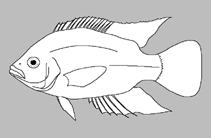
Vértebra: 29 - 32. Diagnosis: Haplochromis pancitrinus is a small sized (less than 9 cm standard length), relatively slender (body depth 29.0-33.5% of standard length), micrognathic species, with mainly bicuspid teeth in the oral jaws (Ref. 85523). Although there are many species that resemble Haplochromis pancitrinus, no other species are known with the typical golden-yellow colouration of sexually active males, without any distinct markings (Ref. 85523).
Body shape (shape guide): fusiform / normal.
Found in sub-littoral waters of the northern part of the Mwanza Gulf over mud bottoms; occasionally it was caught over mud bottoms, in shallower areas more southward in the Gulf (Ref. 85523). Before the ecological changes in Lake Victoria, this species fed on phytoplankton, mainly Cyanophyta; the diet further included Chaoborus larvae, copepods and occasionally detritus (Ref. 85523). Based on the egg dummies on the anal fin and the egg size in ripe females, this species is a female mouth brooder (Ref. 85523).
Life cycle and mating behavior
Madurez | Reproducción | Puesta | Huevos | Fecundidad | Larva
Based on the egg dummies on the anal fin and the egg size in ripe females, this species is a female mouth brooder (Ref. 85523).
de Zeeuw, M.P., M. Mietes, P. Niemantsverdriet, S. ter Huurne and F. Witte, 2010. Seven new species of detritivorous and phytoplanktivorous haplochromines from Lake Victoria. Zool. Meded. Leiden 84:201-250. (Ref. 85523)
IUCN Red List Status (Ref. 130435: Version 2025-1)
Threat to humans
Harmless
Human uses
Herramientas
Special reports
Download XML
Fuentes de Internet
Estimates based on models
Phylogenetic diversity index (Referencia
82804): PD
50 = 0.5000 [Uniqueness, from 0.5 = low to 2.0 = high].
Bayesian length-weight: a=0.01445 (0.00674 - 0.03099), b=2.99 (2.82 - 3.16), in cm total length, based on LWR estimates for this (Sub)family-body shape (Ref.
93245).
Nivel trófico (Referencia
69278): 3.3 ±0.4 se; based on size and trophs of closest relatives
Fishing Vulnerability (Ref.
59153): Low vulnerability (10 of 100).
🛈