Klassifizierung / Names
Namen | Synonyme | Catalog of Fishes(Gattung, Arten) | ITIS | CoL | WoRMS | Cloffa
>
Cichliformes (Cichlids, convict blennies) >
Cichlidae (Cichlids) > Pseudocrenilabrinae
Etymology: Danakilia: Ethiopia desert; for Thysvander Audenaerde (1968) it is a fish from northeast Africa; dinicolai: Named in memory of Ernesto Di Nicola, a member of the 2001 expedition to Lake Abaeded who died in a car accident while returning from the lake (Ref. 85754).
Eponymy: Ernesto Di Nicola (1969–2001) was an Italian musician and teacher. [...] (Ref. 128868), visit book page.
Environment: milieu / climate zone / Tiefenbereich / distribution range
Ökologie
; süßwasser benthopelagisch. Tropical
Africa: Lake Abaeded, Danakil Depression, in Eritrea (Ref. 85754).
Size / Gewicht / Alter
Geschlechtsreife: Lm ? range ? - ? cm
Max length : 9.6 cm SL Männchen/unbestimmt; (Ref. 85754)
Kurzbeschreibung
Bestimmungsschlüssel | Morphologie | Morphometrie
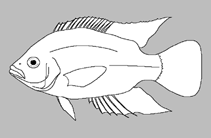
Rückenflossenstacheln (insgesamt) : 13 - 14; Rückenflossenweichstrahlen (insgesamt) : 9 - 11; Afterflossenstacheln: 3; Afterflossenweichstrahlen: 7 - 8; Wirbelzahl: 25 - 26. Diagnosis: Danakilia dinicolai differs from its congener, D. franchettii, in the possession of longer pectoral fins, 31.1-38.7% of standard length vs. 21.7-30.6%; outer row teeth in both oral jaws composed of stout tricuspids, considerably more robust and fewer in number than those of D. franchettii; lower pharyngeal bone relatively massive, longer than wide, length 30-32% of head length, vs. small, only slightly longer than wide, length 25-27% of head length in D. franchettii, with 40-48 teeth in posterior row, vs. 26-36 in D. franchettii (Ref. 85754).
Body shape (shape guide): fusiform / normal.
Found in Lake Abaeded, a small oval depression in a volcanic crater; lake surface is about 30 m below sea level; sand from dunes along the eastern and southern rim is frequently blown into the lake; the lake is fed by many hot springs at surface level and underwater (Ref. 85754). The lakeshore is almost completely encircled by reeds, Phragmites australis, and stands of tamarisk, Tamarix aphylla, but is free of vegetation in the proximity of hot springs (Ref. 85754). Diet primarily consisting of algae grazed from the surface of plants and rocks; however, it is likely that this species is an opportunistic feeder, as individuals were caught on lines baited with grasshoppers (Ref. 85754). Large males guard pits over sand (Ref. 85754).
Life cycle and mating behavior
Geschlechtsreife | Fortpflanzung | Ablaichen | Eier | Fecundity | Larven
Stiassny, M.L.J., G. De Marchi and A. Lamboj, 2010. A new species of Danakilia (Teleostei, Cichlidae) from Lake Abaeded in the Danakil Depression of Eritrea (East Africa). Zootaxa 2690:43-52. (Ref. 85754)
IUCN Rote Liste Status (Ref. 130435: Version 2025-1)
Bedrohung für Menschen
Harmless
Nutzung durch Menschen
Tools
Zusatzinformationen
Download XML
Internet Quellen
Estimates based on models
Phylogenetic diversity index (Ref.
82804): PD
50 = 0.7500 [Uniqueness, from 0.5 = low to 2.0 = high].
Bayesian length-weight: a=0.01862 (0.00830 - 0.04177), b=3.01 (2.82 - 3.20), in cm total length, based on LWR estimates for this (Sub)family-body shape (Ref.
93245).
Trophic level (Ref.
69278): 3.3 ±0.4 se; based on size and trophs of closest relatives
Widerstandsfähigkeit (Ref.
120179): hoch, Verdopplung der Population dauert weniger als 15 Monate. (Preliminary K or Fecundity.).
Fishing Vulnerability (Ref.
59153): Low vulnerability (10 of 100).
🛈