Environment: milieu / climate zone / kisaran kedalaman / distribution range
Ekologi
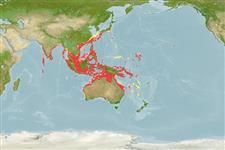
laut berasosiasi dengan karang; kisaran kedalaman 1 - 100 m, usually 5 - 50 m (Ref. 37816). Tropical; 35°N - 32°S, 72°E - 171°E
Indo-West Pacific: Maldives and India to Papua New Guinea, north to southern Japan, south to Lord Howe Island (Ref. 9710).
Length at first maturity / Size / Weight / umur
Kematangan: Lm ?, range 16 - ? cm
Max length : 25.0 cm TL jantan/; (Ref. 2272)
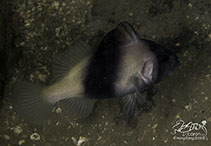
Duri punggung (Keseluruhan (total)) : 8; duri punggung lunak (Keseluruhan (total)) : 13 - 16; Duri dubur: 2; Sirip dubur lunak: 12 - 13. Body compressed, its width 3.3-4 in depth (Ref. 37816). Normally yellow, but sometimes nearly all black and juveniles take-on colors of the local venomous Meiacanthus blennies that are yellow or grey (Ref. 48635).
Body shape (shape guide): short and / or deep; Cross section: compressed.
Found mainly in coastal habitats in semi-silty conditions (Ref. 48635); also found near caves and crevices in rocky and coral reefs from a few meters to at least 100 m. A predator that feeds on surprisingly large prey, swallowed whole through its expandable jaws (Ref. 48635). Feeds mainly on fishes. Secretes the skin toxin grammistin under stress (Ref. 2334).
Life cycle and mating behavior
Kematangan | Reproduksi, perkembang biakan | Pemijahan | telur-telur | Fecundity | Larva
Paxton, J.R., D.F. Hoese, G.R. Allen and J.E. Hanley, 1989. Pisces. Petromyzontidae to Carangidae. Zoological Catalogue of Australia, Vol. 7. Australian Government Publishing Service, Canberra, 665 p. (Ref. 7300)
Status IUCN Red List (Ref. 130435: Version 2025-1)
ancaman kepada manusia
Venomous
penggunaan manusia
Perikanan: komersial; Akuarium: Komersial
Alat, peralatan
laporan khas
muat turun XML
Sumber internet
Estimates based on models
Preferred temperature (Acuan
123201): 24.6 - 29, mean 28 °C (based on 1680 cells).
Phylogenetic diversity index (Acuan
82804): PD
50 = 0.7500 [Uniqueness, from 0.5 = low to 2.0 = high].
Bayesian length-weight: a=0.01778 (0.00680 - 0.04650), b=3.04 (2.81 - 3.27), in cm total length, based on LWR estimates for this (Sub)family-body shape (Ref.
93245).
Trophic level (Acuan
69278): 4.0 ±0.65 se; based on food items.
Fishing Vulnerability (Ref.
59153): Low vulnerability (15 of 100).
🛈
Nutrients (Ref.
124155): Calcium = 47.4 [26.7, 100.6] mg/100g; Iron = 0.534 [0.290, 1.008] mg/100g; Protein = 18.1 [16.2, 19.9] %; Omega3 = 0.138 [0.082, 0.225] g/100g; Selenium = 33.9 [19.2, 65.9] μg/100g; VitaminA = 80 [21, 353] μg/100g; Zinc = 0.995 [0.649, 1.511] mg/100g (wet weight);