>
Perciformes/Uranoscopoidei (Sand dwellers) >
Pinguipedidae (Sandperches)
Etymology: Parapercis: Greek, para = the side of + Greek, perke = perch (Ref. 45335); lutevittata: Lute for yellow and vitta for stripe from Latin, in reference to the longitudinal yellow stripe extending from the pectoral fin base to the caudal fin base on the body of this species.
Environment: milieu / climate zone / rango de profundidad / distribution range
Ecología
marino demersal; rango de profundidad 50 - 100 m (Ref. 86871). Subtropical; 34°N - 33°N, 133°E - 134°E
Distribución
Países | Áreas FAO | Ecosistemas | Ocurrencias, apariciones | Mapa de puntos | Introducciones | Faunafri
Pacific Ocean: Taiwan, Japan. Known from Tosa Bay, southern Japan, and northern and southern Taiwan. It could be also distributed to Vietnam (Prokofiev, 2008)(Ref. 86871).
Tamaño / Peso / Age
Madurez: Lm ? range ? - ? cm
Max length : 15.0 cm SL macho / no sexado; (Ref. 86871)
Short description
Claves de identificación | Morfología | Morfometría
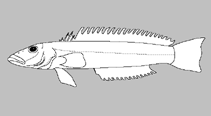
Espinas dorsales (total) : 4 - 6; Radios blandos dorsales (total) : 23 - 24; Espinas anales: 1; Radios blandos anales: 19 - 21. Greatest body depth 4.6–5.9 in SL; head length 3.5– 3.9 in SL; orbit diameter 3.0–3.9 in head length; fifth dorsal spine longest, 3.0–3.8 in head length; posterior margin of causal fin rounded; pectoral fins 4.2–5.2 in SL; pelvic fins just reaching anus, 4.2–5.6 in SL. Lower jaw project-ing; palatine teeth present; vomerine teeth stout; scales on body, abdomen and cheek ctenoid; margin of opercle with a distinct sharp spine mostly single pore on lower margin of anterior preopercle. With four to five large V-shaped dark-brown transverse bands over the upper side of the body; numerous black dots scattered on and between the V-shaped transverse bands, around pectoral fin, and at pectoral fin base; dorsal fin between the spinous and soft-rayed portion without a prominent notch, membrane between 1–4 spines with prominent black blotch; a dark vertical band below eye; a large deep-brown or black blotch on the pectoral fin base, and a large black spot over the caudal fin base; one irregular diffused longitudinal yellow stripe along the middle body when fresh (Ref. 86871).
Body shape (shape guide): elongated.
Life cycle and mating behavior
Madurez | Reproducción | Puesta | Huevos | Fecundidad | Larva
Liao, Y.-C., T.-Y. Cheng and K.-T. Shao, 2011. Parapercis lutevittata, a new cryptic species of Parapercis (Teleostei: Pinguipedidae), from the western Pacific based on morphological evidence and DNA barcoding. Zootaxa 2867:32-42. (Ref. 86871)
IUCN Red List Status (Ref. 130435: Version 2025-1)
Threat to humans
Harmless
Human uses
Herramientas
Special reports
Download XML
Fuentes de Internet
Estimates based on models
Phylogenetic diversity index (Referencia
82804): PD
50 = 0.5000 [Uniqueness, from 0.5 = low to 2.0 = high].
Bayesian length-weight: a=0.00692 (0.00314 - 0.01524), b=3.06 (2.88 - 3.24), in cm total length, based on LWR estimates for this Genus-body shape (Ref.
93245).
Nivel trófico (Referencia
69278): 3.5 ±0.4 se; based on size and trophs of closest relatives
Resiliencia (Referencia
120179): Alto, población duplicada en un tiempo mínimo inferior a 15 meses (Preliminary K or Fecundity.).
Fishing Vulnerability (Ref.
59153): Low vulnerability (10 of 100).
🛈