>
Albuliformes (Bonefishes) >
Albulidae (Bonefishes) > Albulinae
Etymology: Albula: Latin, albus = white (Ref. 45335); koreana: Named for its type locality, Korea.
Environment: milieu / Klimaatzone / Diepte / distribution range
Ecologie
marien pelagic-neritic. Tropical
Northwest Pacific Ocean: Korea and Taiwan.
Grootte / Gewicht / Leeftijd
Maturiteit: Lm ? range ? - ? cm
Max length : 35.0 cm SL mannelijk / geslacht onbekend; (Ref. 87083)
Korte beschrijving
Determinatiesleutels | Morfologie | Morfometrie
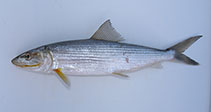
Wervels: 77 - 78. This species is distinguished by the following set of characters: anterior contour of the lower jaw rather pointed; posterior tip of the pelvic fin reaching anterior margin of the anus; anterior tip of the tooth patch on mesopterygoid in front of the tooth patch on the parasphenoid; 77-80 pored lateral line scales; 77-78 vertebrae; body elongated, slightly compressed; conical snout, inferior mouth; 2 nostrils on each side, anterior and posterior ones separated by membrane, posterior one larger than anterior one; protruding upper jaw, maxillary not reaching to anterior border of eye; small patches of villiform teeth on upper and lower jaw; well-developed adipose tissue covering eyes and around eyes, except the pupil; small and rudimentary gill rakers; all fins comprising only soft fin rays; large dorsal fin, located in the middle part of body; anal fin small, located in the posterior part of body; dorsal and anal fin rays gradually become short posteriorly, but last dorsal and anal fin rays slightly elongated; pectoral fin positioned at the ventral part of body; pelvic fin abdominal, its origin below the 12th dorsal fin ray; well-developed axillary scales at the upper base of pectoral and pelvic fins; deeply forked caudal fin, upper lobe slightly longer than lower lobe; body fully covered with cycloid scales, except head and fins (exposed); lateral and dorsal scales with 3 grooves inside, but the lateral scales on the outside exposed region are shorter than the dorsal scales; pored lateral line begins at the upper margin of operculum, extending beyond the caudal fin base in a straight line (Ref. 87083).
Body shape (shape guide): fusiform / normal; Cross section: compressed.
Levenscyclus en paargedrag
Maturiteit | Voortplanting | Paaien | Eieren | Fecunditeit | Larven
Spawning occurs in open waters. Eggs are pelagic (Ref. 205).
Kwun, H.J. and J.K. Kim, 2011. A new species of bonefish, Albula koreana (Albuliformes: Albulidae) from Korea and Taiwan. Zootaxa 2903:57-63. (Ref. 87083)
Status op de Rode Lijst van het IUCN (Ref. 130435: Version 2025-1)
Gevaar voor de mens
Harmless
Gebruik door de mens
Tools
Speciale rapporten
Download XML
Internetbronnen
Estimates based on models
Fylogenetische diversiteitsindex (Ref.
82804): PD
50 = 0.5007 [Uniqueness, from 0.5 = low to 2.0 = high].
Bayesian length-weight: a=0.01288 (0.00544 - 0.03050), b=3.05 (2.85 - 3.25), in cm total length, based on LWR estimates for this (Sub)family-body shape (Ref.
93245).
Trofisch niveau (Ref.
69278): 3.5 ±0.3 se; based on size and trophs of closest relatives
Weerstandsvermogen (Ref.
120179): Hoog, minimale populatieverdubbelingstijd minder dan 15 maanden (Preliminary K or Fecundity.).
Fishing Vulnerability (Ref.
59153): Low to moderate vulnerability (33 of 100).
🛈