


Petrotilapia flaviventris Lundeba, Stauffer & Konings, 2011
Envoyez vos Photos et vidéos
Images Google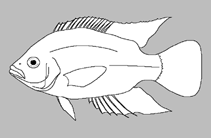 No image available for this species;
drawing shows typical species in Cichlidae.
Images Google
drawing shows typical species in Cichlidae.
Classification / Noms Noms communs | Synonymes | Catalog of Fishes(Genre, Espèce) | ITIS | CoL | WoRMS | Cloffa
> Cichliformes (Cichlids, convict blennies) > Cichlidae (Cichlids) > Pseudocrenilabrinae
Etymology: Petrotilapia: Latin,petra = stone + Bechuana, African native thiape = fish (Ref. 45335); flaviventris: The name flaviventris, from the Latin words flavus, meaning yellow, and venter, meaning the underside or belly, referring to the yellow color on the ventral side of this species; a noun in apposition (Ref. 87181).
Etymology: Petrotilapia: Latin,petra = stone + Bechuana, African native thiape = fish (Ref. 45335); flaviventris: The name flaviventris, from the Latin words flavus, meaning yellow, and venter, meaning the underside or belly, referring to the yellow color on the ventral side of this species; a noun in apposition (Ref. 87181).
Environnement : milieu / zone climatique / profondeur / gamme de distribution Écologie
; eau douce pélagique. Tropical; 12°S - 13°S, 34°E - 35°E
Distribution Territoires | Zones FAO | Écosystèmes | Occurrences | Carte par point | Introductions | Faunafri
Africa: Lake Malawi in Malawi, Mozambique and Tanzania (Ref. 87181).
Taille / Poids / Âge
Description synthétique Clés d'identification | Morphologie | Morphométrie
Épines dorsales (Total) : 17 - 19; Rayons mous dorsaux (Total) : 8 - 9; Épines anales: 3; Rayons mous anaux: 7 - 8. Diagnosis: Absence of a dark submarginal band in the dorsal fin distinguishes Petrotilapia flaviventris from males of P. microgalana, P. genalutea, P. nigra, P. chrysos, P. mumboensis, and P. pyroscelos, which have such a band (Ref. 87181). Adult males of P. flaviventris are yellow on ventral and mid flank with scales outlined in blue; the dorsal one-third is blue to gray with yellow and orange highlights; cheeks and throat are yellow to orange; males of P. tridentiger are light blue with dark blue bars; while those of P. xanthos are yellow; adult male, and female, P. palingnathos have distinctly retrognathous jaws and can thus be distinguished from those of P. flaviventris (Ref. 87181). Females of P. flaviventris are yellow brown with interrupted black horizontal stripes and with a background colouration fading to dark brown dorsally, which distinguishes them from those of P. tridentiger, which are brown, and from P. chrysos and P. microgalana, which are golden yellow; females of P. flaviventris are further distinguished from those of P. xanthos, which are light brown (Ref. 87181).
Body shape (shape guide): short and / or deep.
Body shape (shape guide): short and / or deep.
Cycle de vie et comportement reproducteur Maturité | Reproduction | Frai | Œufs | Fécondité | Larves
Référence principale
Téléchargez vos références | Références | Coordinateur : Kullander, Sven O. | Collaborateurs
Lundeba, M., J.R. Stauffer Jr. and A. F. Konings, 2011. Five new species of the genus Petrotilapia (Teleostei: Cichlidae), from Lake Malawi, Africa. Ichthyol. Explor. Freshwat. 22(2):149-168. (Ref. 87181)
Statut dans la liste rouge de l'IUCN (Ref. 130435: Version 2025-2 (Global))
Préoccupation mineure (LC) ; Date assessed: 22 June 2018
CITES
Not Evaluated
Menace pour l'homme
Harmless
Utilisations par l'homme
FAO - Publication: search | FishSource |
Plus d'informations
Écologie trophique
Aliments (proies)
Composition du régime alimentaire
Consommation alimentaire
Rations alimentaires
Prédateurs
Aliments (proies)
Composition du régime alimentaire
Consommation alimentaire
Rations alimentaires
Prédateurs
Dynamique des populations
Paramètres de croissance
Âges / tailles maximales
Longueur-poids rel.
Rel. longueur-longueur.
Fréquences de longueurs
Conversion de masse
Recrutement
Abondance
Paramètres de croissance
Âges / tailles maximales
Longueur-poids rel.
Rel. longueur-longueur.
Fréquences de longueurs
Conversion de masse
Recrutement
Abondance
Cycle de vie
Reproduction
Maturité
Maturité/épines rel.
Fécondité
Frai
Agrégats de frai
Œufs
Développement de l'œuf
Larves
Dynamique des populations larvaires
Reproduction
Maturité
Maturité/épines rel.
Fécondité
Frai
Agrégats de frai
Œufs
Développement de l'œuf
Larves
Dynamique des populations larvaires
Anatomie
Surface branchiale
Cerveau
Otolithe
Surface branchiale
Cerveau
Otolithe
Physiologie
Composition corporelle
Nutriments
Consommation d'oxygène
Type de natation
Vitesse de nage
Pigments visuels
Son de poisson
Maladies et parasites
Toxicité (CL50)
Composition corporelle
Nutriments
Consommation d'oxygène
Type de natation
Vitesse de nage
Pigments visuels
Son de poisson
Maladies et parasites
Toxicité (CL50)
Génétique
génôme
Génétique
Hétérozygotie
Héritabilité
Diversité génétique
génôme
Génétique
Hétérozygotie
Héritabilité
Diversité génétique
Liées à l'homme
Systèmes d'aquaculture
Profils d'aquaculture
Souches
Cas de ciguatera
Timbres, pièces de monnaie, divers
Systèmes d'aquaculture
Profils d'aquaculture
Souches
Cas de ciguatera
Timbres, pièces de monnaie, divers
Outils
E-book | Guide de terrain | Générateur de fréquences de longueur | Outil de dynamique de population | Carte par point |
Capture-MSY |
Articles particuliers
Télécharger en XML
Sources Internet
AFORO (otoliths) | Aquatic Commons | BHL | Cloffa | Websites from users | FishWatcher | CISTI | Catalog of Fishes: Genre, Espèce | DiscoverLife | ECOTOX | FAO - Publication: search | Faunafri | Fishipedia | Fishtrace | GloBI | Google Books | Google Scholar | Google | IGFA World Record | OneZoom | Open Tree of Life | Otolith Atlas of Taiwan Fishes | PubMed | Reef Life Survey | Socotra Atlas | TreeBase | Arbre de Vie | Wikipedia: aller à, chercher | World Records Freshwater Fishing | Zoobank | Zoological Record
Estimations basées sur des modèles
Indice de diversité phylogénétique (Réf. 82804): PD50 = 0.5010 [Uniqueness, from 0.5 = low to 2.0 = high].
Bayesian length-weight: a=0.00389 (0.00180 - 0.00842), b=3.12 (2.94 - 3.30), in cm total length, based on all LWR estimates for this body shape (Ref. 93245).
Niveau trophique (Réf. 69278): 3.4 ±0.4 se; based on size and trophs of closest relatives
Résilience (Réf. 120179): Haut, temps minimum de doublement de population inférieur à 15 mois (Preliminary K or Fecundity.).