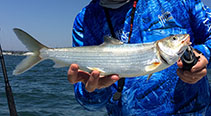
>
Albuliformes (Bonefishes) >
Albulidae (Bonefishes) > Albulinae
Etymology: Albula: Latin, albus = white (Ref. 45335); gilberti: Named for the pioneer ichthyologist Charles Henry Gilbert who, in 1889, first recorded the metamorphosis of bonefish leptocephali (see Jordan 1905, and Gill 1907) based on specimens collected in the Gulf of California. Given that Gilbert's fish collections were conducted mainly along the shore and coastal waters of the northern Gulf of California (Gilbert 1890) it is highly probable that he collected what we recognize here as A. gilberti (Ref. 88068).
Eponymy: Dr Charles Henry Gilbert (1859–1928) was an ichthyologist and fishery biologist, whose main area of study was Pacific salmon. [...] (Ref. 128868), visit book page.
Environment: milieu / climate zone / kisaran kedalaman / distribution range
Ekologi
laut bentopelagis. Tropical
North America: Mexico and USA; from Mazatlán, Sinaloa throughout the Gulf of California and outer coast of the Baja California peninsula, Mexico to California, USA.
Size / Weight / umur
Kematangan: Lm ? range ? - ? cm
Max length : 25.7 cm SL jantan/; (Ref. 88068)
deskripsi pendek
Kunci identifiaksi (pengenalan) | Morfologi | Morfometrik
duri punggung lunak (Keseluruhan (total)) : 17 - 18; Sirip dubur lunak: 8 - 9. Albula gilberti is distinguished from A. esuncula by the following characters: the pelvic-fin tip reach the posterior edge of the anus (vs. tip not surpassing the anterior edge); pelvic-fin rays varies from 9 to 12 (vs. always 10); lateral-line scale counts 68-73 (vs. 68-71); and, gill rakers on first gill arch are higher, 4-10 (vs. 3-8). Since only four or nine specimens were examined for A. esuncula, the diagnostic value of the meristic differences between both species and the position of the pelvic-fin tip should not be considered validated yet and be used with caution. Albula gilberti also differs from A. esuncula by diagnostic nucleotide substitutions at 17 different sites in the 544 bp cytb gene segment; the cytb segment corresponds to nucleotide positions 14502-15045 in the complete mitochondrial genome of Albula glossodonta [GenBank accession no. AP002973; phylogenetic evidence suggests that the genome sequenced was actually from A. argentea (= A. forsteri) and not A. glossodonta (Pfeiler et al., 2006)] (Ref. 88068).
Body shape (shape guide): fusiform / normal; Cross section: compressed.
Spawning occurs in open waters. Eggs are pelagic (Ref. 205).
Pfeiler, E., A.M. Van Der Heiden, R.S. Ruboyianes and T. Watts, 2011. Albula gilberti, a new species of bonefish (Albuliformes: Albulidae) from the eastern Pacific, and a description of adults of the parapatric A. esuncula. Zootaxa 3088:1-14. (Ref. 88068)
Status IUCN Red List (Ref. 130435: Version 2025-1)
ancaman kepada manusia
Harmless
penggunaan manusia
Alat, peralatan
laporan khas
muat turun XML
Sumber internet
Estimates based on models
Phylogenetic diversity index (Acuan
82804): PD
50 = 0.5007 [Uniqueness, from 0.5 = low to 2.0 = high].
Bayesian length-weight: a=0.01288 (0.00544 - 0.03050), b=3.05 (2.85 - 3.25), in cm total length, based on LWR estimates for this (Sub)family-body shape (Ref.
93245).
Trophic level (Acuan
69278): 3.5 ±0.3 se; based on size and trophs of closest relatives
Daya lenting (Acuan
120179): Tinggi, Waktu penggandaan populasi minimum kurang dari 15 bulan (Preliminary K or Fecundity.).
Fishing Vulnerability (Ref.
59153): Low vulnerability (21 of 100).
🛈