This website uses cookies to enhance your browsing experience and ensure the functionality of our site. For more detailed information about the types of cookies we use and how we protect your privacy, please visit our Privacy Information page..
×
Cookie Settings
This website uses different types of cookies to enhance your experience. Please select your preferences below:
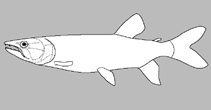
No image available for this species; drawing shows typical species in Hepsetidae.
分類 / Names 俗名 | 同種異名 | Catalog of Fishes(屬, 種) | ITIS | CoL | WoRMS | Cloffa
Teleostei > Characiformes (Characins) 脂鯉目 (Characins) > Hepsetidae (African pikes) 擬狗脂鯉科 (African pikes)
Etymology: Hepsetus:Greek, epsetas, -e, -on = boiled, but there is the following sentence: "oí epsetoi" = certain fishes, and also could be related to "psetta" = grouper (Ref. 45335); occidentalis:The Latin adjective occidentalis means 'western' or 'westerly' and refers to the distribution of this species, which is the westernmost species of the genus (Ref. 94534).
Environment: milieu / climate zone / 深度上下限 / distribution range 生態學
Diagnosis: This species can be distinguished from all other Hepsetus species by the following unique combination of characters: number of lateral line scales high, 49–60; nostril-lower jaw distance high, 40.4–47.6% of head length; number of gill rakers on first arch low, 14–22; number of scales between dorsal fin and lateral line 7.5-9.5; and number of scales between adipose fin and lateral line 4.5-6.5 (Ref. 88135).
Body shape (shape guide): elongated.
The capture, in the Senegal River, of an individual measuring 510 mm SL has been mentioned, but not confirmed; the collections of the Museum of natural History in Paris include a head that is said to belong to a specimen collected in the Cavally River measuring 700 mm TL and wighing 4.000 g (Ref. 2914, 81278).
Life cycle and mating behavior 成熟度 | 繁殖 | 產卵場 | 卵 | 孕卵數 | 仔魚
Decru, E., J. Snoeks and E. Vreven, 2013. The true identity of the holotype of Hepsetus odoe and the names of the two West African species of Hepsetus (Teleostei: Hepsetidae). Ichthyol. Explor. Freshwat. 24(2):187-192. (Ref. 94534)
Phylogenetic diversity index (參考文獻 82804): PD50 = 0.5312 [Uniqueness, from 0.5 = low to 2.0 = high].
Bayesian length-weight: a=0.00562 (0.00189 - 0.01676), b=3.16 (2.92 - 3.41), in cm total length, based on LWR estimates for this (Sub)family-body shape (Ref. 93245).
營養階層 (參考文獻 69278): 3.0 ±0.3 se; based on size and trophs of closest relatives
回復力 (參考文獻 120179): 中等的, 族群倍增時間最少 1.4 - 4.4年 (Preliminary K or Fecundity.).
Fishing Vulnerability (Ref. 59153): Low to moderate vulnerability (30 of 100). 🛈