


Uploaden van uw Foto's en video's
Afbeeldingen | Google afbeelding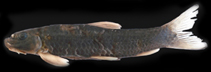 Garra kalpangi
Afbeelding van Bagra, K.
Afbeeldingen | Google afbeelding
Afbeelding van Bagra, K.
Classificatie / Namen Lokale namen | Synoniemen | Catalog of Fishes(Genus, Soort(en)) | ITIS | CoL | WoRMS | Cloffa
> Cypriniformes (Carps) > Cyprinidae (Minnows or carps) > Labeoninae
Etymology: Garra: Name based on a vernacular Indian name (Hamilton, 1822:343, Ref. 1813); a fish living in mud (Ref. 128817); kalpangi: Named for its type locality, River Kalpangi in Yazali, Lower Subansiri District, Arunachal Pradesh; noun in apposition.
Eponymy: A toponym, referring to the River Kalpangi in Arunachal Pradesh, India, where the species was first found. (Ref. 128868), visit book page.
Etymology: Garra: Name based on a vernacular Indian name (Hamilton, 1822:343, Ref. 1813); a fish living in mud (Ref. 128817); kalpangi: Named for its type locality, River Kalpangi in Yazali, Lower Subansiri District, Arunachal Pradesh; noun in apposition.
Eponymy: A toponym, referring to the River Kalpangi in Arunachal Pradesh, India, where the species was first found. (Ref. 128868), visit book page.
Milieu: milieu / Klimaatzone / Diepte / verspreidingsgebied Ecologie
; zoet water benthopelagisch. Tropical
Verspreiding Gebieden | FAO regio's | Ecosystemen | Voorkomen | Verspreidingskaart | Introducties | Faunafri
Asia: India.
Grootte / Gewicht / Leeftijd
Korte beschrijving Determinatiesleutels | Morfologie | Morfometrie
Dorsale zachte stralen (totaal) : 10 - 11; Anale zachte stralen: 7 - 8. This species is distinguished from its congeners of the Himalayan foothills by the following characters: two pairs of barbels; proboscis poorly developed, represented by a squarish area in front of the nostrils; circumpeduncular scales 16; similar to G. gravelyi, G. rotundinasus and G. elongata in having a weakly developed proboscis on the snout. This species is differentiated from G. gravelyi in having branched dorsal-fin rays 8 (vs. 7), branched pectoral-fin rays 10-12 (vs. 13), predorsal scales 10-11 (vs. 8–9), absence (vs. presence) of indistinct black spots at the bases of the branched dorsal-fin rays, absence (vs. presence) of lateral stripes on side of body; from G. rotundinasus in having branched pectoral-fin rays 10-12 (vs.13-15), lateral line scales 32-33 (vs. 36-37), scales between vent and anal-fin origin 3 (vs. 5), transverse scale rows above lateral line 3½ (vs. 2½), transverse scale rows below lateral line 3½-4 (vs. 2½-3), circumpeduncular scales 16 (vs. 12), absence (vs. subtle presence) of lateral stripe along lateral line; from G. elongata in having lateral line scales 32-33 (vs. 40-41), predorsal scales 10-11 (vs. 14-15), branched dorsal-fin rays 8 (vs.7), absence (vs. presence) of transverse groove at tip of snout, absence (vs. presence) of pleated papilliferous fold at corner of mouth, absence (vs. presence) of a wide submarginal band on dorsal fin, absence (vs. presence) of a longitudinal median black band on caudal fin (Ref. 89473).
Body shape (shape guide): elongated; Cross section: compressed.
Body shape (shape guide): elongated; Cross section: compressed.
Levenscyclus en paargedrag Maturiteit | Voortplanting | Paaien | Eieren | Fecunditeit | Larven
Hoofdreferentie
Upload uw referenties | Referenties | Coördinator | Medewerkers
Nebeshwar, K., K. Bagra and D.N. Das, 2012. Garra kalpangi, a new cyprinid fish species (Pisces: Teleostei) from upper Brahmaputra basin in Arunachal Pradesh, India. Journal of Threatened Taxa 4(2):2353-2362. (Ref. 89473)
CITES
Not Evaluated
Gevaar voor de mens
Harmless
Gebruik door de mens
Visserij: van geen belang
FAO - Publication: search | FishSource |
Meer informatie
Trofische ecologie
Voedsel (prooien)
Dieetsamenstelling
Voedselconsumptie
Voedselrantsoenen
Predatoren
Voedsel (prooien)
Dieetsamenstelling
Voedselconsumptie
Voedselrantsoenen
Predatoren
Ecologie
Ecologie
Ecologie
Populatiedynamica
Groeiparameters
Max. leeftijden / maten
Lengte-gewicht rel.
Lengte-lengte rel.
Lengtefrequenties
Massaconversie
Rekrutering
Abundantie
Groeiparameters
Max. leeftijden / maten
Lengte-gewicht rel.
Lengte-lengte rel.
Lengtefrequenties
Massaconversie
Rekrutering
Abundantie
Levenscyclus
Voortplanting
Maturiteit
Rijpheid/kieuwen rel.
Fecunditeit
Paaien
Paaibestanden
Eieren
Ontwikkeling van de eieren
Larven
Larvale populatiedynamiek
Voortplanting
Maturiteit
Rijpheid/kieuwen rel.
Fecunditeit
Paaien
Paaibestanden
Eieren
Ontwikkeling van de eieren
Larven
Larvale populatiedynamiek
Anatomie
Kieuwoppervlak
Hersenen
Otoliet
Kieuwoppervlak
Hersenen
Otoliet
Fysiologie
Lichaamssamenstelling
Voedingsstoffen
Zuurstofverbruik
Type zwemmen
Zwemsnelheid
Visuele pigmenten
Vis geluid
Ziekten en parasieten
Toxiciteit (LC50)
Lichaamssamenstelling
Voedingsstoffen
Zuurstofverbruik
Type zwemmen
Zwemsnelheid
Visuele pigmenten
Vis geluid
Ziekten en parasieten
Toxiciteit (LC50)
Genetica
genoom
Genetica
Heterozygositeit
Erfelijkheid
Genetische diversiteit
genoom
Genetica
Heterozygositeit
Erfelijkheid
Genetische diversiteit
Menselijk gerelateerd
Aquacultuursystemen
Aquacultuurprofielen
Kweeklijnen
Ciguatera gevallen
Postzegels, munten, diversen.
Aquacultuursystemen
Aquacultuurprofielen
Kweeklijnen
Ciguatera gevallen
Postzegels, munten, diversen.
Tools
Speciale rapporten
Bekijk gegevens voor het houden in een aquarium | Bekijk Fact Sheets voor de soort | Bekijk Aquacultuur Fact Sheets
Download XML
Internetbronnen
AFORO (otoliths) | Aquatic Commons | BHL | Cloffa | Websites from users | Bekijk FishWatcher | CISTI | Catalog of Fishes: Genus, Soort(en) | DiscoverLife | ECOTOX | FAO - Publication: search | Faunafri | Fishipedia | Fishtrace | GloBI | Google Books | Google Scholar | Google | IGFA World Record | OneZoom | Open Tree of Life | Otolith Atlas of Taiwan Fishes | PubMed | Reef Life Survey | Socotra Atlas | TreeBase | Tree of Life | Wikipedia: ga naar, zoek | World Records Freshwater Fishing | Zoobank | Zoological Record