


Coptodon konkourensis (Dunz & Schliewen, 2012)
Sube tu fotos y Vídeos
Google image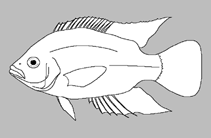 No image available for this species;
drawing shows typical species in Cichlidae.
Google image
drawing shows typical species in Cichlidae.
Clasificación / Nombres Nombres comunes | Sinónimos | Catalog of Fishes(Género, Especie) | ITIS | CoL | WoRMS | Cloffa
> Cichliformes (Cichlids, convict blennies) > Cichlidae (Cichlids) > Pseudocrenilabrinae
Etymology: konkourensis: The name konkourensis refers to the Konkouré River, the drainage to which the new species appears to be endemic; used as a noun in apposition (Ref. 90097).
Etymology: konkourensis: The name konkourensis refers to the Konkouré River, the drainage to which the new species appears to be endemic; used as a noun in apposition (Ref. 90097).
Entorno: milieu / zona climática / rango de profundidad / gama de distribución Ecología
; agua dulce demersal. Tropical
Distribución Territorios | Áreas FAO | Ecosistemas | Ocurrencias, apariciones | Mapa de puntos | Introducciones | Faunafri
Africa: middle Konkouré River and its tributary Kakrima River in Guinea (Ref. 90097).
Tamaño / Peso / Edad
Descripción breve Claves de identificación | Morfología | Morfometría
Espinas dorsales (total) : 16; Radios blandos dorsales (total) : 11; Espinas anales: 3; Radios blandos anales: 8. Diagnosis: This species differs from all other tilapia except Coptodon fusiforme in a shallower body 30.0-31.5% of standard length vs. 32.9-52.5% and from Coptodon fusiforme in having 8 instead of 9-12 lower lateral line scales (Ref. 90097). It differs from all tilapia except Coptodon rheophila by additional morphological and meristic characters: stout teeth in oral jaw vs. spatulate teeth in Pelmatolapia mariae and P. cabrae; median pharyngeal teeth of lower pharyngeal jaw never broadened with crest-like cusps as in Heterotilapia cessiana and H. buttikoferi; posterior pharyngeal teeth of lower pharyngeal jaw never clearly bicuspid as in Tilapia busumana, T. pra, T. brevimanus, T. sparrmanii, T. baloni, T. ruweti and T. guinasana; vertical bars broader not than lighter interspaces; possessing slender to spatulate teeth in oral jaws as in Coelotilapia joka; no densely scaled caudal fin (Ref. 90097). Compared to Coptodon congica, C. tholloni and Congolapia bilineata, it further differs from all Coptodon, excluding C. rheophila, by a combination of the meristic characters: number of dorsal-fin spines, 16 vs. 13-17, and rays, 11 vs. 10-13; number of scales on the upper, 21 vs. 17-23, and lower lateral line, 8 vs. 7-14; and number of gill rakers, 7-9 vs. 7-12, on first ceratobranchial, excluding gill rakers on cartilaginous plague; it differs from C. rheophila by a smaller eye diameter, 7.5-7.6% of standard length vs. 8.0-10.7%, a shorter predorsal distance, 31.1-33.6% of standard length vs. 34.2-38.2%, a longer length of the base of dorsal fin, 61.4-62.3% of standard length vs. 56.9-60.9%, and a shorter pectoral fin length, 22.2-24.0% of standard length vs. 25.1-28.3% (Ref. 90097). It differs from the tilapia related species Chilochromis duponti in no densely scaled caudal fin or comb-like, spatulate teeth; from Gobiocichla in having two unconnected lateral lines vs. one continuous lateral line, and from Steatocranus in not developing a hump on forehead, and in fewer dorsal spines, 16 vs. 19-22 (Ref. 90097). The new species shares all typical Coptodon characters, which are: lower pharyngeal jaw as long as broad with anterior keel shorter than or just as long as toothed area of jaw; posterior pharyngeal teeth more or less clearly tricuspid, but sometimes quadricuspid or pentacuspid, median pharyngeal teeth never broadened with crest-like cusps; first outer gill arch bearing 10-17 rakers; two unconnected lateral lines; only cycloid scales present; 22-30 scales in the longitudinal scale row; upper and lower outer teeth rows bicuspid in both jaws, inner rows with smaller tricuspid teeth in both jaws; isognathous or retrognathous jaws; stout teeth; caudal fin not densely scaled; 13-17 dorsal spines; vertical bars, never oblique and mostly branched; pointed pelvic fin; no hump on forehead; no visor like hanging pad in pharynx; only one supraneural associated with first neural spine (Ref. 90097).
Body shape (shape guide): elongated; Cross section: compressed.
Body shape (shape guide): elongated; Cross section: compressed.
The very slender body in combination with a rounded head shape and slightly retrognathous jaws suggests that it is a benthic-rheophilic species, modified for life in rapids (Ref. 90097).
Ciclo vital y comportamiento de apareamiento Madurez | Reproducción | Puesta | Huevos | Fecundidad | Larva
Referencia principal
Suba sus referencias | Referencias | Coordinador : Kullander, Sven O. | Colaboradores
Dunz, A.R. and U.K. Schliewen, 2013. Molecular phylogeny and revised classification of the haplotilapiine cichlid fishes formerly referred to as "Tilapia". Mol. Phylogenet. Evol. 68(1):64-80. (Ref. 93285)
CITES
Not Evaluated
Amenaza para el ser humano
Harmless
Usos humanos
FAO - Publication: search | FishSource |
Más información
Ecología Trófica
Alimentos (presas)
Composición de la dieta
consumo de alimento
Raciones de comida
Despredadores
Alimentos (presas)
Composición de la dieta
consumo de alimento
Raciones de comida
Despredadores
Dinámica de la población
Coeficiente del crecimiento para
Edades / tallas máximas
Longitud-peso rel.
Longitud-longitud rel.
Longitud-frecuencias
Conversión de masas
Reclutamiento
Abundancia
Coeficiente del crecimiento para
Edades / tallas máximas
Longitud-peso rel.
Longitud-longitud rel.
Longitud-frecuencias
Conversión de masas
Reclutamiento
Abundancia
Ciclo de vida
Reproducción
Madurez
Madurez/Gills rel.
Fecundidad
Puesta
Agregaciones de desove
Huevos
Desarrollo de los huevos
Larva
Dinámica larvaria
Reproducción
Madurez
Madurez/Gills rel.
Fecundidad
Puesta
Agregaciones de desove
Huevos
Desarrollo de los huevos
Larva
Dinámica larvaria
Distribución
Territorios
Áreas FAO
Ecosistemas
Ocurrencias, apariciones
Introducciones
BRUVS - Vídeos
Territorios
Áreas FAO
Ecosistemas
Ocurrencias, apariciones
Introducciones
BRUVS - Vídeos
Anatomía
Superficie branquial
Cerebro
Otolito
Superficie branquial
Cerebro
Otolito
Fisiología
Composición corporal
Nutrientes
Consumo del oxígeno
Tipo de natación
Velocidad de natación
Pigmentos visuales
Sonido de peces
Enfermedades y parásitos
Toxicidad (CL50)
Composición corporal
Nutrientes
Consumo del oxígeno
Tipo de natación
Velocidad de natación
Pigmentos visuales
Sonido de peces
Enfermedades y parásitos
Toxicidad (CL50)
Genética
Genoma
Genética
Heterocigosidad
heritabilidad
Diversidad genética
Genoma
Genética
Heterocigosidad
heritabilidad
Diversidad genética
Relacionados con el ser humano
Sistemas de acuicultura
Perfiles de acuicultura
Razas
Ciguatera cases
Sellos, monedas, varios
Sistemas de acuicultura
Perfiles de acuicultura
Razas
Ciguatera cases
Sellos, monedas, varios
Herramientas
Libro electrónico | Guía de campo | Asistente para frecuencias de tallas | Herramienta de ciclo de vida | Mapa de puntos |
Catch-MSY |
Informes especiales
Comprobar el mantenimiento del acuario | Buscar fichas sobre especies | Consulte las hojas informativas sobre acuicultura
Descargar XML
Fuentes de Internet
AFORO (otoliths) | Aquatic Commons | BHL | Cloffa | Websites from users | Check FishWatcher | CISTI | Catalog of Fishes: Género, Especie | DiscoverLife | ECOTOX | FAO - Publication: search | Faunafri | Fishipedia | Fishtrace | GloBI | Google Books | Google Scholar | Google | IGFA World Record | OneZoom | Open Tree of Life | Otolith Atlas of Taiwan Fishes | PubMed | Reef Life Survey | Socotra Atlas | TreeBase | Árbol de la vida | Wikipedia: Go, búsqueda | World Records Freshwater Fishing | Expediente Zoológico
Estimaciones basadas en modelos
Índice de diversidad filogenética (Referencia 82804): PD50 = 0.5000 [Uniqueness, from 0.5 = low to 2.0 = high].
Bayesian length-weight: a=0.00389 (0.00180 - 0.00842), b=3.12 (2.94 - 3.30), in cm total length, based on all LWR estimates for this body shape (Ref. 93245).
Nivel trófico (Referencia 69278): 2.7 ±0.1 se; based on size and trophs of closest relatives