Klassifizierung / Names
Namen | Synonyme | Catalog of Fishes(Gattung, Arten) | ITIS | CoL | WoRMS | Cloffa
>
Cichliformes (Cichlids, convict blennies) >
Cichlidae (Cichlids) > Pseudocrenilabrinae
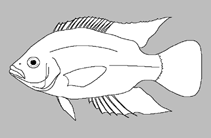
Etymology: robustus: From the Latin robustus, meaning heavy or strong, refers to the big size and robust overall body shape (Ref. 91055).
Umwelt: Milieu / Klimazone / Tiefenbereich / Verbreitungsgebiet
Ökologie
; süßwasser pelagisch. Tropical
Africa: Middle Congo River system near Yaekama in the Democratic republic of Congo (Ref. 91055).
Größe / Gewicht / Alter
Geschlechtsreife: Lm ? range ? - ? cm
Max length : 7.6 cm SL Männchen/unbestimmt; (Ref. 91055)
Kurzbeschreibung
Bestimmungsschlüssel | Morphologie | Morphometrie
Rückenflossenstacheln (insgesamt) : 16 - 17; Rückenflossenweichstrahlen (insgesamt) : 7 - 9; Afterflossenstacheln: 3; Afterflossenweichstrahlen: 5 - 7; Wirbelzahl: 24 - 25. Diagnosis: Congochromis robustus shares with all congeners the following characters: body moderately elongated; steep and rounded front profile; snout rounded; caudal fin rounded; one tubular infraorbital bone; nape and opercle scaled; cheek with 2 scale rows, at least on the posterior part (Ref. 91055). It differs from all congeners in its much larger size, 75.6 mm standard length vs. 49.5 mm in C. dimidiatus, 51.5 mm in C. pugnatus, 52.5 mm in C. sabinae and 44.7 mm in C. squamiceps; its greater cheek depth, 30.4-33.8% of head length vs. 20.1-32.0% in C. dimidiatus, 24.4-28.8% in C. pugnatus, 16.5-31.1% in C. sabinae and 24.1-32.0% in C. squamiceps; its greater snout length, 28.9-38.7% of head length vs. 16.6-27.2% in C. dimidiatus, 28.6-33.3% in C. pugnatus, 18.8-34.3% in C. sabinae and 21.5-30.4% in C. squamiceps; its smaller eye orbit diameter, 23.8-27.7% of head length vs. 28.9-35.1% in C. dimidiatus, 26.9-30.6% in C. pugnatus, 26.2-33.9% in C. sabinae and 27.1-34.8% in C. squamiceps; and its smaller postorbital length, 37.5-43.4% of head length vs. 42.6-47.4% in C. dimidiatus, 39.9-45.1% in C. pugnatus, 37.5-47.3% in C. sabinae and 40.7-46.0% in C. squamiceps (Ref. 91055).
Body shape (shape guide): fusiform / normal.
Lebenszyklus und Paarungsverhalten
Geschlechtsreife | Fortpflanzung | Ablaichen | Eier | Fruchtbarkeit | Larven
Lamboj, A., 2012. A new species of the genus Congochromis (Cichlidae) from the Central Congo basin. Cybium 36(2):349-352. (Ref. 91055)
IUCN Rote Liste Status (Ref. 130435: Version 2025-2)
Bedrohung für Menschen
Harmless
Nutzung durch Menschen
Tools
Zusatzinformationen
Download XML
Internet Quellen
Schätzungen auf der Grundlage von Modellen
Phylogenetischer Diversitätsindex (Ref.
82804): PD
50 = 0.5312 [Uniqueness, from 0.5 = low to 2.0 = high].
Bayesian length-weight: a=0.01445 (0.00674 - 0.03099), b=2.99 (2.82 - 3.16), in cm total length, based on LWR estimates for this (Sub)family-body shape (Ref.
93245).
Trophische Ebene (Ref.
69278): 3.3 ±0.4 se; based on size and trophs of closest relatives
Anfälligkeit der Fischerei (Ref.
59153): Low vulnerability (10 of 100).
🛈