This website uses cookies to enhance your browsing experience and ensure the functionality of our site. For more detailed information about the types of cookies we use and how we protect your privacy, please visit our Privacy Information page.
×
Cookie Settings
This website uses different types of cookies to enhance your experience. Please select your preferences below:
> Gobiiformes (Gobies) > Gobiidae (Gobies) > Gobiinae
Etymology: Eviota:No etymology given, suggested by Christopher Scharpt: from Latin 'eu' for 'true' and 'iota' for anything very small, in combination 'truly very small' referring to it as being the smallest vertebrate at the time it has benn described by Jenkins (thus, making the suggestion by Scharpt plausible; jewettae:Named for Susan L. Jewett, who previously recognized this species as undescribed from specimens taken by the Smithsonian Philippine Expedition in 1978. Eponymy: Susan Lee Jewett (formerly Susan J Karnella) (d: 1945) is an American ichthyologist who was Collections Manager, Division of Fishes, Smithsonian Institution. [...] (Ref. 128868), visit book page.
Environnement : milieu / zone climatique / profondeur / gamme de distribution Écologie
marin récifal; profondeur 7 - 33 m (Ref. 92345). Tropical
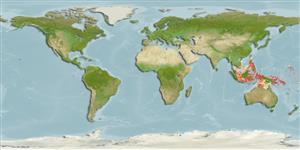
Western Pacific: known from Palau (only from Helen Reef, the southern-most of the South West Islands), Philippine Islands, Papua New Guinea and Raja Ampat, Indonesia.
Taille / Poids / Âge
Maturité: Lm? range ? - ? cm Max length : 1.2 cm SL mâle / non sexé; (Ref. 92345); 1.2 cm SL (female)
Épines dorsales (Total) : 6; Rayons mous dorsaux (Total) : 8; Épines anales: 1; Rayons mous anaux: 8. This species is distinguished from congeners by the following set of characters: cephalic sensory-pore system lacking all pores 98% of the time; dorsal/anal fin-ray formula 8/8; pectoral-fin rays 15-16, ventralmost two rays unbranched with at least 2 (but up to 4) lower rays branched at tips above this, remainder of rays unbranched; 4th pelvic-fin ray bifurcated with each branch about 60% of total length of the ray; unbranched 5th pelvic-fin ray 13-20% of 4th; non-filamentous dorsal-fin spines, tubular anterior nares short, less than ½ pupil diameter in length; when alive, body is translucent and crossed by five broad orange to red bands (Ref. 82345). Body shape (shape guide): fusiform / normal; Cross section: oval.
Cycle de vie et comportement reproducteur Maturité | Reproduction | Frai | Œufs | Fécondité | Larves
Greenfield, D.W. and R. Winterbottom, 2012. Two new dwarfgobies from the Southwestern Pacific Ocean (Teleostei: Gobiidae: Eviota). Zootaxa 3572:33-42. (Ref. 92345)
Statut dans la liste rouge de l'IUCN (Ref. 130435: Version 2025-2 (Global))
Dynamique des populations Paramètres de croissance Âges / tailles maximales Longueur-poids rel. Rel. longueur-longueur. Fréquences de longueurs Conversion de masse Recrutement Abondance
Cycle de vie Reproduction Maturité Maturité/épines rel. Fécondité Frai Agrégats de frai Œufs Développement de l'œuf Larves Dynamique des populations larvaires
Physiologie Composition corporelle Nutriments Consommation d'oxygène Type de natation Vitesse de nage Pigments visuels Son de poisson Maladies et parasites Toxicité (CL50)
Température préférée (Réf. 123201): 28 - 29.1, mean 28.6 °C (based on 62 cells).
Indice de diversité phylogénétique (Réf. 82804): PD50 = 0.5000 [Uniqueness, from 0.5 = low to 2.0 = high].
Bayesian length-weight: a=0.01023 (0.00477 - 0.02194), b=3.01 (2.83 - 3.19), in cm total length, based on LWR estimates for this (Sub)family-body shape (Ref. 93245).
Niveau trophique (Réf. 69278): 3.0 ±0.3 se; based on size and trophs of closest relatives
Vulnérabilité de la pêche (Ref. 59153): Low vulnerability (10 of 100). 🛈