


Trichomycterus perkos Datovo, Carvalho & Ferrer, 2012
muatnaik fotos/gambar dan video
imej Google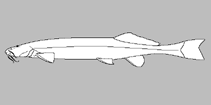 No image available for this species;
drawing shows typical species in Trichomycteridae.
imej Google
drawing shows typical species in Trichomycteridae.
klasifikasi / Nama Nama-nama umum | Sinonim (persamaan) | Catalog of Fishes(Marga, Jenis) | ITIS | CoL | WoRMS | Cloffa
> Siluriformes (Catfishes) > Trichomycteridae (Pencil or parasitic catfishes) > Trichomycterinae
Etymology: Trichomycterus: Greek, thrix = hair + Greek, mykter, -eros = nose (Ref. 45335); perkos: From the Greek adjective perkos (pe????), meaning “s spotted or streaked with black marks, in allusion to the color pattern of the new species formed by either dark stripes (small-sized specimens) or dark stripes combined with small spots (larger individuals).
Etymology: Trichomycterus: Greek, thrix = hair + Greek, mykter, -eros = nose (Ref. 45335); perkos: From the Greek adjective perkos (pe????), meaning “s spotted or streaked with black marks, in allusion to the color pattern of the new species formed by either dark stripes (small-sized specimens) or dark stripes combined with small spots (larger individuals).
Lingkungan: lingkungan / zona iklim / kisaran kedalaman / jangkauan distribusi Ekologi
; air tawar dasar (demersal). Tropical
Penyebaran Wilayah | Daerah-daerah FAO | Ekosistem | Kemunculan | peta titik | Introduksi | Faunafri
South America: tributaries of the Paranapanema and Uruguai River basins in southern Brazil.
Ukuran / Berat / umur
deskripsi pendek Kunci identifiaksi (pengenalan) | Morfologi | Morfometrik
Duri punggung (Keseluruhan (total)) : 2; duri punggung lunak (Keseluruhan (total)) : 8 - 9; Duri dubur: 2; Sirip dubur lunak: 6 - 8. Large specimens of more than 65.8 mm SL, presumably adults, of Trichomycterus perkos can be diagnosed from all their congeners in having a remarkable coloration with melanophores arranged in two distinct skin layers, forming (1) a freckled pattern, with minute light brown spots scattered on the superficial tegumentar layer of the dorsum and caudal peduncle, and (2) a striped pattern, with three- sagittal, midlateral, and ventrolateral - wide, irregularly bordered, and sometimes interrupted dark brown stripes running along an inner skin layer of the trunk and caudal peduncle . Smaller specimens of less than 43.3 mm SL, presumably juveniles, of Trichomycterus perkos lack the superficial freckled pattern, but already exhibit the three wide dark stripes found in the adults.
Nevertheless, both juveniles and adults of T. perkos possess the following unequivocally morphological traits that distinguish them from other congeners: from T. duellmani in having modally seven pectoral-fin rays (vs. modally eight), two pores in the lateral line (vs. four), distal margin of the adpressed pelvic fin not reaching the anus (vs. distal margin extending posteriorly beyond the anus), modally ten branchiostegal rays (vs. six or seven), and modally 41 post-Weberian vertebrae (vs. 33-36); (2) from T. itatiayae by the first pectoral-fin ray not filamentous (vs. filamentous), distal margin of the adpressed pelvic fin not reaching the anus (vs. distal margin extending posteriorly beyond the anus), modally ten branchiostegal rays (vs. eight), and modally 41 post-Weberian vertebrae (vs. 35-37); (3) from T. nigroauratus by the first pectoral-fin ray not filamentous (vs. filamentous), modally seven pectoral-fin rays (vs. modally eight), modally ten branchiostegal rays (vs. seven or eight), and modally 41 post-Weberian vertebrae (vs. 35-36); (4) from T. pauciradiatus in having the first pectoral-fin ray not filamentous (vs. filamentous), modally seven pectoral- fin rays (vs. modally six), five pelvic-fin rays (vs. four), distal margin of the adpressed pelvic fin not reaching the anus (vs. distal margin extending posteriorly beyond the anus), pores i1 and i3 of the infraorbital laterosensory canal lacking (vs. i1 and i3 present), modally ten branchiostegal rays (vs. eight), and modally 41 post-Weberian vertebrae (vs. 36-38); (5) from T. reinhardti by the first pectoral-fin ray not prolonged as a filament (vs. ray filamentous), distal margin of the adpressed pelvic fin not reaching the anus (vs. distal margin extending posteriorly beyond the anus), absence of the pores i1 and i3 of the infraorbital laterosensory canal (vs. i1 and i3 present), modally ten branchiostegal rays (vs. seven or eight), and modally 41 post-Weberian vertebrae (vs. 38); and (6) from T. taenia by the first pectoral-fin ray not filamentous (vs. filamentous), and distal margin of the adpressed pelvic fin not reaching the anus (vs. distal margin reaching the anus) (Ref. 90267).
Body shape (shape guide): elongated.
Body shape (shape guide): elongated.
Mostly found in clear water streams with 1 to 3 m wide, with bottoms composed of stone, gravel, and sand. Streamlets are usually surrounded by modified riparian vegetation (Ref. 90267).
Siklus hidup dan perilaku kawin Kematangan | Reproduksi, perkembang biakan | Pemijahan | telur-telur | Fekunditas | Larva
rujukan utama
Unggah referensi Anda | Acuan | Koordinator : Pinna, Mário de | mitra
Datovo, A., M. Carvalho and J. Ferrer, 2012. A new species of the catfish genus Trichomycterus from the La Plata River basin, southern Brazil, with comments on its putative phylogenetic position (Siluriformes: Trichomycteridae). Zootaxa 3327:33-44. (Ref. 90267)
CITES
Not Evaluated
ancaman kepada manusia
Harmless
penggunaan manusia
FAO - Publication: search | FishSource |
informasi lanjut
Ekologi trofik
Item makanan (mangsa)
Komposisi makanan
Konsumsi makanan
Ransum makanan
Pemangsa
Item makanan (mangsa)
Komposisi makanan
Konsumsi makanan
Ransum makanan
Pemangsa
Ekologi
Ekologi
Ekologi
Dinamika populasi
Parameter pertumbuhan
Maks. usia / ukuran
Panjang-berat rel.
Panjang-panjang rel.
ukuran frekuensi
Konversi massa
pemulihan
Kelimpahan
Parameter pertumbuhan
Maks. usia / ukuran
Panjang-berat rel.
Panjang-panjang rel.
ukuran frekuensi
Konversi massa
pemulihan
Kelimpahan
Siklus hidup
Reproduksi, perkembang biakan
Kematangan
Kedewasaan / insang rel.
Fekunditas
Pemijahan
Agregasi pemijahan
telur-telur
pekembangan telor
Larva
Dinamika larva
Reproduksi, perkembang biakan
Kematangan
Kedewasaan / insang rel.
Fekunditas
Pemijahan
Agregasi pemijahan
telur-telur
pekembangan telor
Larva
Dinamika larva
Anatomi
Area insang
Otak
Otolith
Area insang
Otak
Otolith
Fisiologi
Komposisi tubuh
Nutrisi
Konsumsi oksigen
Jenis renang
Kecepatan berenang
Pigmen visual
Suara ikan
Penyakit & Parasit
Toksisitas (LC50)
Komposisi tubuh
Nutrisi
Konsumsi oksigen
Jenis renang
Kecepatan berenang
Pigmen visual
Suara ikan
Penyakit & Parasit
Toksisitas (LC50)
Genetika
genom
Genetika
Heterozigositas
Diturunkan
Keanekaragaman Genetik
genom
Genetika
Heterozigositas
Diturunkan
Keanekaragaman Genetik
Yang berhubungan dengan manusia
Sistem akuakultur
profil budidaya air
Strain
Kasus Ciguatera
Perangko, koin, dll.
Sistem akuakultur
profil budidaya air
Strain
Kasus Ciguatera
Perangko, koin, dll.
Alat, peralatan
E-book | Penuntun lapangan | tanda freqkuenci panjang | peringkat sejarah hidup | peta titik |
Tangkap-MSY |
laporan khas
muat turun XML
Sumber internet
AFORO (otoliths) | Aquatic Commons | BHL | Cloffa | Websites from users | semak peneliti ikan | CISTI | Catalog of Fishes: Marga, Jenis | DiscoverLife | ECOTOX | FAO - Publication: search | Faunafri | Fishipedia | Fishtrace | GloBI | Google Books | Google Scholar | Google | IGFA World Record | OneZoom | Open Tree of Life | Otolith Atlas of Taiwan Fishes | PubMed | Reef Life Survey | Socotra Atlas | TreeBase | Tree of Life | Wikipedia: pergi, Cari | World Records Freshwater Fishing | Zoobank | Catatan Zoologi
Estimasi berdasarkan model
Indeks keanekaragaman filogenetik (Acuan 82804): PD50 = 0.5000 [Uniqueness, from 0.5 = low to 2.0 = high].
Bayesian length-weight: a=0.00912 (0.00396 - 0.02102), b=2.97 (2.79 - 3.15), in cm total length, based on LWR estimates for this Genus-body shape (Ref. 93245).
Tingkat Trofik (Acuan 69278): 3.2 ±0.4 se; based on size and trophs of closest relatives