


Crenicichla gillmorlisi Kullander & Lucena, 2013
Envoyez vos Photos et vidéos
Images Google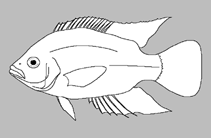 No image available for this species;
drawing shows typical species in Cichlidae.
Images Google
drawing shows typical species in Cichlidae.
Classification / Noms Noms communs | Synonymes | Catalog of Fishes(Genre, Espèce) | ITIS | CoL | WoRMS | Cloffa
> Cichliformes (Cichlids, convict blennies) > Cichlidae (Cichlids) > Cichlinae
Etymology: Crenicichla: Latin, crenulatus = cut, clipped + Greek, kichle = wrasse (Ref. 45335); gillmorlisi: Named for ichthyologist Walter A. Gill Morlis A., fisheries officer of the Itaipú Binacional, Ciudad del Este, Paraguay, who contributed considerably to the PROVEPA surveys of fishes in tributaries of the Paraná River, and in special recognition of his strong long term engagement in the inventory of the fishes of the río Paraná.
Eponymy: Walter A Gill Morlis is a Paraguayan ichthyologist who is a fisheries officer of the Itaipú Binacional, Ciudad del Este, Paraguay. [...] (Ref. 128868), visit book page.
Etymology: Crenicichla: Latin, crenulatus = cut, clipped + Greek, kichle = wrasse (Ref. 45335); gillmorlisi: Named for ichthyologist Walter A. Gill Morlis A., fisheries officer of the Itaipú Binacional, Ciudad del Este, Paraguay, who contributed considerably to the PROVEPA surveys of fishes in tributaries of the Paraná River, and in special recognition of his strong long term engagement in the inventory of the fishes of the río Paraná.
Eponymy: Walter A Gill Morlis is a Paraguayan ichthyologist who is a fisheries officer of the Itaipú Binacional, Ciudad del Este, Paraguay. [...] (Ref. 128868), visit book page.
Environnement : milieu / zone climatique / profondeur / gamme de distribution Écologie
; eau douce benthopélagique; profondeur 1 - 2 m (Ref. 93325). Tropical
Distribution Territoires | Zones FAO | Écosystèmes | Occurrences | Carte par point | Introductions | Faunafri
South America: Río Acaray drainage in Paraguay.
Taille / Poids / Âge
Description synthétique Clés d'identification | Morphologie | Morphométrie
Épines dorsales (Total) : 19 - 22; Rayons mous dorsaux (Total) : 11 - 12; Épines anales: 3; Rayons mous anaux: 7 - 9; Vertèbres: 35 - 37. Distinguished from all congeners by the color pattern which develops as a row of paired vertical bars in young, and which are further fragmented into an adult color pattern composed of small dark spots all over the sides. Other characters useful to diagnose from other species include the following: 42-57 E1 scales; smooth supracleithrum; absence of a humeral blotch; infraorbitals 3 and 4 separate; cycloid cheek and predorsal scales; movable implanted outer teeth; nostril well separated from upper lip; serrated preopercular margin; lower jaw prognathous; preopercular margin serrated; preopercle serrated; black dots marking lateral line scales absent. Most similar to C. mandelburgeri in proportional measurements and meristics, but distinguished by the dissolution of vertical bars into small spots, absent in C. mandelburgeri (Ref. 93325).
Body shape (shape guide): short and / or deep.
Body shape (shape guide): short and / or deep.
Specimens composed of an adult and 2 young were collected from a small stream with brownish very turbid water, with moderate current, about 4 m wide and 1-1.5 m deep. The bottom substrate was composed of rocks and stones. Fishes were encountered along overhanging banks. Associated species included Gymnogeophagus setequedas Reis, Malabarba & Pavanelli (Cichlidae) and Bryconamericus stramineus Eigenmann (Characidae), Astyanax sp. (Characidae), Hypostomus dlouhyi Weber, Hypoptopoma sp. (Loricariidae), Hoplias sp. (Erythrinidae), Leporinus lacustris Amaral Campos (Anostomidae), Steindachnerina brevipinnis (Eigenmann & Eigenmann) (Curimatidae), Eigenmannia virescens (Valenciennes) (Sternopygidae), Crenicichla lepidota (Cichlidae), and Pyrrhulina australis Eigenmann & Kennedy (Lebiasinidae). A juvenile was also captured in a small stream, more than 1.5 m deep with running, dark and turbid water and bottom consisted of sand, in open landscape with low trees and grass. Associated species with this juvenile were Characidium sp. (Crenuchidae) and Bryconamericus stramineus (Characidae), Astyanax sp., Cheirodon sp., Hemigrammus sp., Mimagoniates microlepis (Steindachner) (Characidae), Corydoras diphyes Axenrot & Kullander (Callichthyidae), Bunocephalus sp. (Aspredinidae), Gymnogeophagus setequedas (Cichlidae), Hypoptopoma sp., (Loricariidae), and Phallotorynus victoriae Oliveros (Poeciliidae) (Ref. 93325).
Cycle de vie et comportement reproducteur Maturité | Reproduction | Frai | Œufs | Fécondité | Larves
Référence principale
Téléchargez vos références | Références | Coordinateur : Kullander, Sven O. | Collaborateurs
Kullander, S.O. and C.A.S. Lucena, 2013. Crenicichla gillmorlisi, a new species of cichlid fish (Teleostei: Cichlidae) from the Paraná river drainage in Paraguay. Zootaxa 3641(2):149-164. (Ref. 93325)
CITES
Not Evaluated
Menace pour l'homme
Harmless
Utilisations par l'homme
FAO - Publication: search | FishSource |
Plus d'informations
Écologie trophique
Aliments (proies)
Composition du régime alimentaire
Consommation alimentaire
Rations alimentaires
Prédateurs
Aliments (proies)
Composition du régime alimentaire
Consommation alimentaire
Rations alimentaires
Prédateurs
Dynamique des populations
Paramètres de croissance
Âges / tailles maximales
Longueur-poids rel.
Rel. longueur-longueur.
Fréquences de longueurs
Conversion de masse
Recrutement
Abondance
Paramètres de croissance
Âges / tailles maximales
Longueur-poids rel.
Rel. longueur-longueur.
Fréquences de longueurs
Conversion de masse
Recrutement
Abondance
Cycle de vie
Reproduction
Maturité
Maturité/épines rel.
Fécondité
Frai
Agrégats de frai
Œufs
Développement de l'œuf
Larves
Dynamique des populations larvaires
Reproduction
Maturité
Maturité/épines rel.
Fécondité
Frai
Agrégats de frai
Œufs
Développement de l'œuf
Larves
Dynamique des populations larvaires
Anatomie
Surface branchiale
Cerveau
Otolithe
Surface branchiale
Cerveau
Otolithe
Physiologie
Composition corporelle
Nutriments
Consommation d'oxygène
Type de natation
Vitesse de nage
Pigments visuels
Son de poisson
Maladies et parasites
Toxicité (CL50)
Composition corporelle
Nutriments
Consommation d'oxygène
Type de natation
Vitesse de nage
Pigments visuels
Son de poisson
Maladies et parasites
Toxicité (CL50)
Génétique
génôme
Génétique
Hétérozygotie
Héritabilité
Diversité génétique
génôme
Génétique
Hétérozygotie
Héritabilité
Diversité génétique
Liées à l'homme
Systèmes d'aquaculture
Profils d'aquaculture
Souches
Cas de ciguatera
Timbres, pièces de monnaie, divers
Systèmes d'aquaculture
Profils d'aquaculture
Souches
Cas de ciguatera
Timbres, pièces de monnaie, divers
Outils
E-book | Guide de terrain | Générateur de fréquences de longueur | Outil de dynamique de population | Carte par point |
Capture-MSY |
Articles particuliers
Télécharger en XML
Sources Internet
AFORO (otoliths) | Aquatic Commons | BHL | Cloffa | Websites from users | FishWatcher | CISTI | Catalog of Fishes: Genre, Espèce | DiscoverLife | ECOTOX | FAO - Publication: search | Faunafri | Fishipedia | Fishtrace | GloBI | Google Books | Google Scholar | Google | IGFA World Record | OneZoom | Open Tree of Life | Otolith Atlas of Taiwan Fishes | PubMed | Reef Life Survey | Socotra Atlas | TreeBase | Arbre de Vie | Wikipedia: aller à, chercher | World Records Freshwater Fishing | Zoobank | Zoological Record
Estimations basées sur des modèles
Indice de diversité phylogénétique (Réf. 82804): PD50 = 0.5000 [Uniqueness, from 0.5 = low to 2.0 = high].
Bayesian length-weight: a=0.03020 (0.01328 - 0.06866), b=3.03 (2.84 - 3.22), in cm total length, based on LWR estimates for this (Sub)family-body shape (Ref. 93245).
Niveau trophique (Réf. 69278): 3.3 ±0.5 se; based on size and trophs of closest relatives
Résilience (Réf. 120179): Haut, temps minimum de doublement de population inférieur à 15 mois (Preliminary K or Fecundity.).