>
Blenniiformes (Blennies) >
Tripterygiidae (Triplefin blennies) > Tripterygiinae
Etymology: Enneanectes: Greek, ennea = nine times + Greek, nektos = that swimms (Ref. 45335); glendae: Named for Glenda Rosenblatt, wife of the senior author.
Environment: milieu / climate zone / rango de profundidad / distribution range
Ecología
marino asociado a arrecife; rango de profundidad 1 - 12 m (Ref. 93281). Tropical
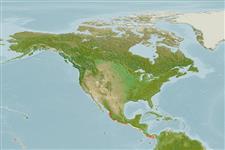
Eastern Pacific: Southern Mexico.
Tamaño / Peso / Age
Madurez: Lm ? range ? - ? cm
Max length : 3.1 cm SL macho / no sexado; (Ref. 93281)
Short description
Claves de identificación | Morfología | Morfometría
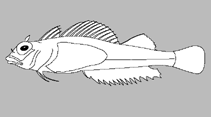
Espinas dorsales (total) : 15 - 18; Radios blandos dorsales (total) : 8 - 10; Espinas anales: 2; Radios blandos anales: 19 - 20. This slender-bodied species is distinguished with the following characters: large eye; scaleless on opercle; longitudinal scale rows 34-36; segmented anal-fin rays 19-20; no dorsal soft rays branched at tip; females weakly barred; breeding males almost black (Ref. 93281).
Body shape (shape guide): elongated; Cross section: oval.
Eggs are hemispherical and covered with numerous sticky threads that anchor them in the algae on the nesting sites (Ref. 240). Larvae are planktonic which occur primarily in shallow, nearshore waters (Ref. 94114).
Life cycle and mating behavior
Madurez | Reproducción | Puesta | Huevos | Fecundidad | Larva
Rosenblatt, R.H., E.C. Miller and P.A. Hastings, 2013. Three new species of the triplefin blennies of the genus Enneanectes (Teleostei, Tripterygiidae) from the tropical eastern Pacific with a key to Pacific species Enneanectes. Zootaxa 3636(2):361-373. (Ref. 93281)
IUCN Red List Status (Ref. 130435: Version 2025-1)
Threat to humans
Harmless
Human uses
Herramientas
Special reports
Download XML
Fuentes de Internet
Estimates based on models
Preferred temperature (Referencia
123201): 26.3 - 28.8, mean 27.3 °C (based on 16 cells).
Phylogenetic diversity index (Referencia
82804): PD
50 = 0.5000 [Uniqueness, from 0.5 = low to 2.0 = high].
Bayesian length-weight: a=0.00617 (0.00288 - 0.01322), b=3.04 (2.86 - 3.22), in cm total length, based on LWR estimates for this (Sub)family-body shape (Ref.
93245).
Nivel trófico (Referencia
69278): 2.8 ±0.3 se; based on size and trophs of closest relatives
Resiliencia (Referencia
120179): Alto, población duplicada en un tiempo mínimo inferior a 15 meses (Preliminary K or Fecundity.).
Fishing Vulnerability (Ref.
59153): Low vulnerability (10 of 100).
🛈