


Ctenogobiops crocineus Smith, 1959
Lägg till din observation i Fish Watcher
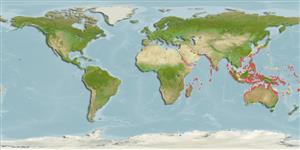
| Native range | All suitable habitat | Point map | Year 2050 |
|
| This map was computer-generated and has not yet been reviewed. |
| Ctenogobiops crocineus AquaMaps Data sources: GBIF OBIS |
Ladda upp din foton och Videor
Bilder | Google image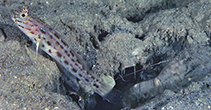 Ctenogobiops crocineus
Bild av Randall, J.E.
Bilder | Google image
Bild av Randall, J.E.
Klassificering / Namn Populärnamn | synonymer | Catalog of Fishes(Släkte, Arter) | ITIS | CoL | WoRMS | Cloffa
> Gobiiformes (Gobies) > Gobiidae (Gobies) > Gobiinae
Etymology: Ctenogobiops: Greek, kteis, ktenos = comb + Latin, gobius = gudgeon + Greek, ops = appearance (Ref. 45335).
Etymology: Ctenogobiops: Greek, kteis, ktenos = comb + Latin, gobius = gudgeon + Greek, ops = appearance (Ref. 45335).
Miljö: miljö / Klimatzon / djupintervall / distributionsområde Ekologi
marina revassocierade; djupintervall 1 - 15 m (Ref. 90102). Tropical
Utbredning Territorier | FAO områden | Ekosystem | Förekomster | Prickkarta | Utplanteringar | Faunafri
Indo-Pacific: widespread, from the Red Sea to the western Pacific, with records from the Great Barrier Reef and the Ryukyu Islands.
Storlek / Vikt / Ålder
Kort beskrivning Bestämningsnycklar | Morfologi | Morfometri
Taggstrålar i ryggfenan (totalt) : 7; Mjukstrålar i ryggfenan (totalt) : 11 - 12; Taggstrålar i analfenan: 1; Mjukstrålar i analfenan: 11. This species is distinguished by the following characters: D VI + I,11-12; A I,11; pectoral rays 19; longitudinal scale series 55-60; body depth 4.8-5.2 in SL; head length (HL) 3.1-3.3 in SL; dorsal profile of snout forming an angle of about 40° to horizontal axis of head and body; wide gill opening, reaching forward nearly to a vertical at posterior edge of eye; 2nd dorsal spine equal to or slightly longer than first spine and longer than the third spine, and about equal to the body depth (0.9-1.1); rounded caudal fin, 1.1-1.3 in HL; body with 4 longitudinal rows of dark brown spots, the 1st and 3rd as thick dashes, the spots of second row much smaller, except large first one over upper end of gill opening; 4th row ventrally on body with 2 or 3 spots on abdomen approaching pupil size, remaining spots only dark flecks; postorbital head with 3 oblique rows of dark dashes at an angle less than 45°, the 1st a single long dash behind eye, the next 2 across cheek, ending on upper half of opercle; 4 oblique rows of dark brown dashes and dots from eye across lips; median, dark brown, V-shaped mark dorsally on snout absent; in life, no small yellow flecks ventrally on body; larger dark spots on ventral half of body often encircled with blue dots; pectoral fins with a small white dash at upper base, a long white streak from base, narrowing into middle of fin (Ref. 90180).
Body shape (shape guide): elongated; Cross section: oval.
Body shape (shape guide): elongated; Cross section: oval.
Livscykel och parningsbeteende Könsmognad | Reproduktion | Lek | Ägg | Fekunditet | Larver
Huvudreferens
Ladda upp dina referenser | referenser | Koordinator | Medarbetare
Kovačić, M., S.V. Bogorodsky and J.E. Randall, 2011. Redescription of the Red Sea gobiid fish Ctenogobiops maculosus (Fourmanoir) and validation of C. crocineus Smith. Zootaxa 3054:60-68. (Ref. 90180)
Status på IUCN:s rödlista (Ref. 130435: Version 2025-2 (Global))
Least Concern (LC) ; Date assessed: 13 March 2015
CITES
Not Evaluated
Hot mot människor
Harmless
Mänskliga användningsområden
FAO - Publication: search | FishSource |
Ytterligare information
Populationsdynamik
Tillväxtparametrar
Max. åldrar / storlekar
Längd-vikt rel.
Längd-längd rel.
Längd-frekvenser
Massakonvertering
Rekrytering
Abundans
Tillväxtparametrar
Max. åldrar / storlekar
Längd-vikt rel.
Längd-längd rel.
Längd-frekvenser
Massakonvertering
Rekrytering
Abundans
Livscykel
Reproduktion
Könsmognad
Mognad/Gills rel.
Fekunditet
Lek
Lekande aggregat
Ägg
Utveckling av ägg
Larver
Larvdynamik
Reproduktion
Könsmognad
Mognad/Gills rel.
Fekunditet
Lek
Lekande aggregat
Ägg
Utveckling av ägg
Larver
Larvdynamik
Anatomi
Gälyta
Hjärna
Otolit
Gälyta
Hjärna
Otolit
Fysiologi
Kroppssammansättning
Näringsämnen
Syreförbrukning
Typ av simning
Simhastighet
Visuella pigment
Ljud från fisk
Sjukdomar & Parasiter
Toxicitet (LC50)
Kroppssammansättning
Näringsämnen
Syreförbrukning
Typ av simning
Simhastighet
Visuella pigment
Ljud från fisk
Sjukdomar & Parasiter
Toxicitet (LC50)
Genetik
Genom
Genetik
Heterozygositet
Ärftlighet
Genetisk mångfald
Genom
Genetik
Heterozygositet
Ärftlighet
Genetisk mångfald
Människorelaterad
Vattenbrukssystem
Vattenbruksprofiler
Avelslinjer
Ciguatera-fall
Frimärken, mynt, diverse.
Vattenbrukssystem
Vattenbruksprofiler
Avelslinjer
Ciguatera-fall
Frimärken, mynt, diverse.
Verktyg
Särskilda rapporter
Kontrollera för underhåll av akvarium | Kontrollera om det finns faktablad om arter | Kontrollera om det finns faktablad om vattenbruk
Ladda ner XML
Internet-källor
AFORO (otoliths) | Aquatic Commons | BHL | Cloffa | Websites from users | Check FishWatcher | CISTI | Catalog of Fishes: Släkte, Arter | DiscoverLife | ECOTOX | FAO - Publication: search | Faunafri | Fishipedia | Fishtrace | GloBI | Google Books | Google Scholar | Google | IGFA World Record | Nationella databaser | OneZoom | Open Tree of Life | Otolith Atlas of Taiwan Fishes | PubMed | Reef Life Survey | Socotra Atlas | TreeBase | Tree of Life | Wikipedia: Go, sök | World Records Freshwater Fishing | Zoobank | Zoologiskt register
Uppskattningar baserade på modeller
Önskad temperatur (Ref. 123201): 24.7 - 29.3, mean 28.4 °C (based on 2743 cells).
Index för fylogenetisk mångfald (Ref. 82804): PD50 = 0.5020 [Uniqueness, from 0.5 = low to 2.0 = high].
Bayesian length-weight: a=0.00741 (0.00347 - 0.01582), b=3.09 (2.91 - 3.27), in cm total length, based on LWR estimates for this (Sub)family-body shape (Ref. 93245).
Trofisk nivå (Ref. 69278): 3.5 ±0.45 se; based on food items.
Resiliens (Ref. 120179): Hög, lägsta populationsfördubblingstid mindre än 15 månader (Preliminary K or Fecundity.).
Näringsämnen (Ref. 124155): Calcium = 210 [94, 456] mg/100g; Iron = 0.931 [0.460, 1.868] mg/100g; Protein = 18 [16, 20] %; Omega3 = 0.0994 [, ] g/100g; Selenium = 21 [8, 52] μg/100g; VitaminA = 157 [42, 562] μg/100g; Zinc = 2.4 [1.5, 3.7] mg/100g (wet weight);