Classification / Names
Noms communs | Synonymes | Catalog of Fishes(Genre, Espèce) | ITIS | CoL | WoRMS | Cloffa
>
Cichliformes (Cichlids, convict blennies) >
Cichlidae (Cichlids) > Cichlinae
Etymology: Teleocichla: Greek, tele, telos = perfect + Greek, kichle = wrasse (Ref. 45335); wajapi: Named after the indigenous people of the Tupi-guarani cultural-linguistic group, Wajãpi, also known as Waiapi or Oyampi. Noun in apposition.
Eponymy: This is named for the Wajãpi people, also known as Waiapi or Oyampi, numbering less than 2000 people distributed in several tribes in Amapá, Brazil (where this cichlid occurs), and in French Guiana. (Ref. 128868), visit book page.
Environment: milieu / climate zone / profondeur / distribution range
Écologie
; eau douce benthopélagique. Tropical
South America: Brazil in rio Jari and two of its tributaries, rio Iratapuru and rio Pacanari.
Taille / Poids / Âge
Maturité: Lm ? range ? - ? cm
Max length : 8.8 cm SL mâle / non sexé; (Ref. 93336)
Description synthétique
Clés d'identification | Morphologie | Morphométrie
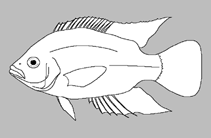
Épines dorsales (Total) : 20 - 22; Rayons mous dorsaux (Total) : 9 - 10; Épines anales: 4; Rayons mous anaux: 6 - 8. Distinguished from other species of Teleocichla, except T. centrarchus, by having four instead of three spines on anal fin. Diagnosed from Teleocichla centrarchus by having 56-62 scales in E1 series (vs. 64-69), smaller orbital diameter 24.6-30.2%, mean 28.2% of head length (vs. 30.8-34.8%, mean 33.5% of head length) and by having barred or zigzag color pattern on flanks (vs. longitudinal series of patches formed by small, dark irregular markings on midlateral area of flanks and on dorsum.). Can be separated from T. cinderella, by the absence (vs. presence) of small, dark irregular markings scattered on flanks; from T. centisquama, and T. monogramma, by having the anterior and posterior branches of the lateral line separated by one scale-row instead of a continuous lateral line; and from T. gephyrogramma by having 56-62 scales in E1 series (vs. 64-75) (Ref. 93336).
Body shape (shape guide): elongated.
Inhabits shallow rapids with clear water and rocky riverbed composed of an array of material, from pebbles to boulders or slabs. Observed to remain mostly stationary in areas where the water velocity was slower, apparently protected between slabs of rock or close to the river bank (Ref. 93336).
Life cycle and mating behavior
Maturité | Reproduction | Frai | Œufs | Fécondité | Larves
Varella, H.R. and C.R. Moreira, 2013. Teleocichla wajapi, a new species of cichlid from the rio Jari, Brazil, with comments on T. centrarchus Kullander, 1988 (Teleostei: Cichlidae). Zootaxa 3641(2):177-187. (Ref. 93336)
Statut dans la liste rouge de l'IUCN (Ref. 130435: Version 2025-1)
Menace pour l'homme
Harmless
Utilisations par l'homme
Outils
Articles particuliers
Télécharger en XML
Sources Internet
Estimates based on models
Phylogenetic diversity index (Réf.
82804): PD
50 = 0.5020 [Uniqueness, from 0.5 = low to 2.0 = high].
Bayesian length-weight: a=0.00794 (0.00356 - 0.01774), b=3.11 (2.93 - 3.29), in cm total length, based on LWR estimates for this (Sub)family-body shape (Ref.
93245).
Niveau trophique (Réf.
69278): 3.2 ±0.5 se; based on size and trophs of closest relatives
Résilience (Réf.
120179): Haut, temps minimum de doublement de population inférieur à 15 mois (Preliminary K or Fecundity.).
Fishing Vulnerability (Ref.
59153): Low vulnerability (10 of 100).
🛈