رده بندی / نامها
اسامي عام | مترادف | Catalog of Fishes(جنس, گونه ها) | ITIS | CoL | WoRMS | Cloffa
>
Cichliformes (Cichlids, convict blennies) >
Cichlidae (Cichlids) > Pseudocrenilabrinae
Etymology: Pelvicachromis: Latin, pelvica, -ae = bassin + Greek, chromis = a fish, perhaps a perch (Ref. 45335); silviae: This species is dedicated to the author's wife Silvia as a 'thank you' in accepting long absences of the author, and in endurance of his usage of many resources for his work (Ref. 93865).
Eponymy: Silvia Lamboj, wife of the author, was honoured “…as a ‘thank you’ in accepting long absences of mine in mind and body, and in endurance of my usage of many resources for my work. [...] (Ref. 128868), visit book page.
محیط زیست: محیط زیست / منطقه آب و هوایی / تغييرات عمق / محدوده توزیع
بوم شناسي
; آب شيرين موجوداتی که در محدوده وسیعی از آبهای آزاد از نزدیک بستر و یا روی کف بستر، در قسمت های میان آبی تا سطح آب و در برخی گونه ها با قابلیت پرواز، زندگی و تغذیه می کنند.. Tropical
Africa: lower parts of the Niger River system (Ref. 93865).
اندازه / وزن / سن
بلوغ: Lm ? range ? - ? cm
Max length : 4.8 cm SL جنس نر / بدون خواص جنسي; (Ref. 93865)
توصيف مختصر
كليدهاي شناسايي | ريخت شناسي | ريخت ستجي بوسيله انداره گيري
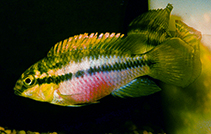
خارهاي باله پشتي (کل) : 14 - 16; شعاع نرم باله پشتي (کل) : 9 - 10; خارهاي باله مخرجي: 3; شعاع نرم باله مخرجي: 7 - 8. Diagnosis: Pelvicachromis silviae is distinguished from other species of Pelvicachromis by a combination of characters (Ref. 93865). It differs from P. subocellatus in somewhat greater body depth, being 37.4-43.0% of standard length vs. 34.5-41.6%; shorter snout length, 20.4-28.1% of head length vs. 23.4-30.9%; greater eye orbit diameter, 31.3-35.7% of head length vs. 28.9-32.9%; greater lower jaw length, 30.9-38.5% of head length vs. 25.4-35.3%; lesser scales between pelvic and pectoral, 3-5 vs. 5-6; in males in lappet-like elongation of some rays of caudal fin vs. no such elongation; and in females in greenish and yellow coloured parts on dorsal parts of body, situated over red belly region, vs. silver coloured scales around red belly region (Ref. 93865). It differs from P. sacramontis in greater body depth, being 37.4-43.0% of standard length vs. 29.0-36.5%; greater head length, 33.2-36.9% of standard length vs. 27.0-32.0%; greater caudal peduncle depth, 15.8-17.5% of standard length vs. 14.0-15.3%; shorter snout length, 20.4-28.1% of head length vs. 26.2-38.7%; greater postorbital distance, 40.4-45.7% of head length vs. 31.7-41.8%; shorter interorbital distance, 24.0-27.9% of head length vs. 29.4-45.3%; and shorter preorbital distance, 16.3-17.3% of head length vs. 18.7-26.5% (Ref. 93865). It differs from P. pulcher in greater body depth, being 37.4-43.0% of standard length vs. 32.6-38.3%; greater head length, 33.2-36.9% of standard length vs. 27.8-32.0%; greater caudal peduncle depth, 15.8-17.5% of standard length vs. 13.0-15.3%; shorter caudal peduncle length, 12.4-14.5% of standard length vs. 13.8-16.5%; shorter snout length, 20.4-28.1% of head length vs. 27.6-36.6%; greater postorbital distance, 40.4-45.7% of head length vs. 34.8-40.4%; shorter interorbital distance, 24.0-27.9% of head length vs. 25.9-33.1%; and shorter preorbital distance, 16.3-17.3% of head length vs. 21.0-33.8% (Ref. 93865). It differs from P. roloffi in greater body depth, being 37.4-43.0% of standard length vs. 33.6-37.6%; geater head length, 33.2-36.9% of standard length vs. 31.5-33.0%; greater caudal peduncle length, 15.8-17.5% of standard length vs. 9.4-12.2%; and higher number of pored scales of lateral line, 26-28 vs. 24-26 (Ref. 93865). It differs from P. taeniatus in greater body depth, being 37.4-43.0% of standard length vs. 29.9-36.4%; greater head length, 33.2-36.9% of standard length vs. 28.4-33.8%; greater pre-anal distance, 66.2-69.8% of standard length vs. 62.8-66.7%; greater prepelvic distance, 37.9-44.3% of standard length vs. 36.0-37.5%; shorter preorbital distance, 16.3-17.3% of head length vs. 18.6-21.1%; and fewer spines in dorsal fin, 14-16 vs. 17-18 (Ref. 93865). It differs from P. kribensis in greater body depth, being 37.4-43.0% of standard length vs. 30.4-37.3%; greater prepelvic distance, 37.9-44.3% of standard length vs. 32.5-37.7%; shorter preorbital distance, 16.3-17.3% of head length vs. 17.0-22.3%; and lesser spines in dorsal fin, 14-16 vs. 17-18 (Ref. 93865). It differs from P. sp. aff. taeniatus "Wouri" in greater body depth, being 37.4-43.0% of standard length vs. 28.7-35.1%; greater prepelvic distance, 37.9-44.3% of standard length vs. 33.4-39.5%; greater eye orbit diameter, 31.3-35.7% of standard length vs. 22.6-32.5%; more slender caudal peduncle, its length 73.2-85.3% of its depth vs. 93.9-124.6%; and fewer spines in dorsal fin, 14-16 vs. 17-18 (Ref. 93865). It differs from P. humilis, P. rubrolabiatus and P. signatus in absence of 7-8 vertical bars on body, visible in several behavioural situations; in three infraorbital bones vs. two; in greater body depth, 37.4-43.0% of standard length vs. 26.4-34.1%; shorter caudal peduncle length, 12.4-14.5% of standard length vs. 13.1-18.1%; greater anal-fin base length, 18.6-22.5% of standard length vs. 13.6-21.0%; shorter snout length, 20.4-28.1% of head length vs. 25.3-43.0%; greater interorbital distance, 24.0-27.9% of head length vs. 18.2-25.6%; and shorter preorbital depth, 16.3-17.3% of head length vs. 19.8-28.7% (Ref. 93865).
In aquaria, this species is a monogamous, pair bonding cave-spawner; frequently imported to Europe and North America for ornamental fish trade; seems not to be rare (Ref. 93865).
چرخه زندگی و رفتار جفتگیری
بلوغ | تولید مثل | تخم ریزی | تخم ها | باروری | توزاد ( لارو)
Lamboj, A., 2013. A new dwarf cichlid (Perciformes) from Nigeria. Cybium 37(3):149-157. (Ref. 93865)
وضعيت در فهرست قرمز IUCN (Ref. 130435: Version 2025-2)
خطر برای انسان ها
Harmless
استفاده انسانی
ابزارها
گزارش های ويژه
بارگيری XML
منابع اينترنتي
تخمینها بر اساس مدلها
شاخص تنوع فیلوژنتیکی (مرجع
82804): PD
50 = 0.5039 [Uniqueness, from 0.5 = low to 2.0 = high].
Bayesian length-weight: a=0.00389 (0.00180 - 0.00842), b=3.12 (2.94 - 3.30), in cm total length, based on all LWR estimates for this body shape (Ref.
93245).
سطح تروفیک (مرجع
69278): 3.2 ±0.4 se; based on size and trophs of closest relatives
جهندگی (مرجع
120179): زياد, كمينه زمان لازم براي دو برابر شدن جمعيت ، كمتر از 15 ماه (Preliminary K or Fecundity.).
آسیبپذیری ماهیگیری (Ref.
59153): Low vulnerability (10 of 100).
🛈