>
Eupercaria/misc (Various families in series Eupercaria) >
Sparidae (Porgies)
Etymology: Acanthopagrus: Greek, akantha = thorn + Greek, pagros, a kind of fish (Ref. 45335); arabicus: Named for its type locality, the Arabian Sea including The Gulf.
Environment: milieu / climate zone / intervalo de profundidade / distribution range
Ecologia
marinhas pelagic-neritic; intervalo de profundidade ? - 50 m (Ref. 11441). Tropical
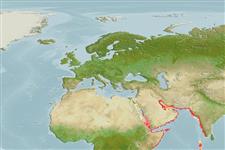
Western Indian Ocean: from Duqum, southern Oman to Qatar, off the coasts of Kuwait (probably including Iran and Pakistan), to Trivandrum, south-western India.
Tamanho / Peso / Idade
Maturidade: Lm ? range ? - ? cm
Max length : 34.5 cm SL macho/indeterminado; (Ref. 4606); common length : 30.0 cm TL macho/indeterminado; (Ref. 3507)
Descrição breve
Chaves de identificação | Morfologia | Morfometria
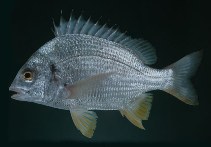
Espinhos dorsais (total) : 11 - 12; Raios dorsais moles (total) : 10 - 11; Espinhos anais: 3; Raios anais moles: 8. This species is distinguished from its congeners by the following set of characters: deep body, 2.03-2.38 (mean 2.21); D XI,11 or XII,10; scale rows between fifth dorsal-fin spine base and lateral line 4 1/2, scale rows above lateral line 4 1/2-5 1/2, scale rows below 12 1/2-13 1/2; second anal-fin spine [17.5-24.2% (mean 20·5%) of SL], 1.31-1.52 (mean 1.39) in 2AS/3AS; pored lateral-line scales 42-45 (mean 43.9); first soft dorsal-fin ray slightly longer than last dorsal-fin spine; pelvic and anal fins vivid or strong yellow, lower caudal-fin lobe yellow (lighter or whitish yellow in larger adults); no black streaks proximally on inter-radial membranes between yellow anal-fin rays; clear black
blotches are usually absent just beneath inter-radial membranes between dorsal-fin rays but upper
dorsal-fin membrane often with darker margin; at the origin of lateral line a weak diffuse dark blotch usually covering first pored lateral-line scale, continuing as a dense dark shading over upper part of posterior opercle (Ref. 93743).
Body shape (shape guide): short and / or deep; Cross section: compressed.
Feeds mainly on echinoderms, worms, crustaceans and mollusks. Mainly exploited by artisanal fisheries. Sold fresh in markets (Ref. 3507).
Life cycle and mating behavior
Maturidade | Reprodução | Desova | Ovos | Fecundidade | Larvas
Iwatsuki, Y., 2013. Review of the Acanthopagrus latus complex (Perciformes: Sparidae) with descriptions of three new species from the Indo-West Pacific Ocean. J. Fish Biol. 83(1):64-95. (Ref. 93743)
Categoria na Lista Vermelha da IUCN (Ref. 130435: Version 2025-1)
Utilização humana
Pescarias: espécies comerciais
Ferramentas
Relatórios especiais
Descarregue XML
Fontes da internet
Estimates based on models
Preferred temperature (Ref.
123201): 24.6 - 29.3, mean 27.2 °C (based on 186 cells).
Phylogenetic diversity index (Ref.
82804): PD
50 = 0.5000 [Uniqueness, from 0.5 = low to 2.0 = high].
Bayesian length-weight: a=0.02570 (0.01482 - 0.04458), b=2.95 (2.80 - 3.10), in cm total length, based on LWR estimates for this species & Genus-body shape (Ref.
93245).
Nível Trófico (Ref.
69278): 3.2 ±0.3 se; based on diet studies.
Resiliência (Ref.
120179): Médio, tempo mínimo de duplicação da população 1,4 - 4,4 anos (Preliminary K or Fecundity.).
Fishing Vulnerability (Ref.
59153): Low to moderate vulnerability (32 of 100).
🛈