


Petrocephalus arnegardi Lavoué & Sullivan, 2014
muatnaik fotos/gambar dan video
imej Google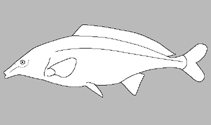 No image available for this species;
drawing shows typical species in Mormyridae.
imej Google
drawing shows typical species in Mormyridae.
klasifikasi / Nama Nama-nama umum | Sinonim (persamaan) | Catalog of Fishes(Marga, Jenis) | ITIS | CoL | WoRMS | Cloffa
> Osteoglossiformes (Bony tongues) > Mormyridae (Elephantfishes)
Etymology: Petrocephalus: Latin, petra = stone + Greek, kephale = head (Ref. 45335); arnegardi: This species is dedicated to Matthew E. Arnegard, in recognition of his contributions to study of mormyrid evolution and diversification; Matthew Arnegard is additionally a member of the “Mintotom Team”: researchers associated with the Carl D. Hopkins Laboratory at Cornell University who have conducted field studies on African weakly electric fishes for more than 15 years ("Mintotom" is the plural form of the word for mormyrid fish in the Fang language of West Central Africa) (Ref. 96601).
Eponymy: Dr Matthew Arnegard (d: 1967) is an evolutionary biologist who was a member of the ‘Mintotom Team’ of researchers in the laboratory of Professor Carl Hopkins, Cornell University (N. [...] (Ref. 128868), visit book page.
Etymology: Petrocephalus: Latin, petra = stone + Greek, kephale = head (Ref. 45335); arnegardi: This species is dedicated to Matthew E. Arnegard, in recognition of his contributions to study of mormyrid evolution and diversification; Matthew Arnegard is additionally a member of the “Mintotom Team”: researchers associated with the Carl D. Hopkins Laboratory at Cornell University who have conducted field studies on African weakly electric fishes for more than 15 years ("Mintotom" is the plural form of the word for mormyrid fish in the Fang language of West Central Africa) (Ref. 96601).
Eponymy: Dr Matthew Arnegard (d: 1967) is an evolutionary biologist who was a member of the ‘Mintotom Team’ of researchers in the laboratory of Professor Carl Hopkins, Cornell University (N. [...] (Ref. 128868), visit book page.
Lingkungan: lingkungan / zona iklim / kisaran kedalaman / jangkauan distribusi Ekologi
; air tawar dasar (demersal). Tropical
Penyebaran Wilayah | Daerah-daerah FAO | Ekosistem | Kemunculan | peta titik | Introduksi | Faunafri
Africa: various tributaries of the Likouala drainage (middle Congo River tributary) in Republic of Congo, and the middle Congo River near Yangambi in Democratic Republic of the Congo (Ref. 96601).
Ukuran / Berat / umur
deskripsi pendek Kunci identifiaksi (pengenalan) | Morfologi | Morfometrik
Diagnosis: Petrocephalus arnegardi is distinguished from all other Petrocephalus species of Central Africa by the following combination of characteristics: pigmentation pattern comprising three well-defined, bilateral black patches, one usually distinct round/ovoid subdorsal black mark situated slightly anterior to dorsal, one black mark at the base of each pectoral fin, and one ovoid black mark centered at the base of caudal fin; dorsal fin at least one third shorter than anal fin; dorsal fin with at least 20 branched rays but no more than 22; anal fin with at least 30 branched rays; 16 teeth or fewer in upper jaw, 25 teeth or fewer in lower jaw; eye relatively large, ration head length and eye-diameter less than 4.7; mouth subterminal; ration of head length to mouth position between 4.2 and 5.6; mouth small, ration head length and mouth width more than 4.1; and EOD of normal polarity, mainly biphasic with sometimes the presence of a small-amplitude positive third phase (Ref. 96601).
Body shape (shape guide): fusiform / normal.
Body shape (shape guide): fusiform / normal.
Siklus hidup dan perilaku kawin Kematangan | Reproduksi, perkembang biakan | Pemijahan | telur-telur | Fekunditas | Larva
rujukan utama
Unggah referensi Anda | Acuan | Koordinator | mitra
Lavoué, S. and J.P. Sullivan, 2014. Petrocephalus boboto and Petrocephalus arnegardi, two new species of African electric fish (Osteoglossomorpha, Mormyridae) from the Congo River basin. ZooKeys 400:43-65. (Ref. 96601)
CITES
Not Evaluated
ancaman kepada manusia
Harmless
penggunaan manusia
FAO - Publication: search | FishSource |
informasi lanjut
Ekologi trofik
Item makanan (mangsa)
Komposisi makanan
Konsumsi makanan
Ransum makanan
Pemangsa
Item makanan (mangsa)
Komposisi makanan
Konsumsi makanan
Ransum makanan
Pemangsa
Ekologi
Ekologi
Ekologi
Dinamika populasi
Parameter pertumbuhan
Maks. usia / ukuran
Panjang-berat rel.
Panjang-panjang rel.
ukuran frekuensi
Konversi massa
pemulihan
Kelimpahan
Parameter pertumbuhan
Maks. usia / ukuran
Panjang-berat rel.
Panjang-panjang rel.
ukuran frekuensi
Konversi massa
pemulihan
Kelimpahan
Siklus hidup
Reproduksi, perkembang biakan
Kematangan
Kedewasaan / insang rel.
Fekunditas
Pemijahan
Agregasi pemijahan
telur-telur
pekembangan telor
Larva
Dinamika larva
Reproduksi, perkembang biakan
Kematangan
Kedewasaan / insang rel.
Fekunditas
Pemijahan
Agregasi pemijahan
telur-telur
pekembangan telor
Larva
Dinamika larva
Anatomi
Area insang
Otak
Otolith
Area insang
Otak
Otolith
Fisiologi
Komposisi tubuh
Nutrisi
Konsumsi oksigen
Jenis renang
Kecepatan berenang
Pigmen visual
Suara ikan
Penyakit & Parasit
Toksisitas (LC50)
Komposisi tubuh
Nutrisi
Konsumsi oksigen
Jenis renang
Kecepatan berenang
Pigmen visual
Suara ikan
Penyakit & Parasit
Toksisitas (LC50)
Genetika
genom
Genetika
Heterozigositas
Diturunkan
Keanekaragaman Genetik
genom
Genetika
Heterozigositas
Diturunkan
Keanekaragaman Genetik
Yang berhubungan dengan manusia
Sistem akuakultur
profil budidaya air
Strain
Kasus Ciguatera
Perangko, koin, dll.
Sistem akuakultur
profil budidaya air
Strain
Kasus Ciguatera
Perangko, koin, dll.
Alat, peralatan
E-book | Penuntun lapangan | Kunci identifiaksi (pengenalan) | tanda freqkuenci panjang | peringkat sejarah hidup | peta titik |
Tangkap-MSY |
laporan khas
muat turun XML
Sumber internet
AFORO (otoliths) | Aquatic Commons | BHL | Cloffa | Websites from users | semak peneliti ikan | CISTI | Catalog of Fishes: Marga, Jenis | DiscoverLife | ECOTOX | FAO - Publication: search | Faunafri | Fishipedia | Fishtrace | GloBI | Google Books | Google Scholar | Google | IGFA World Record | OneZoom | Open Tree of Life | Otolith Atlas of Taiwan Fishes | PubMed | Reef Life Survey | Socotra Atlas | TreeBase | Tree of Life | Wikipedia: pergi, Cari | World Records Freshwater Fishing | Zoobank | Catatan Zoologi
Estimasi berdasarkan model
Indeks keanekaragaman filogenetik (Acuan 82804): PD50 = 0.5000 [Uniqueness, from 0.5 = low to 2.0 = high].
Bayesian length-weight: a=0.01549 (0.00672 - 0.03569), b=2.87 (2.69 - 3.05), in cm total length, based on LWR estimates for this Genus-body shape (Ref. 93245).
Tingkat Trofik (Acuan 69278): 3.2 ±0.4 se; based on size and trophs of closest relatives
Daya lenting (Acuan 120179): Tinggi, Waktu penggandaan populasi minimum kurang dari 15 bulan (Preliminary K or Fecundity.).