


Haplochromis vanheusdeni Schedel, Friel & Schliewen, 2014
Sube tu fotos y Vídeos
Google image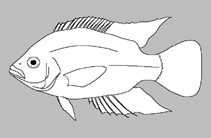 No image available for this species;
drawing shows typical species in Cichlidae.
Google image
drawing shows typical species in Cichlidae.
Clasificación / Nombres Nombres comunes | Sinónimos | Catalog of Fishes(Género, Especie) | ITIS | CoL | WoRMS | Cloffa
> Cichliformes (Cichlids, convict blennies) > Cichlidae (Cichlids) > Pseudocrenilabrinae
Etymology: Haplochromis: Greek, Haploos = single + Greek, chromis = a fish, perhaps a perch (Ref. 45335); vanheusdeni: The species name vanheusdeni honours the Dutchman Hans van Heusden, one of the most dedicated cichlid naturalists, who has documented for the first time with underwater photographs and videos as well as with aquarium observations the behaviour and ecology of this species and many other cichlids all over Africa (Ref. 97348).
Eponymy: Hans van Heusden (d: 1957) is a Dutch aquarist, angler and photographer (including underwater), who currently works for a construction company. [...] (Ref. 128868), visit book page.
Etymology: Haplochromis: Greek, Haploos = single + Greek, chromis = a fish, perhaps a perch (Ref. 45335); vanheusdeni: The species name vanheusdeni honours the Dutchman Hans van Heusden, one of the most dedicated cichlid naturalists, who has documented for the first time with underwater photographs and videos as well as with aquarium observations the behaviour and ecology of this species and many other cichlids all over Africa (Ref. 97348).
Eponymy: Hans van Heusden (d: 1957) is a Dutch aquarist, angler and photographer (including underwater), who currently works for a construction company. [...] (Ref. 128868), visit book page.
Entorno: milieu / zona climática / rango de profundidad / gama de distribución Ecología
; agua dulce bentopelágico. Tropical
Distribución Territorios | Áreas FAO | Ecosistemas | Ocurrencias, apariciones | Mapa de puntos | Introducciones | Faunafri
Africa: Great Ruaha River basin, Tanzania (Ref. 97348).
Tamaño / Peso / Edad
Descripción breve Claves de identificación | Morfología | Morfometría
Espinas dorsales (total) : 16 - 18; Radios blandos dorsales (total) : 8 - 10; Espinas anales: 3; Radios blandos anales: 6 - 8; Vértebra: 28 - 29. Diagnosis: Haplochromis vanheusdeni can be distinguished from all species of the genus Orthochromis except O. torrenticola by the presence of egg spots on the anal fin in both males and females vs. no egg spots, and by hypuralia 1 and 2 and hypuralia 3 and 4 either clearly separated or separated by a clearly visible seam vs. never fused into a single seamless unit (Ref. 97348). It can be distinguished from Orthochromis kalungwishiensis, O. kasuluensis, O. luongoensis and O. torrenticola by having fewer caudal vertebrae, 14-16 vs. 17; and fewer total vertebrae, 28-30 vs. 31-33; from O. rugufuensis and O. uvinzae by having fewer total vertebrae, 28-30 vs. 31-33, and dorsal fin spines, 16-17 vs. 19-20; from O. polyacanthus and O. rubrolabialis by having fewer inner series of teeth in the lower jaw, 1-2 vs. 3-5, and fewer dorsal fin spines, 16-17 vs. 18-20; and from O. malagaraziensis by having more scales between the lateral line and the dorsal fin origin, 3-4 vs. 5-6; from O. machadoi, O. mazimeroensis, O. stormsi and Haplochromis bakongo by having a scaleless chest vs. a scaled chest; from O. mosoensis by having small cycloid scaled on the belly vs. no scales; from O. luichensis by the different stripe and bar patterns on the head ; from Schwetzochromis neodon by the presence of lachrymal stripes and fewer inner teeth rows in both jaws, 1-3 vs. 4-6; from Haplochromis snoeksi by having fewer scales on the horizontal line, 26-29 vs. 30-31, and on upper lateral line, 20-22 vs. 23, and in having fewer caudal vertebrae, 14-16 vs. 17 (Ref. 97348).
Body shape (shape guide): fusiform / normal.
Body shape (shape guide): fusiform / normal.
Haplochromis vanheusdeni is a benthic-rheophilic fish, mostly found among stones over sand and debris in smaller streams or larger rivers (Ref. 97348). Underwater observations suggest a mixed diet of sand-and-debris dwelling organisms and drifting food particles (Ref. 98348). Large males and brood-caring females defend small territories, sometimes centred around a whole under stones; it is a maternal mouthbrooder (Ref. 97348).
Ciclo vital y comportamiento de apareamiento Madurez | Reproducción | Puesta | Huevos | Fecundidad | Larva
Large males and brood-caring females defend small territories, sometimes centred around a whole under stones; it is a maternal mouthbrooder (Ref. 97348).
Referencia principal
Suba sus referencias | Referencias | Coordinador : Kullander, Sven O. | Colaboradores
Schedel, F.D.B., J.P. Friel and U.K. Schliewen, 2014. Haplochromis vanheusdeni, a new haplochromine cichlid species from the Great Ruaha River drainage, Rufiji basin, Tanzania. Spixiana 37(1):135-149. (Ref. 97348)
CITES
Not Evaluated
Amenaza para el ser humano
Harmless
Usos humanos
FAO - Publication: search | FishSource |
Más información
Ecología Trófica
Alimentos (presas)
Composición de la dieta
consumo de alimento
Raciones de comida
Despredadores
Alimentos (presas)
Composición de la dieta
consumo de alimento
Raciones de comida
Despredadores
Dinámica de la población
Coeficiente del crecimiento para
Edades / tallas máximas
Longitud-peso rel.
Longitud-longitud rel.
Longitud-frecuencias
Conversión de masas
Reclutamiento
Abundancia
Coeficiente del crecimiento para
Edades / tallas máximas
Longitud-peso rel.
Longitud-longitud rel.
Longitud-frecuencias
Conversión de masas
Reclutamiento
Abundancia
Ciclo de vida
Reproducción
Madurez
Madurez/Gills rel.
Fecundidad
Puesta
Agregaciones de desove
Huevos
Desarrollo de los huevos
Larva
Dinámica larvaria
Reproducción
Madurez
Madurez/Gills rel.
Fecundidad
Puesta
Agregaciones de desove
Huevos
Desarrollo de los huevos
Larva
Dinámica larvaria
Distribución
Territorios
Áreas FAO
Ecosistemas
Ocurrencias, apariciones
Introducciones
BRUVS - Vídeos
Territorios
Áreas FAO
Ecosistemas
Ocurrencias, apariciones
Introducciones
BRUVS - Vídeos
Anatomía
Superficie branquial
Cerebro
Otolito
Superficie branquial
Cerebro
Otolito
Fisiología
Composición corporal
Nutrientes
Consumo del oxígeno
Tipo de natación
Velocidad de natación
Pigmentos visuales
Sonido de peces
Enfermedades y parásitos
Toxicidad (CL50)
Composición corporal
Nutrientes
Consumo del oxígeno
Tipo de natación
Velocidad de natación
Pigmentos visuales
Sonido de peces
Enfermedades y parásitos
Toxicidad (CL50)
Genética
Genoma
Genética
Heterocigosidad
heritabilidad
Diversidad genética
Genoma
Genética
Heterocigosidad
heritabilidad
Diversidad genética
Relacionados con el ser humano
Sistemas de acuicultura
Perfiles de acuicultura
Razas
Ciguatera cases
Sellos, monedas, varios
Sistemas de acuicultura
Perfiles de acuicultura
Razas
Ciguatera cases
Sellos, monedas, varios
Herramientas
Libro electrónico | Guía de campo | Asistente para frecuencias de tallas | Herramienta de ciclo de vida | Mapa de puntos |
Catch-MSY |
Informes especiales
Comprobar el mantenimiento del acuario | Buscar fichas sobre especies | Consulte las hojas informativas sobre acuicultura
Descargar XML
Fuentes de Internet
AFORO (otoliths) | Aquatic Commons | BHL | Cloffa | Websites from users | Check FishWatcher | CISTI | Catalog of Fishes: Género, Especie | DiscoverLife | ECOTOX | FAO - Publication: search | Faunafri | Fishipedia | Fishtrace | GloBI | Google Books | Google Scholar | Google | IGFA World Record | OneZoom | Open Tree of Life | Otolith Atlas of Taiwan Fishes | PubMed | Reef Life Survey | Socotra Atlas | TreeBase | Árbol de la vida | Wikipedia: Go, búsqueda | World Records Freshwater Fishing | Zoobank | Expediente Zoológico
Estimaciones basadas en modelos
Índice de diversidad filogenética (Referencia 82804): PD50 = 0.5000 [Uniqueness, from 0.5 = low to 2.0 = high].
Bayesian length-weight: a=0.00389 (0.00180 - 0.00842), b=3.12 (2.94 - 3.30), in cm total length, based on all LWR estimates for this body shape (Ref. 93245).
Nivel trófico (Referencia 69278): 3.3 ±0.4 se; based on size and trophs of closest relatives
Resiliencia (Referencia 120179): Alto, población duplicada en un tiempo mínimo inferior a 15 meses (Preliminary K or Fecundity.).